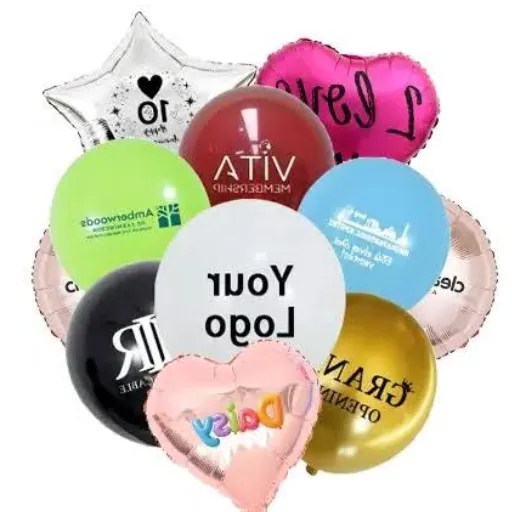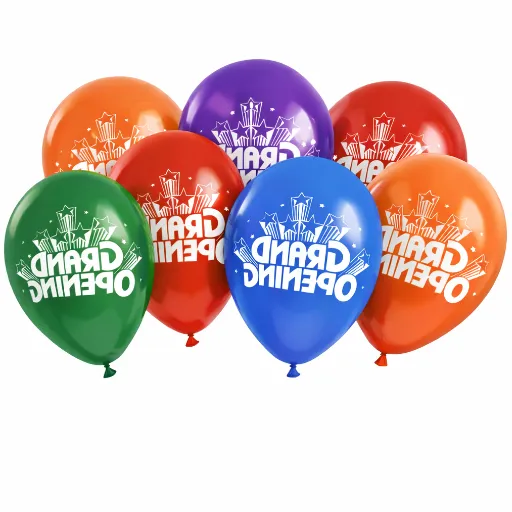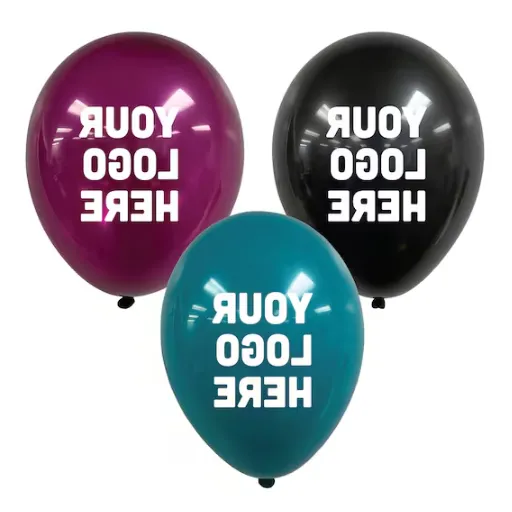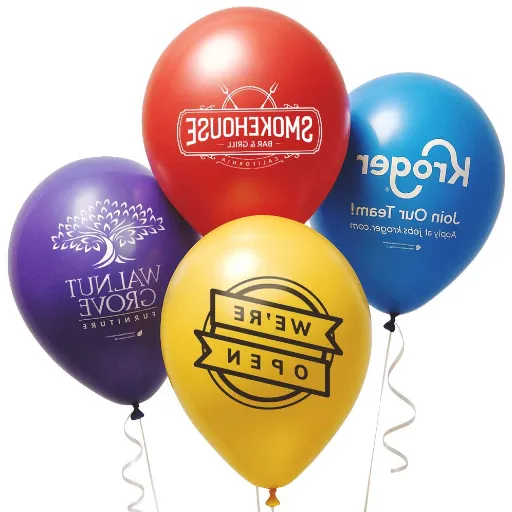
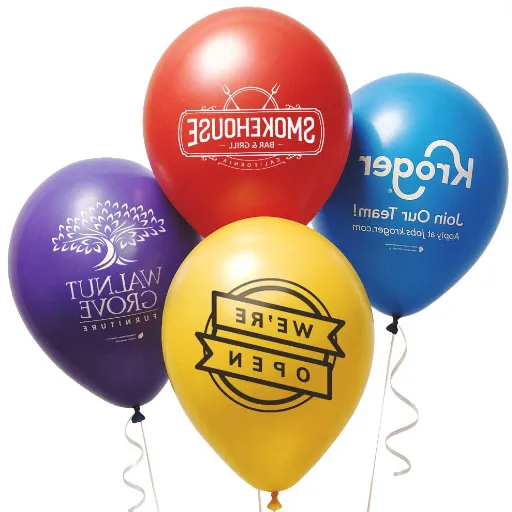
Custom printed balloons are balloons printed with a logo, name, message, photo, or design before they are inflated, using screen printing on latex or digital printing on foil. The right choice comes down to three things: how long the balloon has to last, how many pieces you need, and how much detail the artwork carries.
The print is the easy part. The hard part is the decision around it.
The same logo can cost about $0.80 per balloon at 100 pieces or about $0.06 at 5,000. Pick the wrong material and the ink cracks, the balloon sinks before the event ends, or the order arrives after the date. Search “custom printed balloons” and you get one of two things: a factory catalog that shows what is possible, or a 1,200-word vendor post that lists the questions to ask without answering them.
This guide does both jobs. It covers custom-printed latex balloons and custom-printed foil balloons side by side, how each printing method works, the artwork specs that print cleanly, sizes and float times, MOQs and cost logic, lead times, certifications, honest eco claims, and how to vet a supplier. Every number comes from the manufacturing side of the table.
Trading Shanxi Co., Ltd. prints latex, foil, and photo balloons in-house for event teams, retailers, and distributors in more than 50 countries. If you already know what you need, request a custom printed balloon quote and we’ll price it. If you’re still deciding, read on.
Key Takeaways
- Material decides the product: latex for volume and cost, foil for sharp color and multi-day float, photo print for one-off detail.
- Float time follows the material. Latex holds helium about 8 to 12 hours; foil holds 5 to 7 days or longer.
- MOQ is a function of color count and sides. One color starts near 100 pieces; four colors or double-sided print pushes minimums into the thousands and cuts unit price.
- Artwork causes most reprints. Send vector files, respect the safe zone, and approve a proof on every order.
- Helium costs more in 2026. Air-filled printed displays and accurate quantities are the practical hedge.
What Are Custom Printed Balloons?
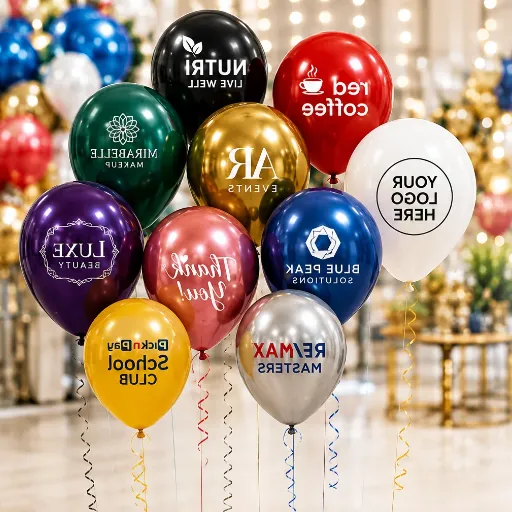
Custom printed balloons are printed before inflation, not decorated afterward. Manufacturers print artwork onto flat latex or foil, check the color and placement, then pack the balloons uninflated for shipping.
That is the short definition. The useful distinction is that “custom printed” covers four different products with different economics and different failure modes.
What you can print
The most common jobs are a logo, a short slogan, a name, a date, a QR code, or a pattern. Brand marks and one-line messages are the core of the category. Photo printing is a separate process and generally a separate product, best handled on foil or on white latex through digital print.
QR codes need special care. They work on a balloon only at a certain size and contrast. A code under about 2 cm, or a code printed in two low-contrast brand colors, will fail to scan. Print it large, keep it dark on light, test a sample, and treat it as a campaign element rather than a decoration.
Who buys them
Four groups drive most orders. Businesses buy promotional balloons for giveaways and grand-opening displays. Event planners buy color-matched sets for weddings, launches, and parties.
Retailers and distributors buy custom printed balloons wholesale for resale. Individuals buy small photo and milestone orders.
Each group needs a different part of this guide. Businesses should focus on use cases and lead times. Distributors should go straight to MOQs, pricing, and compliance. Individuals can skip to photo balloons.
Printed vs plain balloons
Printing changes three things. It adds recognition, because a logo turns a generic balloon into signage. It adds cost, mostly through setup and minimums rather than ink. And it adds lead time, because every design needs a proof and a production slot.
Plain balloons can be bought the week of an event. Printed balloons can’t. That single difference causes more missed events than any other issue in this category.
For the wider range of custom work beyond print, our custom balloon solutions guide covers the category. For the printed product itself, start with logo balloons.
Latex vs Foil vs Photo: Choosing the Right Printed Balloon
With custom printed balloons, the material decides print quality, float time, minimum order, and cost. Choose the material before the design, because the design has to fit what the material can hold.
| Material | Print quality | Color options | Float time | Typical MOQ | Rough unit cost | Best for |
|---|---|---|---|---|---|---|
| Printed latex | Soft, matte, bold graphics | 1 to 4 spot colors typical | 8 to 12 hours with helium; weeks with air | 100 to 500 | 0.06to0.06to0.80+ | Giveaways, volume, color matching |
| Printed foil (Mylar) | Sharp, metallic, high contrast | Up to 8 spot colors or full digital color | 5 to 7 days, sometimes longer | 50 to 250 | 0.60to0.60to3.00+ | Retail openings, photo walls, long events |
| Printed photo | Photo-real on white | Full CMYK | 8 to 12 hours on latex; days on foil | 1 to 50 | 2.00to2.00to8.00+ | Gifts, milestones, personal events |
Custom printed latex balloons
Latex is the workhorse. It is the cheapest printed balloon at volume, it inflates to a round, forgiving surface, and it can be matched to almost any brand color. One-color latex print is the standard for giveaways, storefronts, and large decor builds.
The trade-off is detail and time. Latex stretches as it inflates, so the ink has to stretch with it. Fine lines and small text blur, and a complex logo loses definition.
Helium float is about 8 to 12 hours, which means a latex balloon printed for a morning event is often on the floor by dinner. Browse printed latex balloons for sizes and finishes. For a planner’s view of print sizes and lead times, Specialty Balloons’ event planner’s guide to custom printed balloons is a useful cross-check.
Custom printed foil balloons
Foil, or Mylar, holds a sharp image. The surface doesn’t stretch the way latex does, so logos, small type, and gradients print cleanly. Foil also floats for days, which makes it the better choice for a multi-day promotion or a photo moment that has to survive the weekend.
Foil costs more per unit and offers fewer shapes than latex. It is harder to recycle and less forgiving if overfilled. Use it when the print has to look crisp or the balloon has to stay up. See printed foil balloons and our foil balloons guide for the full range.
Custom photo balloons
Photo balloons are the most personalized printed balloons, and they’re a digital product. Your image is printed onto white latex or foil, usually in full color and usually in small quantities. They suit birthdays, anniversaries, memorials, and personal gifts where the image is the point.
Don’t expect the same result from a photo on latex and a photo on foil. Latex distorts the image as it inflates and softens detail. Foil keeps more of the original.
If the photo has faces and fine detail, foil is the safer format. Our custom photo balloons page shows the options.
The 60-second decision flow
- Event under 12 hours, tight budget, high quantity: printed latex, one color.
- Event lasts days or the print must look sharp: printed foil.
- One image, small quantity, personal: photo balloon.
- Exact brand color across a large build: printed latex from a Pantone match.
- Still undecided between latex and foil? Our latex vs foil comparison breaks down float, cost, and finish.
When Priya opened a cafe in Leeds last March, she wanted logo balloons at the door and on every table. Her first quote was for 100 twelve-inch latex balloons at about 1eachplusa1eachplusa50 setup. Her printer showed her that 250 units dropped the unit price to roughly $0.50 and covered the entrance cluster, the counter, and a few spares.
She ordered 250, spent a little more in total, and paid about half as much per balloon. The lesson isn’t “always order more.” It’s that the first quantity you pick is usually the most expensive one.
How Custom Printed Balloons Are Printed
There are four printing methods in common use, and each fits a different order profile. The factory usually chooses based on your quantity, color count, and artwork, but you should know what you’re buying.
| Method | Best order size | Colors | Detail | What it means for you |
|---|---|---|---|---|
| Screen printing | 250 to 50,000+ | 1 to 6 spot colors | Bold, simple shapes | Lowest unit cost at volume; setup per color |
| Digital printing | 1 to 2,000 | Full CMYK | Photos, gradients, fine type | No plates; higher unit cost; fast turnaround |
| Gravure | 5,000 to 100,000+ | 1 to 8 colors | Photographic at scale | Expensive origination; lowest unit cost at mass volume |
| Heat transfer | 100 to 5,000 | Multi-color | Fine detail | Works on foil and specialty shapes; film can stiffen |
Screen printing
Screen printing pushes thick ink through a mesh stencil, one color at a time. It is the standard for latex logos because the ink layer is dense, opaque, and flexible enough to move with the balloon. Setup is charged per color, which is why one color starts near 100 pieces and four colors starts in the thousands.
Digital printing
Digital printing works like a desktop printer scaled up. It needs no screens, so short runs and full-color artwork are practical. It’s the method behind most photo balloons and small promotional orders. The trade-off is a higher cost per unit at volume, because digital doesn’t get cheaper as fast as screen printing does.
Gravure, offset, and heat transfer
Gravure uses engraved cylinders and produces photographic quality at very high volume. Origination is expensive, so it only makes sense for a large repeat order, typically 5,000 units or more per design. Offset and heat transfer fill the gap for specialty shapes and multi-color work where screen printing can’t hold the detail.
Why the ink must stretch with latex
A latex balloon can expand several times its deflated size. The ink has to expand with it without cracking, flaking, or turning chalky. That is why factories use high-elasticity polymer inks rather than ordinary graphic inks, and why a logo printed too close to the neck or crown can distort.
If a supplier can’t explain how its ink behaves when the balloon inflates, treat that as a warning sign. Ask for a sample and inflate it yourself. A print that looks perfect flat and cracks at 11 inches is a failed order.
Single-sided vs double-sided vs multi-angle
Single-sided print puts artwork on one face. Double-sided print puts it on two opposite faces so the logo reads from both directions. Multi-angle print wraps artwork around the shoulder or places separate designs around the balloon. Each step adds setup and cost, and double-sided usually raises the minimum order because the second pass consumes capacity. Bring your balloon designs to Trading Shanxi Co., Ltd.
Artwork & Design Specs That Actually Print Well
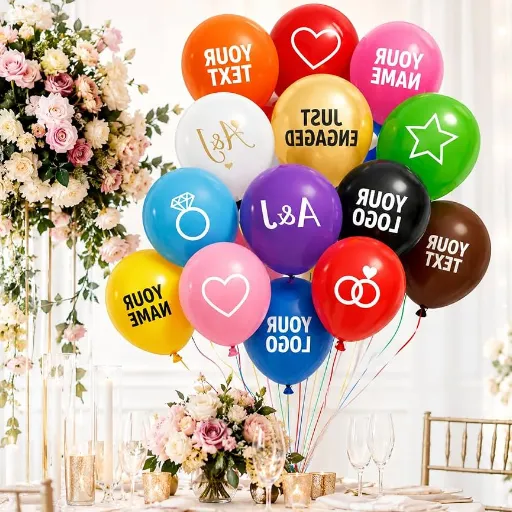
Most bad printed balloons aren’t printing failures. They are file failures that nobody caught. Send the right file and approve a proof, and most problems disappear before production.
File formats and resolution
Send vector artwork in AI, EPS, or PDF format with fonts outlined or embedded. Vector files scale without losing edges, which matters because your logo will be stretched onto a curved, inflating surface.
If you only have a raster image, it needs to be at least 300 dpi at the final print size. A 72 dpi logo pulled from a website looks acceptable on screen and blurry on the balloon. For photos, send the highest-resolution original, not a screenshot or a social media download.
Pantone matching and color limits
Printed balloons are usually matched to Pantone solid coated colors, not CMYK builds. Give your printer a Pantone number for each brand color and ask for a physical proof or printed sample where the budget allows. On dark latex, some colors need a white underlayer to read, which adds a print station and cost.
More colors don’t make a better balloon. One well-placed spot color on a clean background usually reads better at a distance than four colors competing for the same small print area. If your logo has six colors, ask the printer to simplify it for the balloon rather than printing all six.
Print area, safe zones, and distortion on a sphere
A balloon isn’t a flat sheet. On a standard 12-inch latex balloon, the clean print area is roughly 9 by 9 cm, a small fraction of the inflated surface. A 16-inch latex balloon gives you about 12 to 13 cm of usable width. Foil offers more usable space, but the image still curves.
Keep text and critical marks inside the safe zone, away from the neck, the crown, and the outer curve. Distortion increases toward the edges, so a logo that touches the safe-zone boundary can wrap out of view. Ask for the printer’s template before you design.
White ink, dark balloons, and contrast
White ink is a print color, not empty space. On a dark balloon, white type needs its own pass and may need a base layer. Thin white type on dark latex can also lose contrast as the balloon stretches. Use bold weights, generous spacing, and a light background block behind small text where the design allows.
The pre-print proof checklist
- Check spelling, phone numbers, URLs, and dates twice.
- Confirm the Pantone numbers against your brand guide.
- Confirm the logo sits inside the safe zone at final size.
- Check contrast on the actual balloon color, not on a white screen.
- Confirm single or double-sided placement and orientation.
- Approve the exact proof the factory will print, and keep the file.
Discuss custom balloon printing with Trading Shanxi Co., Ltd.
Sizes, Print Area & What Floats
Size decides how far the print reads and whether helium is an option. It also decides how many balloons a custom printed display needs, which is where most budgets go wrong.
| Size | Typical use | Approximate print area | Floats with helium? |
|---|---|---|---|
| 5″ latex | Tight clusters, table accents | 4 to 5 cm | Barely, not practical |
| 11″ latex | Standard promo and giveaway | 9 by 9 cm | Yes, 8 to 12 hours |
| 12″ latex | Standard decor and logo | 9 by 9 cm | Yes, 8 to 12 hours |
| 16″ latex | Larger displays, photo backdrops | 12 to 13 cm | Yes, 8 to 12 hours |
| 18″ foil | Retail and event print | 20 to 25 cm | Yes, 5 to 7 days |
| 36″ foil | Statement pieces and walls | 30 to 38 cm | Yes, 5 to 7 days or longer |
Latex sizes and best uses
Five-inch latex is for clusters and fill, not logos. Eleven and twelve inch are the standard promo sizes and the best balance of print area and cost. Sixteen inch and larger are for displays that have to read from across a room.
Foil sizes and best uses
Foil runs from small 9-inch shapes to 36-inch and larger statement pieces. The bigger the foil, the more usable print area and the longer the float. For a storefront or a photo wall, 18 inches is usually the practical minimum. PromotionChoice’s Mylar balloons buyer’s guide covers size and contrast rules for foil.
Helium vs air, and the 2026 helium squeeze
Printed helium balloons stay up for the event; air-filled printed balloons stay where you put them. Latex holds helium for about 8 to 12 hours. Foil holds for 5 to 7 days, and longer with a float treatment. Air-filled balloons last for weeks and need no tank.
In 2026, that difference costs money. Contract helium prices rose roughly 15 to 30 percent, spot prices ran two to three times higher, and some suppliers reported retail balloon prices up as much as 40 percent (MarketWatch). The response is not to cancel the balloon order. It is to design more air-filled printed displays, use helium only where the float is the point, and size the order accurately so you do not pay for helium twice.
How many balloons for a display
Order a buffer of 5 to 10 percent for inflation failures, wind, and replacements. A 10-foot garland typically needs 100 to 120 balloons of mixed sizes.
A standard column uses 40 to 60. A large organic arch can take 150 or more. Do the count before you price the print, because quantity drives both the unit price and the helium bill.
MOQs, Pricing & Lead Times
Custom printed balloons are priced in tiers, and the tiers follow color count, sides, and quantity. The setup charge, not the balloon, is what makes a small order expensive.
| Order profile | Typical MOQ | Indicative unit price | Setup |
|---|---|---|---|
| 1 color, 1 side, 100 pcs | 100 | 0.78to0.78to1.16 | 35to35to75 |
| 1 color, 1 side, 250 pcs | 250 | 0.44to0.44to0.58 | 35to35to75 |
| 1 color, 1 side, 500 to 1,000 pcs | 500 | 0.28to0.28to0.32 | 35to35to75 |
| 1 color, 1 side, 5,000 pcs | 5,000 | 0.04to0.04to0.23 | Reduced per unit |
| 2 colors | 2,000 | Higher than 1 color | Per color |
| 3 colors | 3,000 | Higher again | Per color |
| 4+ colors or double-sided | 5,000 | Volume only | Per color and side |
| Gravure, multi-color | 5,000+ per design | Lowest at scale | Significant origination |
These ranges are indicative and move with size, material, ink coverage, and freight. Treat them as planning numbers, not a quote.
Create branded balloons with Trading Shanxi Co., Ltd.
How color count and sides drive MOQ
Each color is a separate screen or cylinder and a separate setup. A factory has to spread that setup across the run, so the minimum rises with every added color. Double-sided print effectively doubles the print passes, which is why it usually pushes a one-color order from hundreds into thousands.
This is why the advice to “just add another color” is expensive on a small order. If your budget is fixed, reduce the palette before you reduce the quantity.
The true cost per balloon
The sticker price isn’t the cost. Add setup, freight, the 5 to 10 percent buffer, and the cost of a reprint if the artwork fails. On a 100-piece order, setup can be a third of the total. On a 5,000-piece order, freight and duties often matter more than the balloons.
Ask for a landed-cost quote: unit price plus setup, plus freight to your door, plus any duties or taxes. A factory that quotes only per-unit pricing is telling you half the story.
Production and shipping timelines
| Stage | Typical time |
|---|---|
| Artwork check and file cleanup | 1 to 2 business days |
| Digital or physical proof | About 1 business day |
| Screen production, 1 to 2 colors | 5 to 10 working days |
| Screen production, 3+ colors | About 3 weeks |
| Gravure production | 2 months or more |
| Sea freight | 25 to 40 days |
| Air freight | 5 to 10 days |
Plan backward from the event and add a week of slack. For a standard screen-printed order shipped by air, three to four weeks is realistic. For a multi-color or gravure order by sea, start two to three months out.
When Daniel, a party-goods distributor in Rotterdam, planned a 5,000-piece mixed container for spring, he had three designs and four colors across them. A digital quote came back at a unit price that made the margin impossible.
His factory moved the order to screen and gravure, consolidated the colorways, and quoted a two-month production window plus sea freight. The per-unit cost fell by more than half.
The trade-off was locking the order in January for an April arrival. At that volume, the calendar is part of the price.
Sampling and pre-production proofs
Always request a proof. A digital proof confirms layout and color intent. A physical pre-production sample confirms how the ink behaves on the actual balloon, which is the only test that matters. If the order is large, budget for a sample even when the factory charges for it.
Ready to move from planning to pricing? See how ordering works step by step, or go straight to wholesale latex balloons for volume terms.
How to Choose a Custom Balloon Printing Company
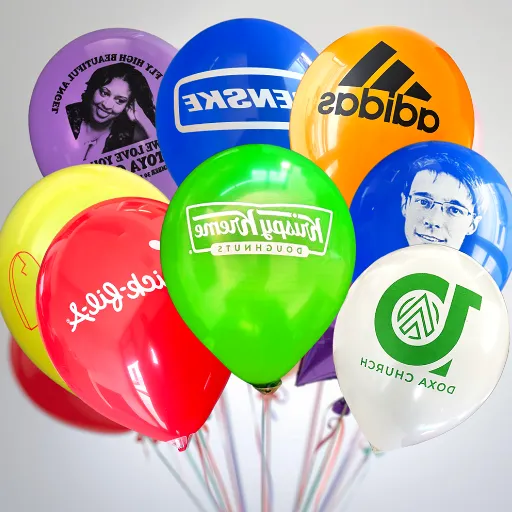
For custom printed balloons, the supplier decides more of the outcome than the design does. A good printer catches file problems, matches color, and hits the date. A bad one forwards your file to a factory and disappears.
Manufacturer vs trading company vs marketplace
A manufacturer controls the print line, the ink, and the schedule. A trading company controls the relationship and subcontracts the work. A marketplace controls neither and adds a layer between you and the factory.
For a one-off photo balloon, a marketplace is fine. For a branded order with a deadline, a manufacturer or a vetted trading partner is safer. Ask who actually prints the balloons and where.
Certifications and compliance
Printed balloons are regulated as toys in most major markets, and the print changes the compliance file. Ask for the documents before you order.
- EU: EN 71-1 (physical and mechanical), EN 71-2 (flammability), EN 71-3 (migration of certain elements), and EN 71-12 (nitrosamines, which applies specifically to balloons), plus REACH Annex XVII restrictions and a Declaration of Conformity.
- US: ASTM F963-23, mandatory through 16 CFR 1250 for products made on or after April 20, 2024, plus CPSIA lead and phthalate limits and a Children’s Product Certificate.
- Warning labels: latex balloons sold in the US require the 16 CFR 1500.19 choking-hazard warning. The CPSC’s small parts guidance explains the requirement.
- 2026 changes: CPSC electronic filing begins July 8, 2026, and EU Regulation 2025/2509 applies from August 1, 2030. Ask suppliers how they are preparing.
EN 71 and ASTM F963 aren’t interchangeable. A supplier that treats them as the same standard isn’t managing your compliance.
Questions to ask and red flags
Ask who prints the order, which method they will use, what MOQ applies at your color count, what the proof process is, what happens if the print is wrong, and how long a reprint takes. Ask for a certificate of conformity and a recent test report, not a logo on a website.
Red flags include a price far below the market, no proof step, vague answers about ink, no reprint policy, and a refusal to name the production site.
OEM/ODM, packaging, and reorder archives
If you sell logo printed balloons rather than use them, ask about OEM and ODM support, custom packaging, barcodes, and whether the factory keeps your artwork on file for reorders. A supplier that archives approved files and color matches makes the second order faster and more consistent than the first.
Sofia, a wedding planner in Seville, sent a supplier a logo pulled from a client’s website. It looked sharp on her screen.
The proof came back at 72 dpi and the supplier flagged it: at print size, the edges would blur and the small tagline would vanish. She tracked down the original vector file, and the order printed cleanly.
The proof cost one day. The reprint would have cost the wedding weekend.
Printed Balloon Ideas by Use Case
The format follows the job. These are the patterns that come up most often for printed balloons for business events, celebrations, and campaigns, with the material and quantity that usually fit.
Brand launches, retail openings, and storefronts
Use printed latex for volume and printed foil for the hero piece. A storefront cluster of printed balloons with a logo, 11 or 12 inch latex and one color, reads from the street, and an 18 inch foil with the same mark anchors the door. Order 250 to 500 latex and 25 to 50 foil for a typical opening.
Trade shows, promotions, and giveaways
Trade-show balloons need to read down an aisle. Go larger: 16 inch latex or 18 inch foil, high contrast, one or two colors.
Air-filled backwall designs save helium, and a small helium cluster at the entrance draws traffic. Add a 5 to 10 percent buffer because aisles are unforgiving. See branded balloons for corporate events for the full playbook.
Weddings, birthdays, and milestones
Color matching matters most here. Printed latex in one or two brand colors, plus a monogram or date, covers arches, table clusters, and photo walls. Order three weeks ahead so there is room for a proof revision. For the decor side, our balloon decoration ideas hub covers arches, garlands, and backdrops.
QR-code and interactive campaigns
A QR code turns a balloon into a measurable touchpoint. Print it large, keep it dark on a light background, test the scan on a sample, and point it at a mobile landing page. Measure scans rather than impressions. QR balloons work best as part of a campaign with an offer, not as standalone decoration.
Eco-Friendly Custom Printed Balloons
Sustainability claims in this category need care. Some are true, some are marketing, and buyers are starting to check.
Natural latex and water-based inks
Natural latex comes from the sap of rubber trees and is a renewable material. Water-based inks reduce the chemical load compared with solvent inks, and many factories now offer them for latex print. Ask which ink system your order uses and whether the supplier can document it.
What you can and cannot claim
You can say the latex is natural and renewable, and that the ink is water-based. Be careful with “biodegradable.” A 2020 University of Tasmania study found no meaningful degradation of latex balloons after 16 weeks in freshwater, saltwater, or industrial compost, with compost samples losing only about 1 to 2 percent of their mass (University of Tasmania). Conditions and additives matter, and the honest claim is “made from natural latex,” not “breaks down in weeks.”
Foil is a different story. It’s a plastic film and isn’t biodegradable. If sustainability is the priority, printed latex is the better material. Our custom printed biodegradable balloons page covers the options and the limits in more detail.
Responsible use, retrieval, and disposal
Never release balloons outdoors. Retrieve them after the event, pop them safely, and dispose of the pieces the same day. The EU banned plastic balloon sticks under the Single-Use Plastics Directive in 2021, and paper or sugarcane sticks are now the standard alternative. Responsible use is a logistics habit, not a product claim.
Frequently Asked Questions
How are balloons printed?
Latex is usually screen printed with flexible inks, and foil is printed digitally or by gravure. Photo balloons use digital print on white latex or foil.
How much do custom printed balloons cost?
Expect about 0.78to0.78to1.16 per balloon at 100 pieces plus 35to35to75 setup. At 250 pieces the unit price falls to roughly 0.44to0.44to0.58, and at 5,000 pieces to about 0.04to0.04to0.23. Freight and color count change the total.
What is the minimum order for custom printed balloons?
One color usually starts at 100 pieces. Two colors typically moves to 2,000, three colors to 3,000, and four colors or double-sided print to 5,000. Photo balloons can start at 1 piece.
Do printed balloons float?
Latex balloons float with helium for about 8 to 12 hours. Foil balloons float for 5 to 7 days or longer. Air-filled printed balloons don’t float, but they last for weeks.
How long do custom printed balloons last?
Uninflated latex has a shelf life of about one year when stored cool and dry. Inflated latex with helium lasts 8 to 12 hours, and foil lasts 5 to 7 days. Air-filled latex can stay up for weeks.
What file format should I send?
Send vector AI, EPS, or PDF files with fonts outlined. Raster images need at least 300 dpi at final print size. Never send a screenshot or a website image.
Can you print photos on latex balloons?
Yes, with limits. Latex distorts the image as it inflates and softens fine detail. Foil holds photo detail better, so use foil for faces and small elements.
How many colors can you print?
Screen printing usually handles 1 to 6 spot colors. Foil and digital can handle full color. Each added color raises setup cost and usually the minimum order.
Are printed balloons safe for children?
The ink and materials must meet EN 71 or ASTM F963 and CPSIA limits, depending on the market. Uninflated balloons are a choking hazard for children under 8, and the required warning must appear on retail packaging.
Are custom printed balloons eco-friendly?
Printed latex is made from renewable natural latex, and water-based inks reduce chemical load, but latex doesn’t degrade quickly in all conditions. Avoid “biodegradable” claims unless you can document them. Never release balloons outdoors.
Get Your Custom Printed Balloon Quote
Custom printed balloons are a series of decisions: material, method, artwork, size, quantity, and supplier. Get those right and the print is the easy part. Get them wrong and the order either costs too much, looks wrong, or arrives late.
Start with the job, not the logo. Choose latex for volume, foil for sharp detail and float, and photo print for one-off images. Match the print method to your quantity.
Send vector art and approve a proof. Plan around MOQ tiers, add a buffer, and build a timeline with slack.
Trading Shanxi Co., Ltd. prints latex, foil, and photo balloons in-house and ships to event teams, retailers, and distributors in more than 50 countries. We will recommend the material and method that fit your order before we quote it. Send your quantity, deadline, and artwork, and we will reply with pricing, a proof timeline, and the compliance documents for your market.