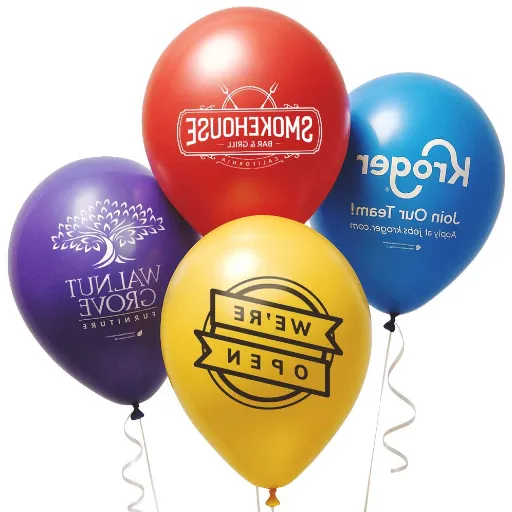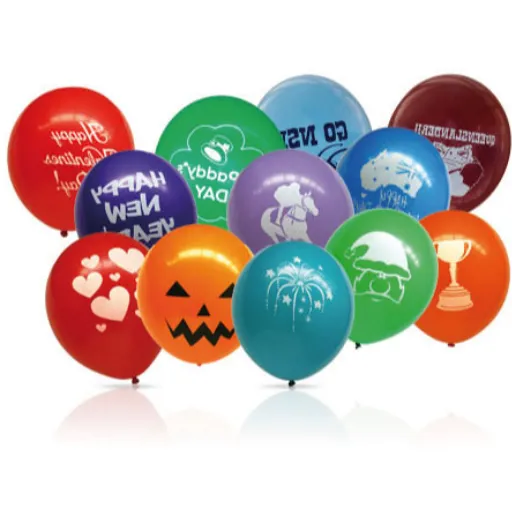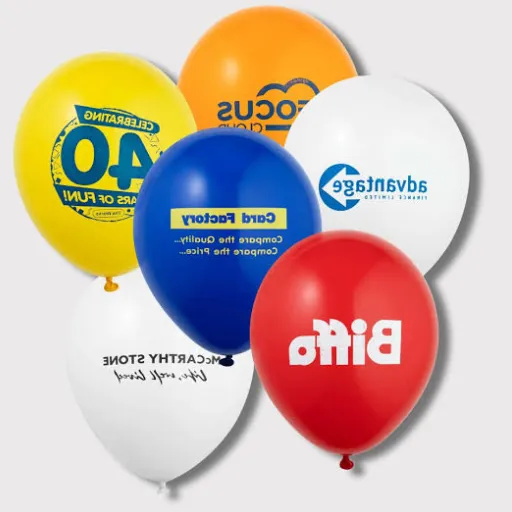
Promotional balloons are custom printed balloons that put a brand’s name, logo, or offer in front of people in a physical space. They work as giveaways, displays, photo props, or mailers. The unit price is low, but the campaign cost depends on how the balloons get into hands, not on the invoice line.
A thousand printed balloons cost about $350. Getting them into a thousand hands costs more.
Dana learned that in March. She ran marketing for a six-location fitness franchise and ordered 1,000 printed latex balloons for a new studio opening. On opening day, her team inflated 400.
The other 600 sat in a stockroom. Nobody had booked a large enough helium cylinder, and nobody had assigned staff to hand them out. Her cost per usable balloon rose 2.5 times.
You probably suspect the sticker price isn’t the whole story. This guide covers the five decisions that decide whether a campaign pays for itself: format, quantity, design, distribution, and measurement, plus the 2026 rules that can cancel one outright.
Trading Shanxi prints latex, foil, and PVC balloons in-house for brands, distributors, and promotional buyers in more than 50 countries. If you already have a quantity and an in-hands date, request a quote. If not, read on.
Key Takeaways
- The balloon is the cheapest part of the campaign. Helium, labor, transport, and waste usually cost more.
- Match the format to the job: latex for volume, foil for keepsakes, self-inflating for mailers, PVC for outdoor landmarks.
- A 1,000-piece latex order at 0.35perballooncanlandbetween0.35perballooncanlandbetween0.012 and $0.15 per impression once you account for balloons that never reach a hand. Publish the assumption, not just the number.
- At least ten U.S. states restrict balloon releases. A release is a compliance decision before it is a creative one.
- Measure with unique QR codes and redemption codes, and accept that promo items rarely carry clean attribution.
The campaign examples in this guide are illustrative composites based on typical orders, not named customers.
What Are Promotional Balloons?
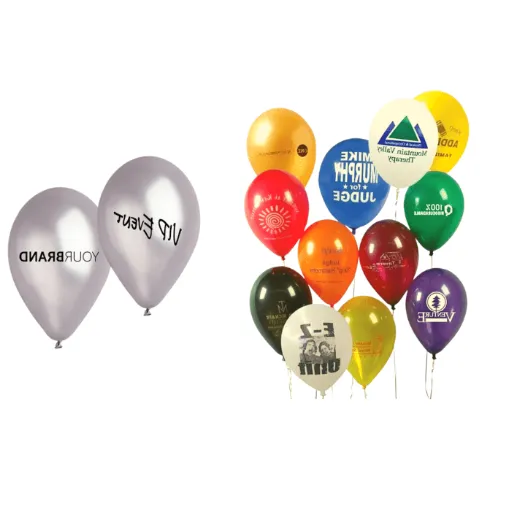
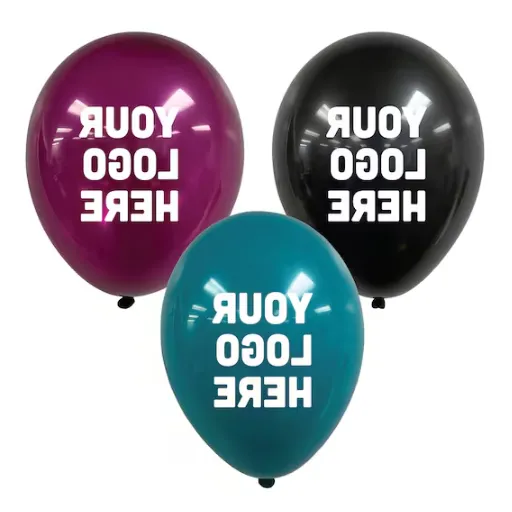
Promotional balloons are printed latex, foil, or inflatable balloons used to carry a brand’s name, logo, offer, or message into a public space. They are bought as giveaways, displays, photo props, or direct-mail pieces, and they are priced by material, size, print colors, quantity, and delivery terms.
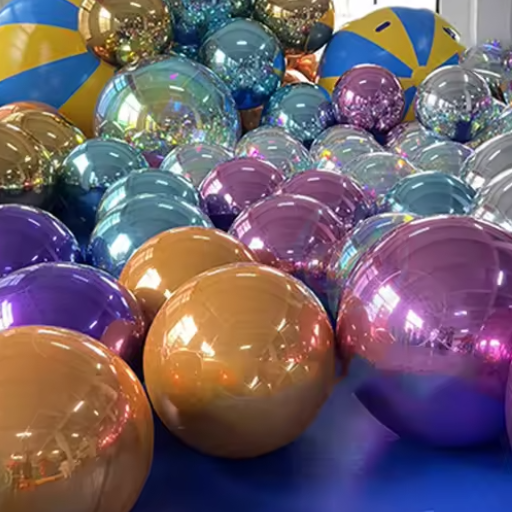
The category covers more than one product. A 12-inch latex giveaway, an 18-inch foil keepsake, a self-inflating mailer, and a 15-foot PVC rooftop sphere are all promotional balloons. They solve different problems.
The four jobs a balloon does
A balloon can be a giveaway (someone takes it home), a display (it marks a location), a photo prop (it creates a shareable picture), or a mailer (it arrives flat). Most campaigns use one primary job and one supporting job: a trade-show booth uses a display to pull people in and a giveaway to send them away with the brand.
A promotional balloon carries a message; event decor creates an atmosphere. If you are decorating a venue, start with branded balloons for corporate events. Giant rooftop and hot-air inflatables are a different product with a different buyer; see giant PVC advertising balloons. This guide covers printed latex, foil, and self-inflating formats.
Why Promotional Balloons Work, and When They Don’t
Balloons work because they are large, cheap, portable, and photogenic. A printed balloon costs less than a branded pen and takes up far more visual space. It travels in a car, sits on a desk, and ends up in photos. That is the entire mechanism.
What the evidence actually says
The strongest data comes from the promotional-products industry, not from balloon suppliers. PPAI’s 2023 Consumer Survey, which polled more than 3,000 U.S. consumers between 18 and 78, found that 66% could name the advertiser on a logoed product they received in the past 12 months.
The same survey found that 52% looked the company up online, and 47% posted about the item on social media. A 2026 VistaPrint survey reports similar patterns: 72% said a promotional product improved their perception of a brand, and 63% said they keep and use promotional products regularly.
Two cautions: these studies cover promotional products broadly, not balloons, and recall isn’t conversion.
Priya saw the difference at a regional home show. Her first year, she spent the booth budget on 2,000 latex giveaways. Her second year, she ordered 600 giveaways and one 6-foot foil cluster at the aisle corner; booth visits roughly doubled.
When balloons are the wrong promotional item
Balloons are a poor fit in four situations:
- The audience is premium and small. A $40,000 consulting engagement isn’t won with a balloon.
- The venue bans helium or balloons. Many museums, hospitals, and arenas do.
- The audience is sustainability-sensitive and you have no disposal plan. A balloon in a tree is a brand liability.
- The campaign idea is a mass release. In many states, that is a fine.
If two or more apply, spend the budget elsewhere.
Choosing the Right Custom Promotional Balloon Format
Format decides cost, lead time, and what the recipient does with the balloon. For most custom promotional balloons, the format decision is really a material decision.
Latex is the workhorse: the cheapest printed balloon at volume, it prints well in one to four colors and works for handouts, arches, and clusters. See our guide to custom printed latex balloons.
Foil costs more per unit and holds air or helium far longer, often a week or more. It takes full-color print and holds a shape. Foil suits a keepsake or a premium brand moment, not a 5,000-piece street handout. Our custom printed foil balloons guide covers shapes and print.
Self-inflating balloons ship flat and inflate on activation. They remove helium from the equation, which makes them useful for mailers, remote teams, and events where gas supply is uncertain. The trade-off is a higher unit cost and fewer shapes; Ace Balloon sells 8 to 19 cm formats with a claimed 30-day inflation life.
Format comparison
| Format | Typical unit cost | Typical MOQ | Print and life | Best job |
|---|---|---|---|---|
| Printed latex, 11″ to 12″ | 0.26to0.26to0.60 | 100 to 500 | 1 to 4 colors, screen; 12 to 24 hours helium, days air | High-volume giveaway |
| Printed foil, 18″ | 0.60to0.60to2.00 | 100 to 500 | Full color; 5 to 7+ days | Keepsake, retail, premium |
| Self-inflating | 1.00to1.00to3.00 | 500 to 1,000 | Full color; 30+ days claimed | Mailer, remote activation |
| Giant PVC inflatable | 150to150to1,500+ | 1 to 5 | Full color; weeks, reusable | Outdoor landmark |
Indicative 2026 ranges based on published supplier prices and typical order sizes, not quotes.
Promotional balloon ideas by use case
| Use case | Format | Typical quantity | Primary metric |
|---|---|---|---|
| Grand opening | Latex cluster plus foil keepsake | 250 to 1,000 | Foot traffic, photos |
| Trade-show booth | Latex giveaway plus one hero display | 500 to 2,000 | Booth visits, QR scans |
| Retail sale weekend | Latex handout to children | 500 to 1,000 | Redemptions, footfall |
Promotional Balloons With Logo: Design Rules That Work
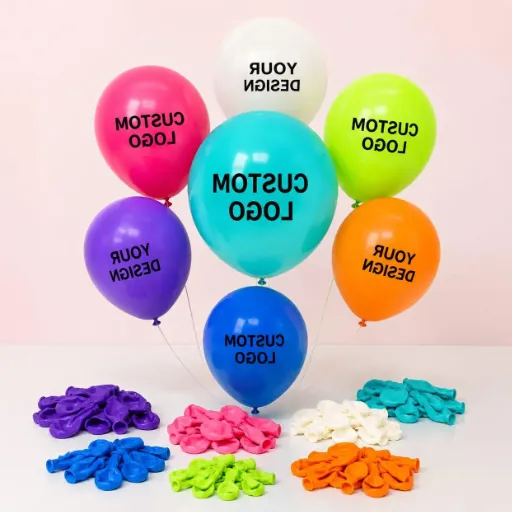
Design decides whether the balloon reads at ten feet or looks like a colored smudge.
Logo size, imprint area, and viewing distance
A printed 11-inch latex balloon has a usable print area of roughly a 3-inch circle. Keep the logo inside 60% to 70% of that area, and size it to read at 10 feet for a giveaway or 30 feet for a display. Our logo balloons page lists imprint areas by format.
Thin strokes, gradients, and small type disappear when latex stretches. Simplify the mark instead of shrinking the full logo; a one-color version usually reads better at the same size.
Color, contrast, and ink cost
For most branded balloons for business, one color on a light balloon is the cheapest and most legible choice. White ink on a dark balloon costs more because it needs a base layer. Pantone matching is available, but expect the color to shift when the balloon inflates, so approve a physical proof when brand color is critical.
QR codes that survive inflation
QR codes work on balloons only when they are printed large enough. Use a minimum of 1.2 inches square, keep the quiet zone clear, and put a short URL underneath. Place the code where the latex stretches least, near the neck or on a foil panel.
The 2026 VistaPrint survey found that 39% of Gen Z scanned a QR code after receiving a promotional item, compared with 2% of Boomers. A code that is too small wastes that advantage.
Artwork files and proofing
Send vector artwork as AI, EPS, or PDF files with fonts outlined. Use 300 DPI raster files only when vector is impossible. Approve a digital proof for layout on every order, and a physical proof for ink behavior on brand-critical runs.
Promotional Balloon Printing: What It Costs
Cost has three layers: the balloon, the setup, and the delivery. Most quotes show only the first.
Unit price benchmarks
Published prices in October 2026 ranged widely by size and print. Max Balloons, a US supplier that lists ASI #69709 and SAGE #52560, shows screen-printed latex at 0.258to0.258to3.00 each for 9- and 10-inch sizes, and 0.269to0.269to3.38 for 11- and 12-inch sizes. Bomballoon quotes foil at 0.58eachatMOQ100,fallingto0.58eachatMOQ100,fallingto0.20 at MOQ 500.
Be careful with headline prices. Cheap Custom Balloons advertises “from 0.15perballoon”initspagetitle,whilethebodycopysays0.15perballoon“initspagetitle,whilethebodycopysays0.39. That gap usually reflects a one-color, high-volume, ex-works number with no freight or setup.
Setup, freight, and landed cost
Each print color needs a screen or plate, and each side needs a separate pass. A two-color, double-sided order carries four setup charges. Setup is fixed, so it hurts small orders and nearly disappears at volume; promotional balloons bulk pricing starts at 500 to 1,000 pieces for that reason.
Then add freight, duty, and a defect buffer. A simple landed-cost formula:
- Unit price × quantity
- Plus setup
- Plus freight and duty
- Plus 5% to 10% for defects and overage
- Divide by sellable units
For a deeper sourcing model, including MOQ tiers and supplier comparisons, see custom printed balloons wholesale.
A cost-per-impression model you can defend
Cost per impression is the number a finance team will ask for. The honest version is a range, because nobody knows exactly how many people see each balloon.
| Input | Conservative | Base | Optimistic |
|---|---|---|---|
| Order | 1,000 × 11″ latex, 1 color, 1 side | Same | Same |
| Unit price | $0.35 | $0.35 | $0.35 |
| Setup | $50 | $50 | $50 |
| Freight | $60 | $60 | $60 |
| Total cost | $460 | $460 | $460 |
| Usable after loss | 600 | 850 | 1,000 |
| Impressions per balloon | 5 | 15 | 40 |
| Total impressions | 3,000 | 12,750 | 40,000 |
| Cost per impression | $0.153 | $0.036 | $0.012 |
The base case assumes 15% loss to burst and damage and fits a giveaway at a busy retail site. The conservative case assumes 40% never reach a hand and each balloon is seen by a handful of people. The optimistic case assumes full utilisation and a highly visible display.
Publish the assumption with the number. A $0.15 impression may still beat a local print ad, but only if the balloons reach hands. That is a distribution question, not a print question.
Want the real number for your quantity? Request a quote with your format, colors, and in-hands date.
Distribution, Logistics, and Measurement
Distribution is where most campaigns lose money. The balloons are the easy part.
Helium, air, and the 2026 supply reality
Helium is the largest variable cost and the least controllable. Trade coverage in 2026 described supply pressure tied to Middle East conflict and disruption to Qatari LNG, which produces helium as a by-product, so confirm the current situation with your gas supplier.
Air-filled and self-inflating formats remove the dependency. They don’t float, but they last longer and cost less to activate; if the campaign doesn’t require floating, don’t pay for helium. Our guide to printed helium balloons covers gas planning.
Inflation and transport math
One person can inflate 100 to 150 latex balloons per hour by hand, faster with a regulator. A helium cylinder yields a predictable number of balloons, though the count varies with size, temperature, and fill pressure. Balloons travel badly in heat and wind.
Order 10% to 15% overage, budget labor for inflation, tying, and hand-out, and inflate on site if the venue is more than an hour away.
Giveaway logistics by channel
Promotional balloons for trade shows, retail, and mailers each need a different plan.
- Trade show: pre-inflate a display, ship deflated giveaways, and inflate on site.
- Retail: keep a counter stack and a staff script. A balloon without a greeting is just litter.
- Direct mail: use deflated latex with a straw or a self-inflating format.
- Outdoor display: use weights, check wind, and confirm the venue allows tethered balloons.
Ask about helium bans, fire code, and setup windows before you order.
What to measure, and what not to claim
Promotional items rarely carry clean attribution. Track QR scans by channel, redemptions at checkout, and foot traffic against a comparable day, and use a holdout market when the budget allows. Otherwise, report the leading indicators and say plainly that business promotional balloons are a reach play.
Compliance, Safety, and the 2026 Rules
A balloon campaign can be cancelled by a rule that has nothing to do with marketing. Check these before you order.
Balloon release bans
At least ten U.S. states restrict intentional balloon releases, and several countries ban them outright. Penalties range from a small fine to a per-balloon charge.
Marcus manages a dealership in Florida. He planned a 200-balloon release for a Memorial Day sale until his events coordinator found the state restriction. They replaced it with a tethered display and a QR code. The display cost less than the potential fine, and the code produced 60 scans over the weekend.
| Market | Restriction | Indicative penalty |
|---|---|---|
| Florida | Intentional release of lighter-than-air balloons banned | From about $150 |
| Hawaii | Intentional release banned | Up to $500 per offense |
| Connecticut | Releasing 10 or more balloons in 24 hours prohibited | About $35 plus fees |
| Rhode Island | Intentional release of 10 or more balloons prohibited | About $100 first offense |
| Tennessee | Releasing more than 25 balloons prohibited | About $250 plus per-balloon penalties |
| Virginia | Release of slow-degrading balloons prohibited | About $25 per balloon |
| Other states and countries | California, Delaware, Maine, and Maryland restrict releases; Australia, the Bahamas, and Kenya ban or limit them | Varies |
Thresholds change, so confirm the local rule. The Balloons Blow law tracker is a starting point, not a legal opinion.
Product safety and labeling
Balloons are a choking hazard for children under 8. U.S. law requires warning labels, and the EU and UK apply the EN 71 toy safety standards.
If you import balloons into the United States, CPSC electronic filing of Certificates of Compliance begins on July 8, 2026, with a Foreign Trade Zone phase on January 8, 2027. Ask your supplier for the Children’s Product Certificate and confirm they can file electronically.
Helium cylinders are pressurized gas, not toys: store them upright, ventilate the space, and follow the venue’s fire code. Latex allergy is rare but real, so give handlers gloves if anyone on the team is sensitive.
Sustainability claims
Sustainability is now a purchasing criterion. The 2026 VistaPrint survey found 31% of Gen Z value it in a promotional item, against 6% of Boomers.
Natural latex is biodegradable under the right conditions, but “eco-friendly” without qualification is a greenwashing risk. Say “natural latex,” explain disposal, and never imply that releasing a balloon is responsible. Our guide to biodegradable printed balloons covers materials and claims.
Frequently Asked Questions
What are promotional balloons?
Printed latex, foil, or inflatable balloons that carry a company’s name, logo, or offer into a public space. Businesses use them as giveaways, displays, photo props, or mailers.
Are promotional balloons effective advertising?
They are effective for reach and recall at a low unit cost. PPAI’s consumer research found 66% of recipients could name the advertiser on a logoed product. Balloons are weaker for qualified leads and direct response.
How much do promotional balloons cost?
Printed latex usually runs 0.26to0.26to0.60 per balloon at 100 to 1,000 pieces, before setup and freight. Foil runs 0.60to0.60to2.00, and self-inflating formats 1.00to1.00to3.00. Compare landed cost per usable balloon.
What is the minimum order for promotional balloons?
Many suppliers start at 25 to 100 pieces for one-color latex. Volume pricing begins at 500 to 1,000, and foil or custom shapes often require 100 to 500.
Do promotional balloons need helium?
No. Air-filled latex lasts for days and costs less to activate. Helium is only necessary when the balloon must float, and self-inflating formats need no gas at all.
Are balloon releases legal?
Not in at least ten U.S. states, and not in several other countries. Check the local rule before planning any release. A tethered display delivers the same visual moment without the fine.
Plan Your Promotional Balloon Order
The campaigns that work are planned backwards from the hand-out, not forwards from the print quote. Decide the job, pick the format, size the order, budget the distribution, and set the measurement before you approve artwork. Promotional balloons reward that discipline more than most promo items, because the cost sits in distribution.
If you are ready to price an order, send five things: quantity, format, imprint colors, in-hands date, and destination. We will quote latex, foil, or PVC from the same production floor.
Request a promotional balloon quote or read how to order custom balloons if you want the process first.