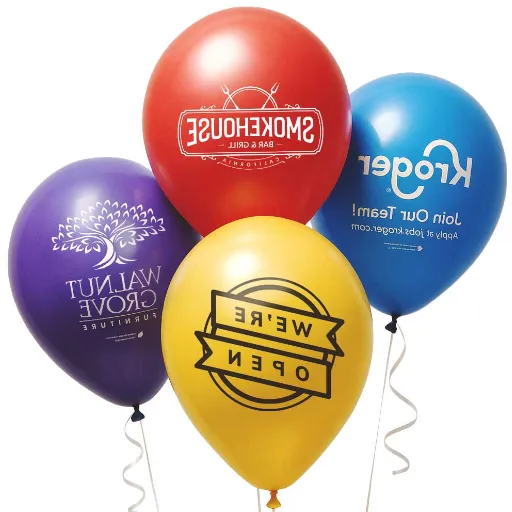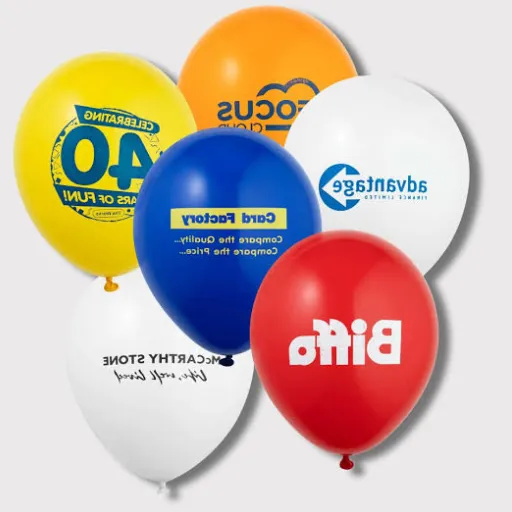
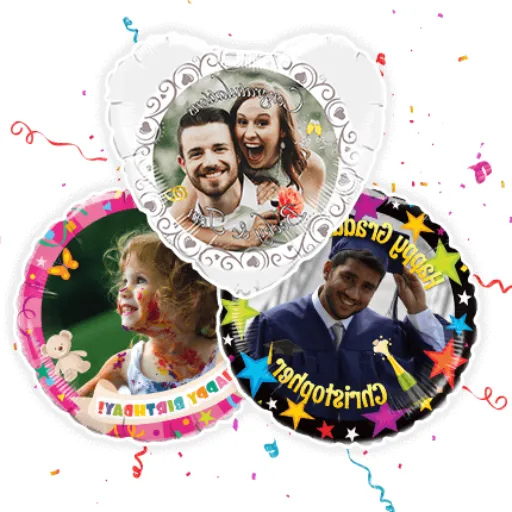
Custom photo balloons are balloons printed with a photograph, usually by digital or screen process, on foil film or latex. Whether your photo prints sharp depends on three things: the pixel count of your file, the material, and the size of the balloon.
Every complaint about photo balloons is really the same complaint. The picture looked fine on the phone. On the balloon it’s blurry, the colours are dull, a face is pulled wide across the curve, or the red came out brown. Almost none of that is the balloon’s fault.
Search “custom photo balloons” and you get upload boxes and price tags. Four vendors, four pricing models, and no page that tells you how many pixels a 12-inch balloon needs. This guide does, along with foil versus latex for photographs, distortion, colour approval, and real costs. We print these up to two metres across, so it’s written from the press rather than the shopping cart.
Key Takeaways
- A 12-inch balloon needs roughly 1,650 pixels across for a 300 DPI print, or about 825 pixels at 150 DPI. Most phone photos clear this easily. Most screenshots and social media saves do not.
- Foil is the correct material for faces and fine detail. Latex stretches five to seven times at inflation and pulls a photograph out of shape.
- Tabletop photo balloons in 6-inch and 11-inch sizes are air-filled and do not float. Only the larger helium sizes rise.
- One-off photo balloons cost roughly ten times the unit price of a 500-piece run, because setup is spread across one balloon instead of five hundred.
- Approve a physical proof for any job where skin tone or brand colour matters. A monitor proof will not predict a metallic substrate.
Want to see the sizes and finishes side by side? Browse our custom photo balloon range and match a format to your photo before you order.
What Are Custom Photo Balloons?
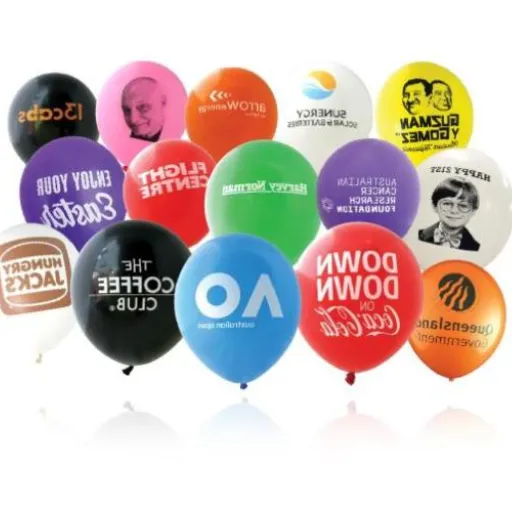
Custom photo balloons are balloons printed with a photographic image rather than a logo or text. The image is reproduced by digital printing for full-colour detail, or by screen printing for simpler spot-colour artwork. They’re used for gifts, milestone birthdays, weddings, memorials, and brand events.
That definition matters because photo balloons aren’t the same product as logo balloons, even when the machine is identical. A logo is one or two flat colours with hard edges. A photograph is thousands of continuous tones, including skin, the hardest thing in printing to get right. A logo that prints slightly off-register still reads as a logo. A face that prints slightly soft reads as a bad photograph. That’s why this page is organised around the image, not the balloon.
Four groups buy these, and each hits a different constraint. Individuals hit resolution, because they upload whatever’s on their phone. Planners hit colour, because the balloon must match a palette. Brands hit consistency, because five hundred balloons must look like one. Distributors hit cost, because unit price decides the margin.
If your artwork is flat colour with clean edges rather than a photograph, read our guide to custom printed balloons instead.
Custom Photo Balloons: Foil or Latex?
This is the decision that determines whether your photograph survives. Foil wins for photographs, and it is not close.
| Property | Foil / Mylar | Latex |
|---|---|---|
| Surface | Opaque metallized film | Semi-translucent rubber |
| Stretch at inflation | None | 5 to 7 times |
| Image distortion | Minimal | Significant |
| Colour depth | Full colour, gradients hold | Best with 1 to 2 spot colours |
| Detail | Fine detail and faces hold | Fine detail softens |
| Float time | 3 to 7 days depending on size | 8 to 24 hours |
| Minimum order | Often 15 to 100 | Often 25 to 100 |
| Unit cost | Higher | Lower |
| Best for | Portraits, pets, detailed scenes | Colour blocks, large type, big shapes |
Why foil wins for faces and fine detail
Foil is a plastic film carrying a thin metallized layer. It doesn’t stretch when inflated, so the print you approve is the print that hangs there, at the same proportions, for days. A face on a surface that doesn’t move keeps its proportions. A face on a surface that expands by several hundred percent doesn’t.
There’s a second advantage. Foil is opaque, so the ink sits on a solid base. Latex is semi-translucent, so ambient light passes through and lifts the printed image, washing out contrast. That’s why photographs on latex look flat even when the print is technically fine. Our custom printed foil balloons guide covers film construction, dies, and tooling.
What latex can and cannot hold
Latex isn’t a bad material. It’s a bad material for photographs and a good material for graphics. Large type, bold shapes, solid colour blocks, and simple two-colour illustrations all print well. At volume it’s cheaper, and it floats without the stiffness of foil.
If your design is a photograph of a person, latex will let you down. The image softens, the contrast drops, and the proportions shift. Our custom printed latex balloons guide covers grades, print areas, and ink behaviour.
The one-question decision
Ask yourself one thing: does the balloon need to show a face or fine detail? If yes, choose foil. If no, and you want volume or a lower unit cost, choose latex. For a fuller comparison outside the photo context, see latex vs foil balloons.
Custom Photo Balloons: Image Specs That Print Sharp
Here’s the number nobody publishes. Required pixels equal the print diameter in inches multiplied by your target DPI. That’s the whole calculation.
Print areas below are computed from published bands for each size. Treat them as planning figures and confirm the exact area for your shape with your printer.
| Balloon size | Usable print area | 150 DPI | 300 DPI |
|---|---|---|---|
| 6″ tabletop | ~2.5″ / 6 cm | ~375 px | ~750 px |
| 11″ tabletop | ~4.5″ / 11 cm | ~675 px | ~1,350 px |
| 12″ latex | ~5.5″ / 14 cm | ~825 px | ~1,650 px |
| 18″ foil | ~9″ / 23 cm | ~1,350 px | ~2,700 px |
| 22″ foil | ~11″ / 28 cm | ~1,650 px | ~3,300 px |
| 24″ latex | ~12″ / 30 cm | ~1,800 px | ~3,600 px |
| 36″ giant | ~15″ / 38 cm | ~2,250 px | ~4,500 px |
How many pixels a balloon actually needs
A modern phone camera produces images well above 3,000 pixels on the long edge, which comfortably covers everything up to a 36-inch balloon. The files that fail are rarely camera files. They’re screenshots, social media saves, and pictures sent through messaging apps that compress them.
Priya found this out the hard way. She ordered a 24-inch foil balloon for her parents’ fortieth anniversary using a photo she’d saved from a family WhatsApp group. The file was 900 pixels wide. On a 24-inch balloon that’s roughly 75 DPI, about a quarter of the detail the print needed. The faces were soft and the detail in her mother’s sari was gone. A fresh export from the camera roll would’ve fixed it in thirty seconds.
File formats and colour mode
Send vector files where you have them. For photographs, send the highest-resolution JPEG or PNG you hold and avoid re-saving it. Supply images in RGB unless your printer asks otherwise, and skip heavy filters or sharpening, because both exaggerate artefacts the press will reproduce faithfully.
Contrast and brightness
Printing reduces contrast. Ink on a substrate can’t reproduce the backlit glow of a screen, so dark areas block up and mid-tones flatten. If your photo is already low-contrast, lift it slightly before sending. If it’s a night photo or a backlit portrait, expect the print to read darker than the file. That’s the most common reason a buyer says the balloon “looks muddy.”
The five photos that will fail
- The screenshot. Screen resolution, no exceptions.
- The social media save. Compressed and resized on upload.
- The messaging app forward. Compressed again every time it’s shared.
- The group photo cropped to one face. Cropping removes pixels.
- The dark indoor shot. Underexposed detail can’t be recovered.
Check your file’s pixel dimensions before ordering. If the long edge is below the number in the table for your size, request a smaller balloon or a better file.
Designing for a Sphere
A balloon isn’t a flat surface, and a photograph is a rectangle. Something has to give. The middle prints closest to true proportion; the edges curve away and compress. On a round balloon the effect is mild barrel distortion, more pronounced on a heart or custom silhouette because the shape narrows toward the points.
Distortion, safe zones, and what wraps out of view
Keep critical content inside a central circle covering roughly 60 percent of the print area. That’s your safe zone. Faces, text, and logos belong there. Content near the edge still prints, but it curves away and reads at an angle, and on a very round balloon the outer band can turn almost edge-on and become invisible from the front.
Three rules cover most cases. Keep the subject centred. Leave margin around it. Avoid long horizontal lines of text near the top or bottom, because they’ll bow. If you need text, run it across the middle, away from the neck and crown.
Single-sided, double-sided, and multi-panel
Single-sided is the default and the cheapest. Double-sided prints the same or different artwork on both faces, which matters when a balloon is seen from two directions, like a table centrepiece. We cover the spec in our guide to designing double-sided photo balloons. Multi-panel suits large custom shapes where the image wraps around the form, but it needs a die line, so it’s a project decision rather than an add-on.
Not sure your photo will hold at the size you want? Send us the file and we’ll tell you before you commit to a run.
Custom Photo Balloons: Sizes, Shapes, and What Each Is For
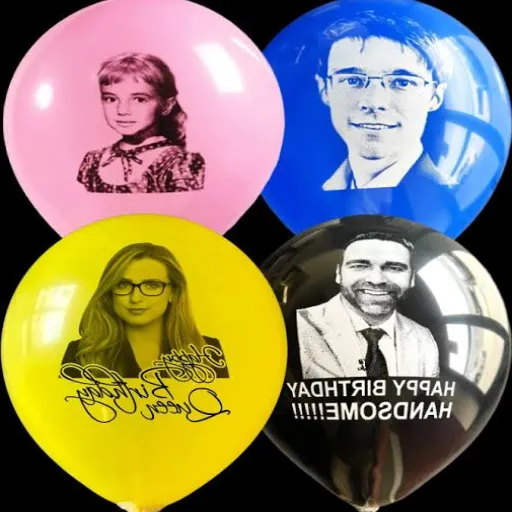
Size decides both the print area and whether the balloon floats.
| Size | Typical use | Fill | Floats? |
|---|---|---|---|
| 6″ | Tabletop, cupcake topper, gift tag | Air | No |
| 11″ | Tabletop centrepiece, small gift | Air | No |
| 12″ | Latex decor, garlands, bouquets | Helium or air | Yes, with helium |
| 18″ | Gift balloon, centrepiece | Helium | Yes |
| 22″ | Gift balloon, photo moment | Helium | Yes |
| 24″ | Statement piece, entrance | Helium | Yes |
| 36″ | Hero piece, retail display | Helium or air | Yes, with helium |
| Up to 2 m | Custom shape, installation | Helium or air | Project dependent |
Tabletop sizes: air-filled, and they do not float
This catches people out. Many 6-inch and 11-inch photo balloons are designed for air, mounted on a cup and stick, and sold as tabletop displays. They won’t float, because they’re not built for helium. VistaPrint’s photo balloon range makes the split explicit: its 6-inch and 11-inch sizes are air-fill only, and only the 22-inch Mylar takes helium. That isn’t a limitation to work around. With helium prices up sharply, an air-filled tabletop display sidesteps the cost and lasts far longer, because there’s no gas escaping through the wall.
Helium sizes: the gift and centrepiece range
From 18 inches up, foil balloons take helium and float for days. Published float times vary: we list 3 to 5 days for 18-inch foil, other manufacturers state 5 to 7. Plan for the shorter end. Latex at 12 inches and above floats too, but for hours rather than days: 8 to 12 standard, 12 to 24 for printed.
Giant and custom shapes
Above 24 inches you’re in display territory. A 36-inch giant photo balloon gives roughly 15 by 15 inches of print area, enough for a proper portrait. Our own production runs from 30 centimetres to two metres, wider than any consumer print-on-demand service. If you need a shape that isn’t round, heart, or star, that’s a tooling conversation. See how to order custom balloons.
Colour: What You Approve vs What Prints
Your screen glows. A balloon reflects. Those are different physical events, and the gap between them is where most colour disputes begin.
Screen colour is not print colour
A monitor emits light in red, green, and blue. Print reflects light off ink in cyan, magenta, yellow, and black. Some colours that look vivid on screen don’t exist in reflective ink, and bright oranges and deep blues are the usual casualties. That isn’t a defect. It’s the medium.
White stock versus metallized film
Foil adds a second variable. Printing on white stock gives a predictable base. Printing on metallized film puts the ink over a reflective layer, which shifts perceived colour: light tints read warmer, dark tones read cooler. Some consumer services dodge this by printing on a white background only. That’s reasonable for a gift balloon and poor for a brand colour that must match a printed programme.
The physical proof rule
For anything where colour accuracy matters, approve a physical proof. Not a PDF, not a screen preview, an actual printed sample.
Daniel learned this on a restaurant opening. His team approved a deep red logo on screen, the run printed, and the red came back noticeably browner on the metallic film. Two hundred balloons had to be reprinted inside a nine-day window. The fix was a physical proof plus a white underprint, which cost one extra production day and nothing else.
Working to a brand palette? Request a proof against your Pantone references before the full run.
MOQs, Cost, and Lead Times
Photo balloon pricing confuses people because vendors quote four incompatible models. One sells at 11.75peritemwithnominimum.Anotherstartsat11.75peritemwithnominimum.Anotherstartsat85 per order with a minimum of 15. A third advertises “as low as $4.43.” All three can be true at once.
Why one photo balloon costs ten times a bulk order
Every print job carries setup: preparing the file, making the plate or screen, setting the press, and running a proof. That setup is fixed. At one balloon it lands on one unit; at five hundred it spreads across five hundred. The ink and film cost barely changes; the setup cost per unit collapses. That’s why a low minimum is a pricing decision, not a quality decision. You aren’t buying a worse balloon. You’re paying for setup you can’t amortise.
Unit price by quantity
| Quantity | Typical position | What drives it |
|---|---|---|
| 1 to 25 | Retail, per-item pricing | Full setup on each unit |
| 100 | Entry wholesale | Setup partly absorbed |
| 500 | Standard production run | Setup largely amortised |
| 1,000+ | Wholesale | Setup negligible per unit |
| 5,000+ | Distributor | Tooling and freight dominate |
Figures from the market show the spread: a consumer service lists 11.75peritem,[BalloonPrinting.com](https://balloonprinting.com/)startsat11.75peritem,[BalloonPrinting.com](https://balloonprinting.com/)startsat85 per order with a 15-piece minimum, and a promotional supplier advertises foil photo balloons as low as $4.43. None of those include freight or tooling.
One production detail worth knowing. CSA Balloons describes photo balloon printing as a dot-based screen process, done while the balloon is inflated, then deflated for shipping. That’s why the print survives inflation instead of cracking at it.
Proof, print, and ship
A realistic timeline: artwork check and proof in about one business day, production in four to six business days for standard digital work, then shipping. Multi-colour screen work and custom dies add weeks. Order 5 to 10 percent extra for inflation failures and handling damage.
DIY versus professional
There are four home methods, from tissue paper transfers to heat transfer sheets, and they work for small personal projects. We cover them in our DIY photo balloons guide. The honest summary: DIY is cheaper per unit at very small quantities, produces lower image quality, and doesn’t scale. Above roughly twenty balloons, professional printing wins on both price and quality.
Memorial, Children, and Sensitive Photos
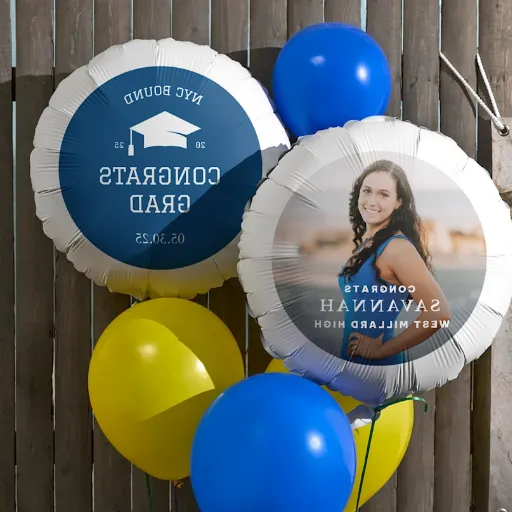
Photo balloons are used heavily for memorials, and that deserves more care than a product page usually gives it.
Memorial and remembrance balloons
People often order memorial photo balloons in grief, on a deadline, with one photograph that matters. Send the best file you have, even a scan of an old print; a scan at 300 DPI is usually workable for an 18-inch balloon. Then allow time, because rushed memorial orders are the ones most likely to arrive wrong.
We’d also say this plainly: many places ban or discourage balloon releases, and they leave litter regardless. Check your state’s rules in this guide to balloon release laws. Holding or displaying a memorial balloon responsibly achieves the same thing without the harm.
Photos of children and consent
If you’re printing a photograph of a child who isn’t yours, get permission from a parent or guardian. That’s both legal and ethical, and it applies to school events and sports teams as much as commercial work.
For balloons intended for children, note that latex carries a choking hazard. US rules require a warning under 16 CFR 1500.19, and children under eight shouldn’t inflate balloons unsupervised. The CPSC guidance on small parts sets out the framework.
Safety, releases, and disposal
Never release foil balloons outdoors. The metallized layer conducts electricity, and loose balloons have caused outages and line damage. Weight and tether anything used outside. Dispose of balloons by puncturing and binning them: foil isn’t kerbside recyclable in most areas, and latex degrades slowly regardless of marketing claims.
Frequently Asked Questions
Can you put a photo on a balloon?
Yes. Photographs print onto foil film by digital process, or onto latex by screen or digital printing. Foil holds detail far better because it doesn’t stretch.
Do photo balloons float?
It depends on size and fill. Tabletop sizes of 6 and 11 inches are air-filled and don’t float. Foil from 18 inches up floats on helium for 3 to 7 days. Latex floats 8 to 24 hours.
What resolution should a photo be for a balloon?
Multiply the print diameter in inches by 300. A 12-inch balloon needs about 1,650 pixels across, an 18-inch about 2,700, a 36-inch about 4,500. At 150 DPI, halve those.
Why does my photo look distorted on a balloon?
Latex stretches several times its flat size at inflation, pulling the image out of proportion, and any image on a curved surface compresses toward the edges. Foil plus a centred composition solves both.
Can you print photos on latex balloons?
Yes, but the result softens. Latex is semi-translucent and stretches, so contrast drops and fine detail is lost. Use latex for bold graphics and foil for photographs.
What size balloon is best for a photo?
An 18-inch foil is the sweet spot for a portrait: about 9 inches of print area, good detail, floats for days. Use 22 to 24 inches for a group shot and 36 inches for a hero piece.
How long do photo balloons last?
Foil holds helium for 3 to 7 days depending on size; air-filled foil lasts weeks. Latex floats 8 to 24 hours. Deflated foil can be stored and reused if handled carefully.
Are photo balloons reusable?
Foil balloons deflate through the valve, store flat, and reinflate later. The print survives if the balloon isn’t creased. Latex is single-use.
How much do custom photo balloons cost?
Retail single balloons run 4to4to12 each. Bulk orders fall sharply per unit as setup spreads across the run. Freight and tooling sit outside most advertised prices, so request a full quote.
Can you print a photo on both sides?
Yes. Double-sided printing can repeat the same image or carry different artwork on each face. It costs more and suits centrepieces viewed from two directions.
Get a Custom Photo Balloon Quote
Here’s the short version.
- Choose foil for anything with a face in it.
- Check your file’s pixel count against the size you want.
- Keep the subject centred and leave margin for the curve.
- Approve a physical proof when colour matters.
- Expect a low minimum to cost more per balloon.
Those five rules prevent almost every disappointing custom photo balloon. If your project is a single gift, our custom photo balloon range covers the tabletop and helium sizes. If it’s a branded run, a wedding set, or a custom silhouette up to two metres, send the artwork and quantity and we’ll quote it properly.
Request a quote for custom photo balloons and we’ll confirm what your photo will look like at the size you need, before anything goes to press.