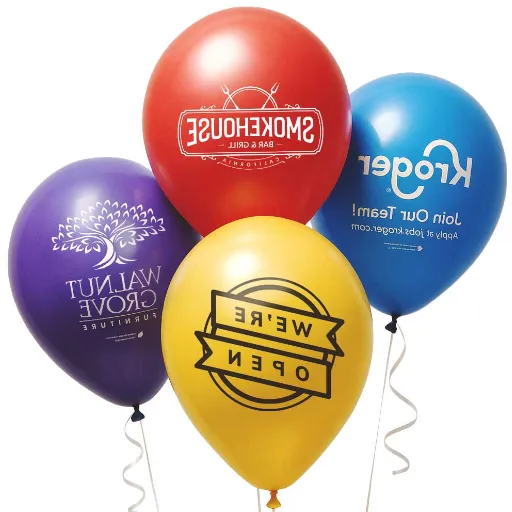
Custom printed foil balloons are metallized plastic film printed with a logo, artwork, or photo. Minimum orders start at 100 pieces for stock shapes and 500 for a new silhouette, and helium float runs about 3 to 7 days depending on size.
Here’s the part most suppliers skip. A “foil” balloon contains no foil. It’s plastic film carrying a layer of aluminum thinner than a wavelength of light, heat-sealed into a pillow with a one-way valve. That explains why the print looks sharper than latex, why your Pantone moves on press, and why it can short a power line.
Most pages ranking for custom printed foil balloons are factory homepages and marketplace listings. Few explain the film, the die, or how to approve color on metal. This guide covers all of it. If your artwork is ready, request a quote.
Key Takeaways
- Foil balloons are a metallized plastic laminate, not aluminum foil. The base film, aluminum layer, and heat-seal layer drive print quality, float, and recyclability.
- Stock shapes start around 100 pieces. A new custom silhouette starts around 500, and die tooling should be booked 60 to 90 days ahead.
- Foil doesn’t stretch, so the printing problem is registration on a curved die-cut, not ink elasticity.
- Print color shifts on a reflective substrate. Approve a physical sample, not a screen proof.
- Metallized film conducts electricity and isn’t kerbside recyclable. Plan weights, tethers, and retrieval before the event.
What Are Custom Printed Foil Balloons?
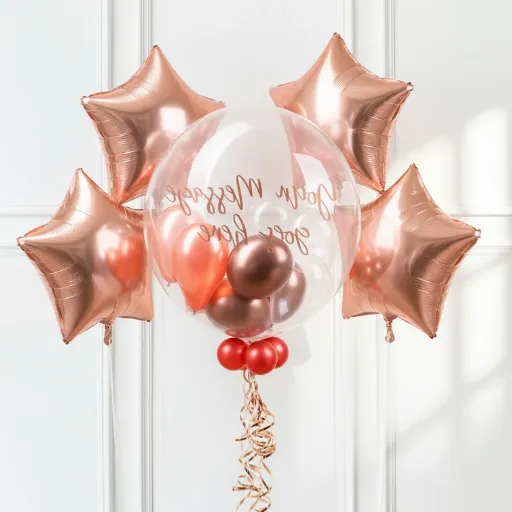
Custom printed foil balloons are metallized plastic film printed with a logo, artwork, or photograph before the panels are heat-sealed into shape. The print sits on a flat, non-stretch surface, which is why logos, fine type, and QR codes stay sharp where latex softens them. The aluminum is a vapor layer measured in nanometres, not foil.
The sequence is the same for every order: print the film, laminate it, die-cut to shape, fit a self-sealing valve, leak-test, pack.
“Foil” is metallized film, not aluminum foil
A typical construction is a PET base film of 12 to 30 microns, a vacuum-deposited aluminum layer of 0.02 to 0.05 microns providing the mirror finish and helium barrier, and a heat-seal layer bonding the panels at the seam. Suppliers name it differently, so ask for the actual laminate: one lists PA+PE and PET+PE (FAIR), another nylon and polyethylene (Bomballoon).
Thickness and finish
Those layer figures are per layer; the finished laminate is thicker. Our own foil range runs 0.12 mm, 0.15 mm, 0.20 mm, and 0.30 mm, set by size, indoor or outdoor use, and durability. See the full parameter set on the foil balloon specifications product page. Finish is separate: metallized gives the mirror look, holographic shifts with the light, matte reduces reflection, clear lets print sit on a transparent body.
Foil balloons fail at the seam or the valve, not the face. Ask two questions: do you leak-test every unit or sample it, and what’s your fill recommendation for hot conditions? FAIR publishes 90% to 95% fill in heat and 100% leak testing as standard.
What you can print on foil
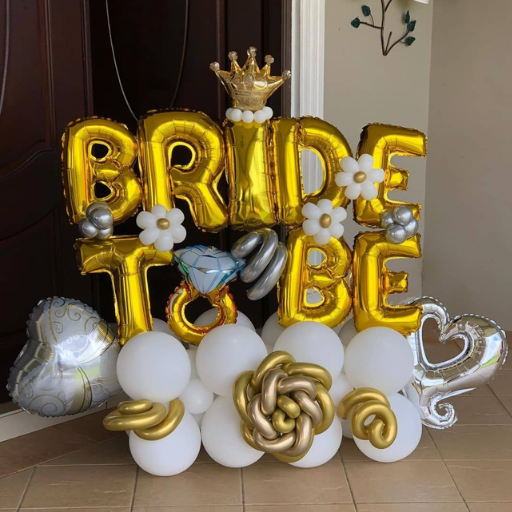
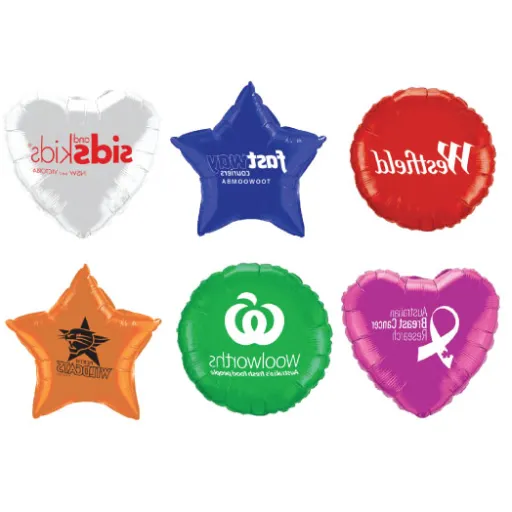
Custom foil balloons with logo artwork, full-color gradients, photographs, fine serif type, small QR codes, and dense pattern work all reproduce cleanly because the surface doesn’t distort as it inflates. See the custom logo foil balloons range for finished examples.
Brands buy them for launches, planners for photo walls, and distributors buy custom printed foil balloons wholesale to resell under their own label. For the wider category, see custom printed balloons.
Foil vs Latex for Printing: The Real Trade-off
This isn’t a general material comparison. It’s a print-specific one. For float, cost, and disposal in full, see latex vs foil balloons. If you’re printing on latex, our custom printed latex balloons guide covers ink elasticity.
| Factor | Printed foil | Printed latex |
|---|---|---|
| Surface behavior | Non-stretch, flat | Stretches 5x to 7x at inflation |
| Detail and small type | Sharp, holds fine lines | Softens; small type fills in |
| Color capability | Full color, photographic | Best at 1 to 2 spot colors |
| Logo distortion | Minimal | Curves and stretches |
| Stock minimum | About 100 pieces | About 100 pieces |
| Custom-shape minimum | About 500 pieces (new die) | Not applicable the same way |
| Relative unit cost | Higher | Lower at volume |
| Helium float | About 3 to 7 days | About 8 to 12 hours |
| End of life | Not biodegradable, not kerbside recyclable | Degrades slowly; conditions matter |
Foil wins on detail, color, and time in the air: a logo with a tagline under it prints on foil and blurs on latex. Latex wins on cost, minimums, and disposal. Ask one question: does the print have to stay sharp, or the balloon have to stay up?
Custom Shaped Foil Balloons: Dies and Tooling
Stock shapes are round, heart, star, number, and letter. The die already exists, so the minimum stays low. Custom shaped foil balloons are anything not on the shelf: a product replica, a mascot, a logo mark. That shape needs a cutting die built, tested, and mounted before a single balloon can be cut. The die is a one-time charge. The bigger cost is time: Bomballoon advises booking dies and PMS proofs 60 to 90 days ahead.
Priya’s cosmetics launch. Priya runs marketing for a skincare brand and wanted her bottle silhouette for a trade show. Her supplier quoted 100 pieces and two weeks, but didn’t mention the new die the shape required. The real timeline was a die build, a sample, a revision, then production, and the show date didn’t move. She ordered stock 18-inch rounds and booked the die for spring, which shipped four months later at a lower unit price than the rush job would have.
Sizes and design limits
| Size | Typical use | Notes |
|---|---|---|
| 9 to 10 inch | Accents, balloon sticks, table scatter | Small print area; keep artwork simple |
| 18 inch | The workhorse for logos, retail, photo walls | Practical minimum for a readable logo |
| 20 to 24 inch | Storefronts, entrances, trade show aisles | More print area, more helium |
| 32 to 40 inch | Numbers, letters, statement pieces | Longest float; plan inflation on site |
| Custom | Product replicas, mascots, logo silhouettes | Requires a die; book 60 to 90 days ahead |
A silhouette has to survive cutting. Thin necks, sharp interior angles, and isolated details smaller than a few millimetres will tear or fail to seal, so bring vector art and let the die engineer simplify it before tooling.
18 Inch Custom Foil Balloons
18 inch custom foil balloons are the practical default: enough print area for a readable logo and tagline, and the most common stock size. Above it, helium and freight climb faster than print area does.
Foil Balloon Printing: Methods and Order Sizes
Latex is printed while partially inflated, so the ink has to stretch with the rubber. Foil is printed flat on film that won’t stretch. That replaces the ink-elasticity problem with a registration problem: keeping colors aligned on a curved, die-cut panel that’ll be folded and sealed.
Rotogravure uses engraved cylinders. Preparation is expensive, but per-unit cost falls sharply at volume, so it suits long runs with fixed artwork (FAIR print methods).
Screen printing pushes ink through a mesh screen; each color needs its own screen, which is why the minimum climbs with color count. Digital handles photographs, gradients, and short runs without plate costs, at a higher per-unit price. Foil stamping and holographic finishes are decorative passes, not CMYK. Double-sided print doubles the passes; for a balloon seen from one angle, single-sided is enough.
| Method | Best order size | Color capability | Setup cost | Best for |
|---|---|---|---|---|
| Rotogravure | 5,000+ per design | Multi-color, repeatable | High (cylinders) | Annual reorders, retail programs |
| Screen | 100 to 2,000 | 1 to 6 spot colors | Moderate (per screen) | Logos, simple palettes |
| Digital | 1 to 500 | Full color | Low | Photos, gradients, short runs |
| Foil stamp / holographic | Varies | Decorative only | Moderate | Premium finishes |
Method follows order size, not preference: digital below 500 units, screen for spot colors to 2,000, rotogravure once the same artwork reorders annually. Ready to match a method to your order? Send your quantity, color count, and artwork. Get a foil balloon quote.
Artwork for Custom Printed Foil Balloons: Die Lines and Color
Die lines, safe zones, and bleed
Every custom shape has a die line: the exact cut path. Artwork extends past it as bleed so the cut doesn’t leave a white edge. Inside the die line sits the safe zone, where text and logos stay clear of the seam and valve. Get the die template before you design. If the artwork is still open, our custom balloon designs guide covers composition for a curved surface.
Why your Pantone shifts on a metallic substrate
Ink on a mirror isn’t ink on white paper. The metallized layer reflects light back through the ink, brightening some colors, darkening others, shifting neutrals. The same Pantone can look right on screen and wrong on the finished balloon. The fix is procedural: approve a physical pre-production sample under the lighting the balloon will be seen in, then hold production to it.
Marcus and the red that wasn’t. Marcus runs a restaurant group and ordered 300 custom foil balloons for a reopening. The brand red was approved from a digital proof. The production run arrived a shade toward orange, because the metallic substrate pulled the ink warmer. Nobody was at fault; the proof was the wrong instrument.
The second order specified a physical sample and a white underprint behind the red, and that run matched. The lesson cost one reprint and one week.
White ink and the proof checklist
Metallic film shows through light ink. If your design has pale colors, pastels, or a white logo on a colored field, you need a white underprint beneath those areas. Before approving production, confirm five things: vector artwork with fonts outlined, rasters at 300 dpi at final size, the die template applied with bleed and safe zone respected, Pantone references with white underprint specified, and a physical sample approved under realistic lighting.
Float, Helium, and the 2026 Economics
| Size and fill | Typical float | Notes |
|---|---|---|
| 18 inch, helium | 3 to 7 days | Standard indoor conditions |
| 32 to 40 inch number or letter, helium | 5 to 7 days | Larger volume, longer retention |
| Premium shapes, helium | 2 to 3 weeks in ideal conditions | Depends on film and valve quality |
| Any size, air-filled | 7 to 14 days or longer | Doesn’t float; needs a stand or wall |
Sources disagree on the 18-inch figure. Our own how long foil balloons last guide says 3 to 5 days; one manufacturer states 5 to 7. Film, fill purity, temperature, and valve quality move the number, so quote a range.
Heat, cold, and cost per display day
Heat expands the gas and accelerates loss. Cold contracts it, so a balloon that looked full indoors can look wrinkled on a cold loading dock and recover once it warms. Fill to 90% to 95% in hot conditions, and inflate on site in temperature extremes. Cold-weather behaviour has its own guide: helium balloons in cold weather.
For a five-day promotion, latex means re-inflating every morning: helium, labor, and a second trip. That matters more in 2026, when contract helium prices rose 15% to 30% and some suppliers reported retail balloon prices up as much as 40% (MarketWatch).
MOQs, Tooling, and Real Cost for Custom Printed Foil Balloons
The minimum on custom printed foil balloons is driven by setup. Each color is a separate screen or cylinder, paid for across the run. Stock round and catalog shapes commonly start around 100 pieces. A new laser-cut die commonly starts around 500, and some shapes sit at 200, per Bomballoon’s published minimums. Budget resellers advertise minimums from 500 with per-unit pricing from about $0.15 (CheapCustomBalloons). Five variables move the price: size, film thickness, color count, sides, and quantity.
Wholesale foil balloons are quoted the same way: per-unit price is a function of the run, not a list price.
Indicative price bands
| Order profile | Typical minimum | Indicative unit price | Notes |
|---|---|---|---|
| Stock round, 1 to 2 colors, 500 pcs | About 100 to 500 | 0.20to0.20to0.58 | Standard catalog shapes |
| Stock round, full color, 500 pcs | About 500 | Higher than spot | Digital or multi-color screen |
| Custom silhouette, 500 pcs | About 500 | 0.80to0.80to2.30 | Excludes die; new tooling |
| Letter foil, 500 pcs FOB | About 500 | 0.04to0.04to0.45 | Simple stock shapes |
| Rotogravure reorder, 5,000+ | 5,000+ per design | Lowest at scale | Cylinder cost already absorbed |
These are planning bands, not quotes. Freight, duties, tooling, and inspection sit outside every one of them, so ask for a landed cost. Distributors buying wholesale foil balloons typically start with stock catalog shapes at 500 to 5,000 pieces per design, then add a private label.
Lead times and shipping
Bomballoon quotes 7 business days of production after proof approval, with air DDP in 4 to 7 days. FAIR quotes 15 to 25 working days. For a custom die, add 60 to 90 days. A stock shape with existing artwork runs three to four weeks door to door. Our how to order custom balloons walkthrough covers the sequence.
Safety, Compliance, and Disposal
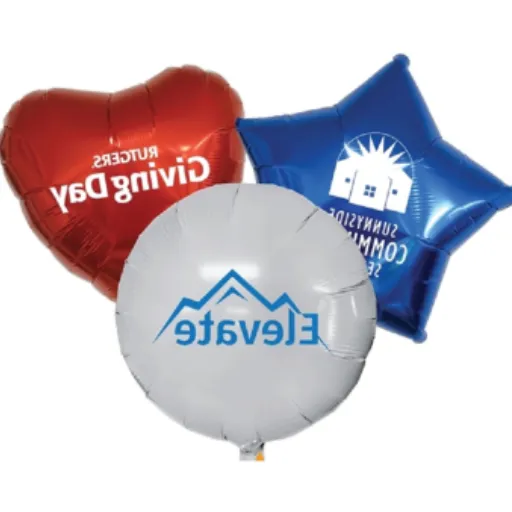
Metallized film conducts electricity, and that makes custom printed foil balloons a different safety problem from latex. A balloon that touches an overhead line, or drifts into a substation, can short equipment and cause outages, downed wires, or fire (Clark Public Utilities). The controls are non-negotiable. Weight every helium balloon, tether outdoor displays, never release outdoors, and puncture and bin every balloon at teardown.
Dana’s near miss. Dana planned an outdoor activation in a retail car park with 40 helium foil balloons on ribbons. The site walk two days before showed a service drop running directly over the display area. She moved the display under the store canopy, swapped the floating cluster for air-filled foil on a frame, and weighted every ribbon. The activation looked the same; the risk didn’t.
Certifications to request
Foil balloons sold as toys or children’s products fall under toy safety rules in most markets. In the EU that means EN 71-1 (with its balloon warning-label clause), EN 71-2 for flammability, EN 71-3 for heavy-metal migration, and REACH. In the US it means ASTM F963-23, mandatory through 16 CFR 1250, plus CPSIA.
Manufacturers commonly claim CE, UKCA, RoHS, SGS reports, BSCI audit, and ISO 9001. None are interchangeable, so ask for the report.
Choosing a Foil Balloon Manufacturer
A foil balloon manufacturer should send four things on request: the laminate specification, a certificate for each standard claimed, a leak-test record, and a physical pre-production sample. If any is missing, the certification is a logo, not a document.
Reuse, recycling, and honest eco claims
Foil balloons aren’t biodegradable and aren’t accepted in kerbside recycling. Councils advise a scrunch test to separate true aluminum foil from metallized plastic film, and metallized film fails it (Herefordshire Council). Foil is still reusable: deflate it carefully, store it flat, and it’ll serve another event. Our guide to reusing foil balloons covers the method.
Be skeptical of “biodegradable foil” marketing: some manufacturers offer PLA and PBAT film lines, but without a named film and a test report the claim is decoration. See biodegradable balloons and eco-friendly alternatives to foil balloons.
Frequently Asked Questions
Can you print on foil balloons?
Yes, and foil is the better surface for detailed printing because it doesn’t stretch. Full-color photographs, gradients, fine type, and small QR codes all reproduce cleanly. Supply images at 300 dpi at final size.
How much do custom printed foil balloons cost?
Published supplier pricing runs 0.20to0.20to0.58 per unit for stock shapes at 500 pieces, and 0.80to0.80to2.30 for custom silhouettes, excluding the die.
What is the minimum order for custom foil balloons?
Stock shapes start around 100 pieces. A new custom silhouette starts around 500, because a cutting die has to be built and tested. Book that tooling 60 to 90 days ahead of your event.
Do foil balloons float?
Yes, with helium. An 18-inch printed foil balloon floats three to seven days depending on film, fill purity, temperature, and valve quality. Air-filled foil stays inflated for one to two weeks but does not float.
Can you print photos on foil balloons?
Yes. Foil takes full-color photographic print better than latex because the surface doesn’t stretch. Supply images at 300 dpi at final size and approve a physical sample, since the metallic layer shifts color.
Can you print white on a metallic balloon?
Only with a white underprint. Metallic film shows through light ink, so white logos, pastels, and pale colors need an opaque white layer beneath them. Specify it on the artwork; it is not automatic.
What shapes can foil balloons be made in?
Stock shapes include round, heart, star, number, and letter. Custom silhouettes follow a product, mascot, or logo mark, provided the outline survives die cutting without thin necks or isolated detail.
Are foil balloons reusable or recyclable?
Reusable, yes: foil holds its shape after deflation, so it stores flat and refills later. Recyclable, no: it’s metallized plastic film, and most municipal programs exclude it. Puncture and bin every balloon at teardown.
Get a Custom Printed Foil Balloon Quote
Custom printed foil balloons are a specification decision before a design decision. Get the film, the die, the method, and the proof right, and the artwork takes care of itself.
- Foil is metallized plastic film, not aluminum. That drives print quality, float, and disposal.
- Stock shapes start around 100 pieces. A custom silhouette starts around 500 and needs 60 to 90 days of tooling.
- Approve a physical sample. Metallic substrates shift color, and a screen proof won’t catch it.
- Weight, tether, and retrieve. Metallized film conducts and isn’t recyclable.
Send the shape, quantity, color count, and event date, and we’ll come back with the film, the die situation, and a landed cost for your custom printed foil balloons. Request your custom printed foil balloon quote, or browse the custom logo foil balloons range to see finished work.