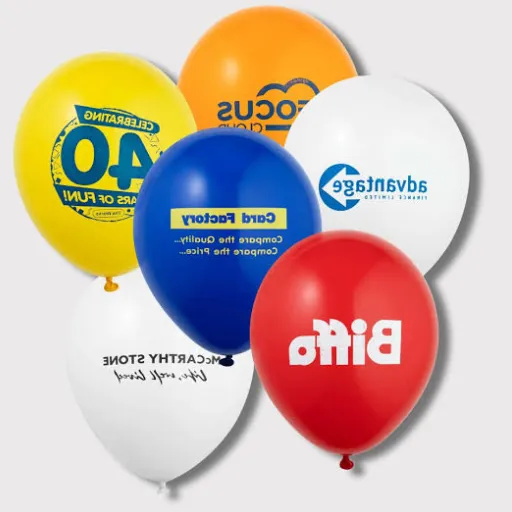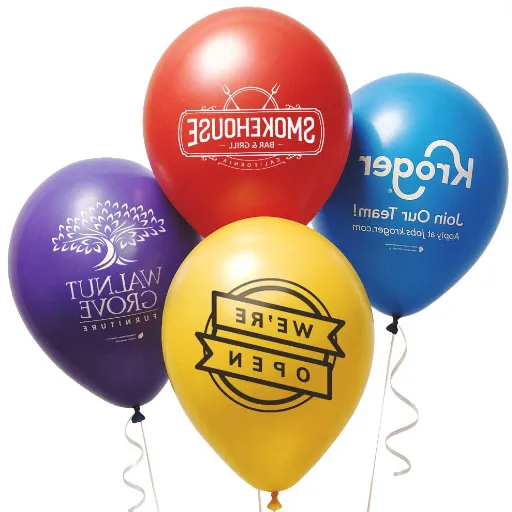

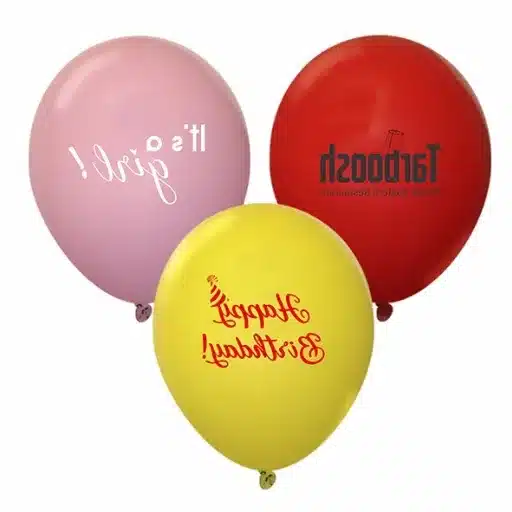
Yes, custom printed biodegradable balloons exist, and the balloon is the easy part. Natural latex is plant-based and biodegrades under the right conditions. The ink, the coating, and the sentence your marketing team wants to publish are three separate problems. One of them is now a legal question.
In June, a brand manager named Maya sent her printer a brief for “eco-friendly branded balloons.” The balloons arrived on natural latex, exactly as ordered. Then legal killed the campaign headline, because “eco-friendly” had quietly become a phrase a compliance team can’t sign off on.
Maya’s order was fine. Her sentence wasn’t. This guide separates the two, covering the inks that keep a custom printed biodegradable balloon honest, artwork for a surface that stretches 30%, realistic colour counts, and what you can claim in writing.
Key Takeaways
- Natural latex is the biodegradable part. The print is the variable. Water-based screen ink breaks down with the latex; metallic and glitter finishes interrupt breakdown.
- Balloons are printed flat and inflated round. An imprint quoted at 4 inches becomes about 5.25 inches on a 9-inch balloon, so artwork must be designed for the stretch.
- Colour count drives everything. One colour starts near 100 pieces; each added colour adds a screen, a setup charge, and a higher minimum order.
- From 27 September 2026, generic claims like “eco-friendly” are restricted in the EU unless substantiated. Say what you did, not how good you are.
- Biodegradable is not recyclable, and neither one means safe to release. Plan retrieval before you plan the print.
Want a real number instead of a range? Request a custom printed balloon quote with your artwork and quantity, and we’ll send pricing plus the ink specification for the exact product.
Are Custom Printed Balloons Biodegradable?
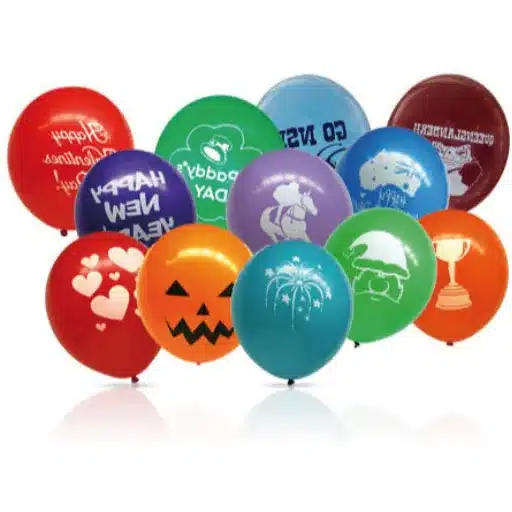
Partly, and the split matters. On any custom printed biodegradable balloon, the body is made from natural latex tapped from the Hevea brasiliensis rubber tree, which is renewable and biodegradable under the right conditions. The print is a separate material with its own end-of-life behaviour.
Water-based screen ink breaks down alongside the latex it sits on. Solvent-based inks, metallic foils, glitter sprays, and heavy gloss coatings don’t, and they can slow breakdown of the balloon underneath them.
That’s the whole decision in one paragraph. If the sustainability story matters to you, choose the ink as carefully as the balloon. For the material science, see are latex balloons biodegradable, and for the wider picture, our complete guide to biodegradable balloons.
One correction worth making early. Biodegradable is not recyclable. Municipal recycling doesn’t accept latex balloons, printed or plain, because they jam the sorting machinery. Our guide to disposing of balloons responsibly covers what to do after the event.
The Ink Is the Whole Story
The material is settled. The ink is where buyers get surprised.
Inks that break down with the latex
Water-based screen ink is the default for branded eco work, and it earns that position. It’s the ink behind most water-based ink balloons: it stretches without cracking and breaks down at a similar rate to the latex underneath. Screen printing also suits the material, because the balloon is printed flat and centred on its most stable surface.
For the full print and product picture, see our custom printed balloons guide.
Inks and finishes that work against you
- Metallic and foil coatings sit on top of the latex as a separate layer.
- Glitter sprays add particles that never break down.
- Heavy gloss coatings interrupt the surface microbes need to reach.
- Solvent-based inks are more durable, which is exactly why they linger.
A metallic finish photographs beautifully and survives handling. It simply costs you the claim you wanted to make.
The decision table
| Ink or finish | Breakdown impact | Colour range | Typical MOQ band | Best use |
|---|---|---|---|---|
| Water-based screen ink | Breaks down with the latex | 1 to 4 colours | From ~100 pcs | Branded eco campaigns |
| Solvent-based screen ink | Persists beyond the latex | 1 to 6 colours | From ~1,000 pcs | High-handling promotions |
| Gravure (full-colour) | Depends on the ink system | Full process colour | ~2,000+ pcs | Large runs, fine detail |
| Metallic or foil finish | Interrupts breakdown | Metallic palette | Varies by printer | Premium retail |
| Glitter or heavy gloss | Interrupts breakdown | Decorative only | Varies by printer | Avoid on eco jobs |
What to ask your printer for in writing
Treat the ink specification as a document, not a conversation. Ask for the ink type in writing, confirmation that it’s water-based if that’s your requirement, and a declaration covering cadmium, lead, phthalates, and polycyclic aromatic hydrocarbons.
Then ask the harder question. Request the certificate covering the printed finished product, not just the base balloon. Our guide to biodegradable balloon certifications explains how to read a real test report.
Designing Artwork for a Balloon That Stretches
Most print problems are design problems that were invisible on screen.
Printed flat, inflated round
A balloon is printed while flat and stretched when filled. On custom printed latex balloons the imprint grows with it, by roughly 25 to 30% in each direction.
| Balloon size | Imprint quoted flat | Approximate size inflated | Note |
|---|---|---|---|
| 9″ round | 4″ | ~5.25″ | The small-format workhorse |
| 11″ round | 4.5″ | ~5.75″ | The most common branded size |
| 36″ giant | 15″ × 15″ | Larger still | Statement and photo pieces |
Two consequences follow. Fine hairlines and small type thin as they stretch, so anything under a few millimetres of stroke weight is a gamble. And a design that fills the whole imprint area runs into curved edges once inflated.
Safe zones and colour on colour
Keep the message centred and let the edges breathe. The centre of a latex balloon is the most stable print surface; the outer thirds curve away and distort first.
Printing on coloured latex isn’t printing on white paper. White ink on a dark balloon needs enough coverage to stay opaque, and a Pantone match on a coloured balloon is a range, not a promise. If your brand colour is exact, test it on your chosen balloon colour before committing to a run. Colour drift is the most common complaint we see, and it’s avoidable at the sample stage.
Design rules that also protect the eco story
- Use fewer colours, or simple gradients rather than photographic detail.
- Leave out glitter sprays, foil coatings, and decorative fringe.
- Choose solid tones and neutral palettes that look intentional.
- Put one clear logo across a group of balloons instead of crowding each one.
None of that is a compromise. A single confident logo on a clean balloon outperforms a busy print almost every time, and it’s the version that biodegrades.
Custom Printed Biodegradable Balloons: Colours, Setup, and Minimums
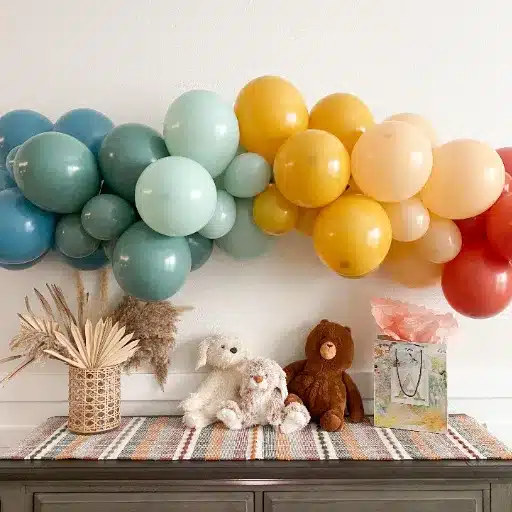
Design ambition meets order economics here, and this is where budgets get reworked.
The screen-count economics
Each colour needs its own screen and setup. The first colour is the cheapest you will ever pay for; every colour after it adds a setup charge and pushes the minimum order up. A five-colour design isn’t five times one colour. It’s a bigger run, a bigger setup, and a bigger risk if the proof is wrong.
The MOQ table
Suppliers quote minimum order quantities in different currencies, which makes comparison harder than it needs to be. Convert everything to pieces before you decide. For biodegradable balloons with logo artwork, the minimum is set by colour count, not by order value.
| Design | Typical minimum | Why |
|---|---|---|
| 1 colour, 1 side | From ~100 pieces | Single screen and setup |
| Second side or added colour | ~1,000 pieces | Additional screen and alignment |
| 4 or more colours | ~5,000 pieces | Multiple screens, higher setup |
| Gravure full-colour | ~2,000 pieces | Justified by run length |
| Some printed latex lines | Up to 50,000 pieces | Per-design plate economics |
Priya learned this the expensive way. Her agency approved a five-colour design for a client’s product launch, then found the minimum sat at 5,000 pieces for a campaign that needed 800. Redesigning to two colours took a morning and saved most of the budget. The lesson wasn’t that five colours are wrong. It was that colour count is a budget decision, not a design decision.
Price bands and lead times
Published market pricing for custom printed latex balloons sits in wide bands, because it depends on size, colour count, sides printed, ink type, and quantity. Representative ladders from the promotional market run from about £0.85 per balloon at 100 pieces down to roughly £0.11 at 5,000 for small-format screen print, and from around 0.31at1,000piecestoabout0.31at1,000piecestoabout0.15 at 20,000 for a 12-inch one-colour design.
Treat those as bands, not quotations. Unit price without the ink and finish specification isn’t comparable. For plain-latex economics, our wholesale latex balloons guide covers it in full.
Straightforward screen printing runs in 5 to 10 working days from artwork approval. More colours extend that to around three weeks, and gravure work can take two months or more. Printed latex also carries a shelf life of about one year, so order for the campaign, not the warehouse.
Ready to test before you commit? See how our custom balloon production line handles branded orders, or start with a sample pack.
Campaign Planning: Making a Printed Balloon Work
A custom printed biodegradable balloon is a marketing asset with a short life and a specific job. Plan both.
Quantity by use
- Giveaways need high volume at low unit cost, usually one colour and one size.
- Display clusters need a size mix, because uniform balloons read as flat.
- Arches and installations need small fillers and large statement balloons.
Sketch the installation before you order. Adding 5-inch fillers to a quotation is far cheaper than discovering you ordered 300 of the wrong size.
Size mix and float
Not every balloon floats. Helium-filled balloons are the ones guests remember, and the expensive ones. Air-filled balloons carry a display at a fraction of the cost, which matters given current helium supply.
Ink adds weight, so heavy coverage on a large helium balloon slightly reduces lift. A quality 12-inch latex balloon holds helium for roughly 12 to 18 hours untreated. Build the float plan into the campaign brief, not the event-day checklist.
Print that gets scanned and read
A balloon is a curved, moving, stretching surface, which limits print.
- Keep the message short enough to read from a few metres away.
- If you use a QR code, test it on an inflated balloon at the actual distance.
- Choose one call to action. Two competing messages on a curved surface means neither gets read.
Retrieval and reuse
This is the step that makes the eco claim true after the event, not only at the point of sale. Decide who takes the balloons down and where they go. Anchored displays are far easier to retrieve than a loose ceiling release, and retrieval separates a responsible campaign from a decorated one.
Sustainable Balloon Branding Without Greenwashing
This is the part you won’t find on a product page, and it has the shortest deadline.
What changed on 27 September 2026
The EU’s Empowering Consumers for the Green Transition Directive, Directive (EU) 2024/825, amends the Unfair Commercial Practices Directive and applies from 27 September 2026 with no transition period. It blacklists generic environmental claims such as “eco-friendly,” “green,” “natural,” “biodegradable,” and “climate friendly” unless the trader substantiates them or qualifies them clearly and prominently on the same medium.
It also prohibits claims that a product is neutral, reduced, or positive on environmental impact purely because of offsetting, and it bans self-created sustainability labels. It applies to any trader selling to EU consumers, wherever that trader is based, which reaches non-EU brands whose agency-supplied claims end up in consumer marketing.
Enforcement happens at national level, and in Germany and Austria it is substantially private. In practice, a competitor can seek an injunction. This is not a fine-print risk; it is a marketing-copy risk. The European Commission’s official directive text is the primary source, and Latham & Watkins has a practical summary for businesses.
Say this, not that
The fix isn’t to stop talking about sustainability. It’s to describe what you did.
| Avoid | Say instead |
|---|---|
| “Eco-friendly balloons” | “Printed with water-based inks on 100% natural latex” |
| “Biodegradable balloons,” unqualified | “Natural latex balloons, which biodegrade under the right conditions” |
| “Carbon neutral promotional gifts” | “This campaign uses no offsetting” |
| A self-designed green badge | A recognised third-party certification, named |
| “Sustainable branding partner” | “We print on natural latex with water-based inks and provide the certificate” |
Notice the pattern. Every safe version names a material, a process, or a document. Every risky version names a feeling.
The verification trail your claim rests on
A claim is only as strong as the paperwork behind it. Keep three things in one folder: the ink specification, the certification covering the printed finished product, and the record of where the latex came from.
If a supplier can’t produce the certificate in their own company name covering the printed product, your claim has no foundation. That’s worth knowing before you publish, not after. Castle Balloons makes the related design point in its guide to balloon design for eco-conscious events, and Wisa publishes the compliance detail most of the category leaves out.
Why we would rather tell you this than sell you a slogan
We manufacture printed and plain balloons, so we benefit when you order. We benefit more when you order something that holds up to scrutiny.
Our own product claim is small: natural latex body, water-based ink where you ask for it, documentation on request. It’s a shorter sentence than the eco-friendly printed balloons pitch most of our category uses, and it’s one we can defend.
Which Buyer Are You?
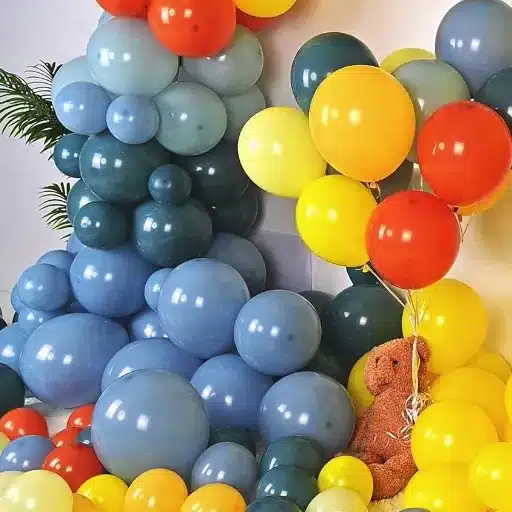
Brand or agency. Your priorities are claim compliance, artwork standards, and sign-off discipline. Put the ink type and the sustainability language in the creative brief before the first proof. Approve a physical proof on your chosen balloon colour.
Event company or decorator. Your priorities are batch consistency, float planning, and retrieval logistics. Ask how they guarantee colour matching across batches, because a reorder six weeks later must match the first.
Retailer, NGO, or charity. Your priorities are smaller volumes and honest messaging. Tomás, who runs a small wildlife charity, planned an anchored display instead of a release and photographed the retrieval. That post outperformed every previous campaign, precisely because it showed what happened to the balloons.
Ready to order? Send us your artwork and the claim you want to make. We’ll tell you what’s achievable, what it costs, and what you can honestly say.
Custom Printed Biodegradable Balloons: FAQ
Are custom printed balloons biodegradable?
The balloon body is. Natural latex biodegrades under the right conditions, and water-based screen ink breaks down alongside it. Metallic, glitter, and heavy gloss finishes don’t, and can slow breakdown of the latex beneath them.
What ink is used on biodegradable balloons?
Water-based screen ink. It stretches with the balloon without cracking and breaks down at a similar rate to the latex. Solvent-based inks are more durable but persist far longer.
Can you print a full-colour logo on a latex balloon?
Yes, but not affordably at low volume. Screen printing handles one to four colours well. Full process colour requires gravure printing and minimum orders in the thousands.
Do printed balloons float, and for how long?
They do. Ink adds weight, so heavy coverage slightly reduces lift on large helium balloons. A quality 12-inch latex balloon holds helium for roughly 12 to 18 hours untreated.
What is the minimum order for custom printed biodegradable balloons?
Single-colour printing can start near 100 pieces. A second side or added colour typically requires around 1,000 pieces, and four or more colours around 5,000.
Are printed balloons recyclable?
No. Municipal recycling doesn’t accept latex balloons, printed or plain, because they jam sorting equipment. Biodegradable and recyclable are different properties, and neither means a balloon is safe to release.
Can I say my branded balloons are eco-friendly?
Be careful. Generic claims like “eco-friendly” are restricted under EU rules applying from 27 September 2026 unless you can substantiate them. Describe what you did: water-based inks on natural latex.
What file format do I need for balloon printing?
Vector artwork, typically EPS or AI, scales without losing definition. Layered files help when a printer must separate colours for screen print.
The Short Version
Custom printed biodegradable balloons come down to four decisions. Choose the material, which is settled: natural latex. Choose the ink and finish, which is where the eco story is won or lost. Choose the colour count, which sets your setup cost and your minimum order. And choose your words, which are now regulated.
Get those four right and you’ve got a campaign you can defend in a meeting, in a search result, and in front of a regulator.
Start with one colour, a physical proof on your chosen balloon colour, and the ink specification in writing. Those three steps cost very little and prevent almost every problem described in this guide.
Then write the sentence only after the paperwork is in the folder. Talk to our custom print team about your artwork, your quantity, and the claim you want to make, and we’ll tell you honestly which parts are achievable.