

Biodegradable balloons are most often made from natural latex tapped from rubber trees, and yes, that material can break down in the environment. The catch is that independent science shows real-world decomposition is slow and unpredictable, so the honest answer is that “biodegradable” describes what a balloon is made of, not a guarantee about how fast it disappears after a party.
That distinction matters more than ever in 2026. Retailers call their latex “eco-friendly,” conservation groups call the label greenwashing, and a wave of news coverage about a new fully biodegradable balloon from Imperial College London has confused the market even further. Buyers are stuck trying to shop responsibly with contradictory claims and no trusted source in between.
This guide sorts it out. You will learn what biodegradable balloons are actually made of, how long they really take to decompose in different environments, which certifications prove a real claim, how the law treats balloon releases, and exactly how to choose and buy natural latex balloons responsibly for a party, an event, or a business.
Key Takeaways
- Most biodegradable balloons are natural latex from the Hevea brasiliensis rubber tree; foil and Mylar balloons are metalized plastic and are not biodegradable
- A 2020 University of Tasmania study found latex balloons showed little to no degradation over 16 weeks in freshwater, saltwater, and even industrial compost, which contradicts decades of marketing claims
- The famous “degrades like an oak leaf” claim traces back to an un-peer-reviewed 1989 industry study based on six balloons
- Certifications like ASTM D6866 biobased content and FSC rubber sourcing are how you verify a genuine claim; a marketing label alone proves nothing
- Balloon release bans are spreading (Louisiana in August 2026, Connecticut in May 2026, and others), so responsible use means anchored displays and proper disposal, never release
What Are Biodegradable Balloons?
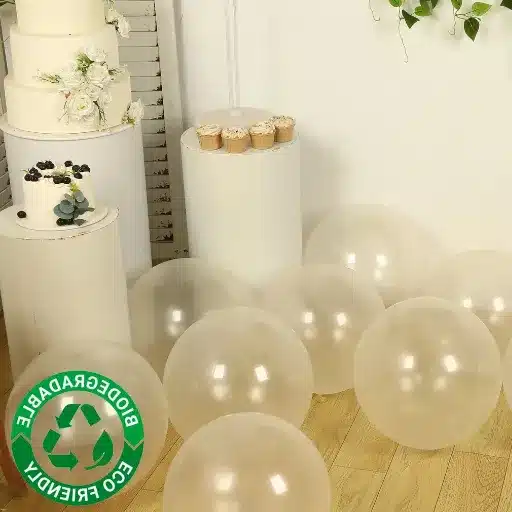
A biodegradable balloon is a balloon made from a material that microorganisms can break down into natural compounds over time. In practice, nearly every balloon sold as biodegradable is made from natural latex, a milky sap harvested from the Hevea brasiliensis rubber tree, the same renewable source used for natural rubber gloves and elastic bands. Manufacturers dip balloon-shaped forms into the latex, cure them in ovens, and add colorants and a small amount of processing chemicals along the way.
Natural latex is genuinely plant-based and renewable. That puts it in a different category from foil or Mylar balloons, which are thin sheets of metalized plastic that do not biodegrade at all, and from synthetic latex, which is made from petroleum-derived polymers. When people search for biodegradable balloons, they are almost always looking for high-quality natural latex, and for good reason.
The phrase “biodegradable” itself needs a reality check. In materials science, biodegradable means a material can be broken down by microorganisms given the right conditions. It does not mean the item disappears quickly, and it does not mean it is harmless to litter. A paper cup is biodegradable in theory, but you would still not toss one into a lake. The same logic applies to balloons, and that distinction is the heart of this guide.
For example, eco-conscious shoppers often assume any latex balloon will vanish within months. In a sunny backyard compost pile with constant moisture and active microbes, a thin piece of natural latex can start to break down within that kind of window. But in cool water, in a dry landfill, or even in an industrial compost windrow, the evidence says something very different, as the next section explains.
[Image: a natural latex balloon being inflated beside its raw material source, a tapped rubber tree]
Are Biodegradable Balloons Really Biodegradable?
The direct answer: natural latex is biodegradable in principle, but the rate depends heavily on the environment, and independent testing shows it can persist far longer than the marketing suggests.
The most cited evidence comes from researchers at the University of Tasmania‘s Institute for Marine and Antarctic Studies. They placed latex balloons, including ones labeled biodegradable, into freshwater, saltwater, and industrial compost windrows and measured them every two weeks for 16 weeks. The findings, published in the Journal of Hazardous Materials, were striking: the balloons largely kept their shape and size in every environment. Composted balloons lost only about 1 to 2 percent of their mass, and some balloons in freshwater actually gained mass. When the researchers dug balloons out of a commercial compost heap at the end of the study, they reported finding them essentially unscathed, knots still intact.
That study did not prove latex never breaks down. It proved that 16 weeks is nowhere near enough time in realistic conditions, even in a system built to accelerate decomposition. Scientists and conservation groups point to even longer persistence in the wild. Balloons Blow, an advocacy group, reported balloons that stayed intact for seven years in an outdoor exposure test, and the Marine Conservation Society states that latex can last up to four years in the marine environment. Some researchers estimate that under certain conditions, a balloon could take 15 years or more to fully degrade.
Now here is the uncomfortable part for the industry. The claim that balloons degrade “as fast as an oak leaf” comes from a 1989 study by Don Burchette, who wrote it as a technical adviser for the balloon industry’s own trade body. It was published with support from a rubber-industry organization, was never peer-reviewed, involved just six balloons, and its methods were never made fully repeatable. Yet that single study has been quoted for three decades as if it were settled fact.
The science camp has a point, and so does the honest side of the industry. Natural latex is a renewable, plant-based material, and it does break down eventually under the right conditions, which is far better than a foil balloon that will sit in the environment essentially forever. The error is treating “biodegradable” as permission to release or discard balloons carelessly. A better mental model: biodegradable describes the material, while responsible disposal is the behavior. They are not the same thing.
How Long Do Balloons Take to Decompose by Environment?
There is no single number, because breakdown depends on oxygen, moisture, temperature, UV exposure, and the presence of microbes, plus the thickness of the latex and any inks or coatings added during printing. Here is what the evidence suggests for natural latex in different settings.
| Environment | What the evidence shows for natural latex | Notes |
|---|---|---|
| Active backyard compost | Fastest realistic option; can break down in months in warm, moist, microbe-rich conditions | Balloons must be popped and cut; full breakdown still varies |
| Sunny open ground / soil | Can degrade over months to years depending on climate and UV | Surface exposure to sunlight speeds cracking |
| Freshwater (rivers, lakes) | Little measurable loss in the 16-week UTAS study; some balloons gained mass | Cold, low-oxygen water slows microbes dramatically |
| Saltwater (ocean) | Little measurable loss in the 16-week study; latex can persist up to ~4 years per the Marine Conservation Society | Mistaken for jellyfish by turtles and seabirds |
| Landfill | Extremely slow; can persist for years | Landfills are designed to limit oxygen, water, and microbes |
| Industrial compost | Only 1-2% mass loss after 16 weeks in the UTAS trial | Even optimized systems did not break balloons down quickly |
A few practical takeaways come out of this table. Sunlight and heat are the biggest accelerants, which is why a balloon left in a sunny yard weathers faster than one buried in cool soil. Foil and Mylar balloons do not biodegrade at all; they physically break into smaller plastic fragments over time. And an inflated balloon that rises high enough can freeze and shatter into tiny pieces at altitude, which is why the “they burst up high” argument exists, but researchers estimate that a meaningful share of released balloons, roughly 5 to 13 percent by some estimates, comes back down largely intact.
When Marcus, an event planner in Ohio, read these numbers for the first time, it changed how he pitched eco-friendly decor. He had been telling wedding clients that latex balloons “just break down, no worries,” and one bride who worked in marine biology gently corrected him with the UTAS study. Rather than argue, he switched his pitch to anchored natural latex displays with a documented disposal plan, and he now leads with that honesty. His clients trust him more, and his proposals stand out against decorators who overpromise.
[YouTube embed: an authoritative explainer on latex balloon degradation and responsible disposal]
Biodegradable vs Foil vs Synthetic Latex
Part of choosing biodegradable balloons is understanding what they are not. The comparison matters because a lot of the environmental harm attributed to balloons comes from the non-biodegradable types.
| Material | Source | Biodegradable? | Wildlife/infrastructure risk |
|---|---|---|---|
| Natural latex | Rubber tree sap | Yes, in principle, slowly and only under certain conditions | Can be mistaken for food while it persists |
| Foil / Mylar | Metallized plastic film | No; never fully breaks down | Major cause of power outages; entangles and is ingested |
| Synthetic latex | Petroleum-based polymers | No | Persists like plastic |
| Balloons with added coatings | Varies | Reduced by inks, glitters, and plastic liners | Added materials slow breakdown |
Foil balloons are the clearest problem. They conduct electricity, which is why utility companies blame them for power outages every year, and they are made from layers of plastic that do not degrade. A foil balloon is a small piece of permanent litter. Natural latex is the more responsible choice for anyone who wants balloons at all, but it still must be used and disposed of properly. Synthetic latex and heavily coated or glitter-filled balloons fall between the two and are best avoided if you care about end-of-life impact.
For a deeper look at how the materials compare across decomposition, recycling, and wildlife risk, our latex vs foil balloons guide walks through the full comparison.
Certifications and Standards: How to Verify a Real Claim
The word “biodegradable” on a package is a marketing claim, not a measurement. Anyone can print it. The way to separate a genuine natural latex balloon from a greenwashed one is to look for third-party certifications and to ask for test documents.
Certifications That Matter
- ASTM D6866 (biobased content): measures the amount of carbon in a product that comes from renewable biological sources. Balloons certified under ASTM D6866, often validated by UL with an Environmental Claim Validation mark, can show 100 percent biobased content, which confirms the material is genuinely plant-derived latex rather than synthetic.
- FSC (Forest Stewardship Council): certifies that the rubber was harvested from responsibly managed sources and that the supply chain is traceable. European manufacturers such as Gemar carry FSC Chain of Custody certification, which is a strong signal for sustainable sourcing.
- EN 71 / CE toy safety: confirms the balloons meet safety limits for heavy metals and other regulated substances in the European market. This is separate from biodegradability but matters for quality and for selling to children’s events.
- Nitrosamine and additive limits: latex balloons are vulcanized with sulfur and processing chemicals, and responsible manufacturers control for nitrosamines and heavy-metal accelerators. If a supplier can share a compounding or migration test report, that is a meaningful quality signal.
Red Flags to Watch For
- A label that says biodegradable with no certification mark and no test report behind it.
- Claims that every balloon “degrades like an oak leaf” or disappears within weeks, unsupported by any independent study.
- No answer when you ask for the ASTM D6866 certificate or the compounding test report.
- Balloons described as biodegradable that include glitter, plastic liners, or foil layers, since those additions defeat the purpose.
Priya runs a small party-supply store and wanted to stock “eco” balloons for a growing number of green-conscious customers. Two distributors both claimed their balloons were biodegradable. One sent a one-page sell sheet. The other sent an ASTM D6866 certificate, an FSC sourcing document, and a compounding test report within a day. Priya chose the second supplier, added a small note to her product pages explaining what the certifications meant, and her store became the one local shops recommend for genuinely sustainable supplies. That is the difference a document trail makes.
Want to see exactly which documents to request before you buy in bulk? Our wholesale latex balloons guide includes a ready-to-use verification checklist for buyers.
[Image: a sample ASTM D6866 / UL Environmental Claim Validation certificate]
Balloon Releases and the Law
If you have ever considered a balloon release for a memorial, a gender reveal, a graduation, or a company stunt, stop and check the law first, because it is changing fast.
In August 2026, Louisiana’s Act 196 took effect, making the intentional outdoor release of 12 or more balloons a violation of the state’s litter law. First offenses carry a $500 fine and 8 hours of community service, and repeated offenses escalate to a $2,500 fine, 80 hours of community service, and a one-year driver’s license suspension. Louisiana lawmakers acted after Mylar balloons caused power outages and after livestock and wildlife were found harmed by balloon debris.
Louisiana is not alone. Connecticut became the sixth state to ban lighter-than-air balloon releases in May 2026, joining Florida, Hawaii, Maryland, Delaware, and Virginia. Virginia imposes a civil penalty of $25 per balloon and has seen measurable drops in balloon litter along its coast since the law took effect. Municipalities across the country and countries like the United Kingdom and Australia have their own restrictions.
There is an important trap buried in some of these laws. Several exempt biodegradable or photodegradable balloons from the release ban itself, which sounds like a green light. It is not. The exemption means those materials are not the target of the litter law, but intentional outdoor release is still prohibited, and conservation groups point out that a biodegradable balloon can still harm wildlife while it persists. Marine animals actively mistake burst latex for jellyfish, and the 2019 seabird research found that balloons are among the deadliest forms of plastic debris for seabirds, with a mortality risk roughly 32 times higher than ingesting hard plastic fragments.
The responsible position, and the one we take as a manufacturer, is simple: never release balloons outdoors. Use them indoors or anchored to weights and stands, and dispose of them properly after the event. If you are planning a memorial or celebration that traditionally involved a release, our guide to alternatives to balloon releases offers dozens of meaningful, wildlife-safe ideas, from planting trees to releasing bubbles.
How to Dispose of Balloons Responsibly
Responsible disposal is where “biodegradable” stops being a marketing word and becomes a real behavior. It takes about thirty seconds per balloon.
- Pop the balloon rather than letting it deflate slowly, so it does not drift and become litter.
- Cut the neck and any attached ribbon or string so nothing can wrap around an animal.
- Put the pieces in the trash. Do not put them in recycling; balloons jam sorting machinery and contaminate recycling streams.
- Separate ribbons, clips, weights, and any foil or plastic attachments, since those have different end-of-life paths.
- Never release balloons outdoors, whether they are labeled biodegradable or not.
Can you compost natural latex at home? Technically yes, if you pop and cut the balloons and add them to an active, warm, moist pile, they can break down over months. In practice, most home compost piles are too cool or too dry to do the job quickly, and many municipal composters will not accept balloons at all. If you want to try, treat balloons as a small experiment in a healthy pile rather than a reliable disposal method. The safest, most honest instruction is still the same as any responsible brand: use them, pop them, cut them, and bin them.
A recent biodegradable balloon might still carry traces of ink or coating, and printed balloons are best treated the same way. Our guide on how to dispose of balloons responsibly goes deeper into composting caveats and the exact steps for separating ribbons, clips, and weights.
How to Buy Biodegradable Balloons for Your Business
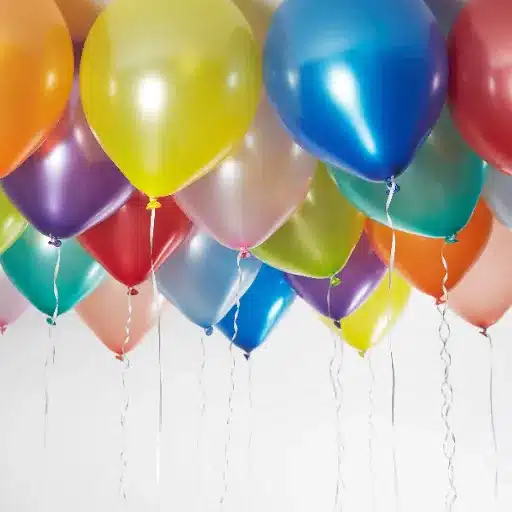
For retailers, event companies, and distributors, buying biodegradable balloons responsibly is a sourcing decision, not just a shopping decision. You are choosing a supplier you can vouch for, which means you should verify claims the way you would audit any material spec.
What to Request From Any Supplier
- Third-party test reports for decomposition and compounding, not a one-page brochure.
- The ASTM D6866 biobased certificate if the claim is that the latex is genuinely plant-derived.
- FSC or equivalent sourcing documentation if you need traceable, responsible rubber.
- Consistent quality across batches and colors, because wall thickness and color stability affect float time and durability.
- Custom printing with water-based inks when you need branded balloons, since solvent inks can interfere with the material’s end-of-life behavior.
- Clear MOQ, lead time, and a sample-before-bulk protocol so you can verify quality before committing.
Ask for samples and test them. Inflate a batch, compare float times, check for weak spots, and request the documentation before you place a large order. A supplier who cannot produce certification documents for a “certified” claim is telling you everything you need to know.
Sofia, who runs a regional event-styling company, built this into her vendor policy after a client’s sustainability officer asked for proof that her “biodegradable” arches were what the invoice claimed. Sofia now keeps a digital folder for every balloon supplier with their certificates and test reports, and she sends it to clients who ask. The folder has won her two corporate contracts over lower-priced competitors, because companies with public sustainability commitments will pay for verifiable claims.
For corporate and brand work, custom printed balloons on natural latex let you carry a logo or message while keeping the material responsible, but the ink matters. Our custom printed biodegradable balloons guide covers water-based inks, design limits on latex, and how to talk about your sustainability choice without overstating it.
The Future: Toward Truly Degradable Balloons
The honest-science story is not static. In August 2026, researchers at Imperial College London announced a material they call Bioloon, which they say is a fully biodegradable balloon that breaks down in about nine months across soil, seawater, and fresh water, without the sulfur vulcanization additives that slow natural latex decomposition. The team behind it plans to bring it to market within about two years at a price comparable to standard balloons.
That development is genuinely encouraging, and it also proves a point worth stating plainly: if a genuinely fast-degrading balloon requires new chemistry, then today’s standard latex balloons do not disappear quickly on their own. The industry’s old assurances were always too good to be true. What Bioloon and similar research show is that the market is finally moving toward materials that match the marketing.
Until those products arrive, the responsible path is the one we have described: choose natural latex from a verifiable supplier, use it anchored and indoors, dispose of it properly, and never release it. That is how you celebrate with balloons today without passing the cost on to wildlife or the landscape.
FAQ
Are biodegradable balloons actually biodegradable?
Natural latex is biodegradable in principle, but independent testing shows real-world decomposition is slow and environment-dependent. A 2020 University of Tasmania study found latex balloons showed little degradation over 16 weeks in freshwater, saltwater, and industrial compost.
What are biodegradable balloons made of?
Nearly all are made from natural latex, a renewable sap tapped from the Hevea brasiliensis rubber tree. Foil and Mylar balloons are metalized plastic and are not biodegradable.
How long do balloons take to decompose?
There is no single answer. Natural latex can break down in months in an active, sunny compost pile, but it can persist for years in water, soil, or landfill. Foil balloons never fully biodegrade.
Are balloons compostable?
Natural latex can compost slowly in a warm, active pile if popped and cut, but most home piles are not hot enough to do it quickly, and many municipal composters reject balloons. The safest disposal is popping, cutting, and binning.
Are foil balloons biodegradable?
No. Foil and Mylar balloons are metalized plastic and do not biodegrade. They are also the type most often linked to power outages.
Is a balloon release illegal?
It depends where you live, and the list is growing. Louisiana banned releases of 12 or more balloons in August 2026, Connecticut followed in May 2026, and several other states and municipalities restrict or ban releases.
Are biodegradable balloons safe to release?
No. Even biodegradable balloons persist long enough to harm wildlife, and most release laws restrict intentional outdoor releases regardless of material. Never release balloons outdoors.
Where can I buy biodegradable balloons responsibly?
Buy natural latex from a supplier that can provide ASTM D6866 biobased certification, FSC sourcing documents, and third-party test reports. For volume orders, request samples before you commit.
Conclusion
Biodegradable balloons are a real product made from a real renewable material, but they come with real caveats that marketing too often hides. Natural latex can break down, yet independent science shows it happens slowly and only under the right conditions. The “oak leaf” claim was never peer-reviewed. Foil and Mylar balloons are the true environmental problem, yet latex still must be used responsibly. Release bans are spreading, so anchored, indoor use and proper disposal are the only honest way forward. And when you buy, certifications like ASTM D6866 and FSC are how you verify that a claim is real.
The good news is that responsible use is fully compatible with spectacular events. You can build a gorgeous natural latex arch for a wedding, a crisp balloon wall for a product launch, or a cheerful bouquet for a birthday, keep it anchored indoors, and dispose of it in thirty seconds afterward. You get the joy of balloons without the guilt, and you can tell your guests exactly why your choice was responsible, because you verified it.
If you are planning an event or stocking a business, we would love to help you choose certified natural latex balloons with the documentation to back them up. Contact our team for wholesale pricing, custom printing with water-based inks, and guidance on sourcing biodegradable balloons you can feel good about.
Trading Shanxi Co., Ltd. is a balloon manufacturer and supplier. We write honestly about balloon materials because we believe verifiable quality beats marketing claims, and because celebrations should not cost the planet.