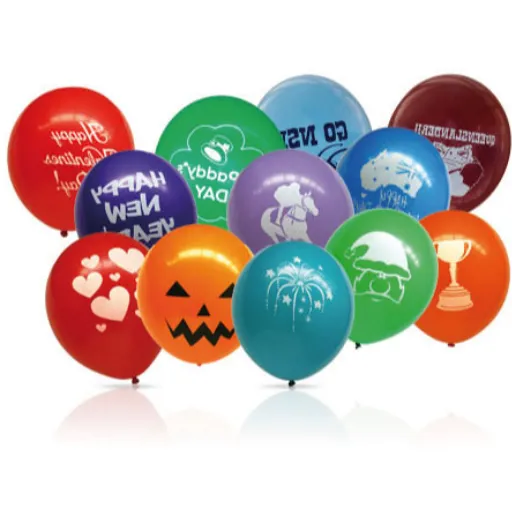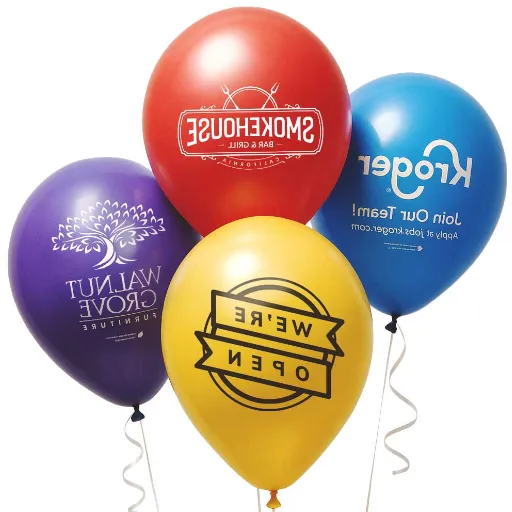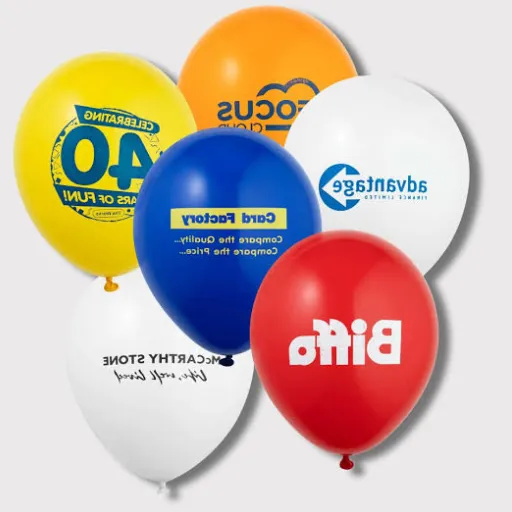

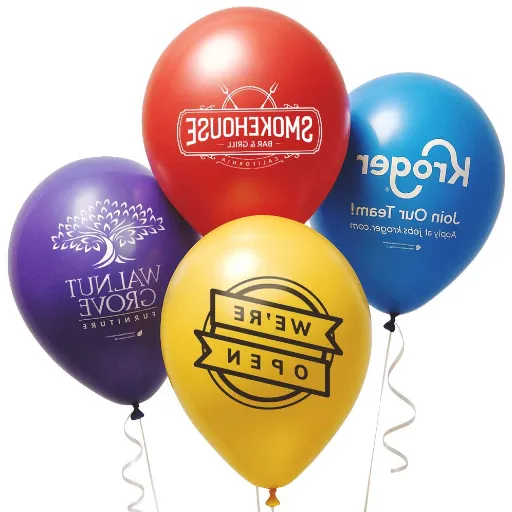
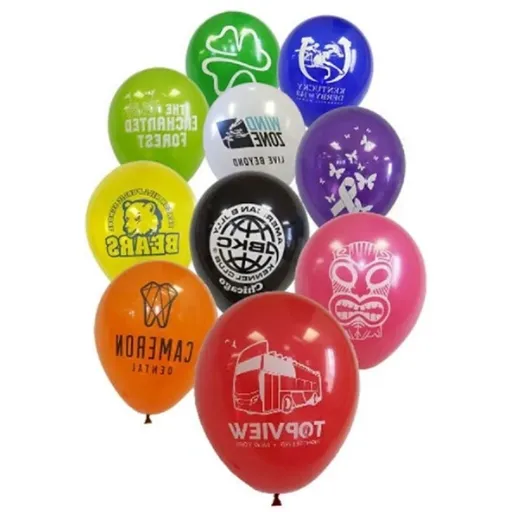
Custom printed balloons wholesale starts at roughly 100 to 250 pieces for one-color latex and climbs to 5,000 or more for multi-color, double-sided, or gravure printing. The per-unit price falls fast with volume, but the number that decides your margin is landed cost per sellable balloon, not the figure on the first line of the quote.
A supplier quotes you $0.28 per balloon. By the time the carton reaches your warehouse, the real cost is closer to $0.42. Nothing dishonest happened. Setup was billed separately, freight was estimated, duty was excluded, and 8% of the run failed inspection.
You’ve probably seen two suppliers quote the same balloon at prices that don’t line up. That’s because wholesale pricing is a cost structure, not a discount.
This guide breaks down the five numbers that decide whether a custom printed balloons wholesale order makes money: unit price, setup, freight, duty, and defect rate. It also covers MOQ tiers, supplier models, compliance documents, private label, and the order-by calendar that keeps a container from arriving after the season.
Trading Shanxi prints latex and foil balloons in-house for distributors, retailers, and promotional buyers in more than 50 countries. If you already have a spec, request a wholesale quote and we will price it. If you are still building the number, read on.
Key Takeaways
- Wholesale pricing has four layers: balloon, setup, freight, and duty. Compare landed cost per sellable unit, not unit price.
- MOQ rises with color count and sides. One color starts at 100 to 250 pieces; four colors or double-sided print pushes the minimum to 1,000 to 5,000.
- Setup is a fixed cost. At 100 pieces it can be a third of the order; at 5,000 it nearly disappears.
- Compliance is a document set, not a badge. Ask for EN 71 and ASTM test reports plus a CPC or Declaration of Conformity.
- The order-by date is set by production plus freight. Book Q4 by August and spring orders before Chinese New Year.
The buyer scenarios in this guide are illustrative composites based on typical wholesale orders, not named customers.
What Wholesale Means for Custom Printed Balloons

Custom printed balloons wholesale is the purchase of logo, message, or photo printed balloons in production quantities for resale or distribution. Orders usually start at 100 to 250 pieces for one-color latex and reach 5,000 or more for multi-color, double-sided, or gravure work. Price depends on material, color count, sides, quantity, and delivery terms.
Wholesale printed balloons aren’t a retail pack with a discount. They’re a production run with their own economics. A distributor buys to stock, a promo distributor buys to fill a client order, a retailer buys to build a store brand, and a decorator buys to finish a project. Each one needs a different mix of price, speed, and customization.
The wholesale custom balloons market breaks into six buyer types.
| Buyer | Typical order | What decides the order |
|---|---|---|
| Importer or distributor | 5,000 to 100,000+ | Landed cost, MOQ, certifications, reorder consistency |
| Promotional distributor | 250 to 5,000 | Proof speed, imprint quality, margin after commission |
| Party retailer | 1,000 to 20,000 | Packaging, barcodes, sell-through, seasonality |
| Decorator or event company | 250 to 2,000 | Color match, float performance, delivery date |
| Online seller | 500 to 5,000 | Defect rate, FBA prep, cash flow |
| Brand or corporate buyer | 500 to 10,000 | Pantone match, compliance, reprint policy |
Most buyers work with a factory, an importer or distributor, or a domestic printer. The supplier section below compares all five models, including trading companies and marketplaces.
One distinction matters before you request pricing. Blank latex bought in bulk is a stock purchase. Printed latex is a production order.
If you are sourcing unprinted stock, start with our guide to wholesale blank latex balloons. If you need your logo or message on the balloon, you are in the right place.
For the full product decision behind the print, including latex versus foil and artwork specs, see the complete custom printed balloons guide.
Custom Printed Balloons Wholesale: How Pricing Works
Every wholesale quote contains four cost layers. Suppliers often show only the first one.
- The balloon. Material, size, and gram weight. A 12-inch latex balloon should weigh about 2.8 to 3.2 grams. Budget stock at 2.2 to 2.5 grams costs less and fails more.
- The setup. A screen, plate, or cylinder for each color and each side. This is a fixed cost per design, not per balloon.
- The print run. Labor, ink, drying, inspection, and packaging. This is where volume lowers the unit cost.
- Freight and duty. Air or sea, DDP or FOB, plus tariff and customs clearance. This is the layer most buyers underestimate.
Setup and plate fees, explained
Each color needs its own screen on latex or its own cylinder on gravure. Each side needs a separate pass. That is why a two-color, double-sided order carries four setup charges, not one.
Logo Balloons in Canada publishes the breakdown: CAD 47 for an ink change, CAD 45 for PMS color matching, CAD 57 for a different logo on the second side, and CAD 23 for a logo redraw. Those are small numbers on a 10,000-piece order. On a 100-piece order, a 50 setup adds 0.50 to every balloon.
The rule is simple. Setup is fixed; balloons are variable. Spread the fixed cost across more units, or cut the number of colors and sides.
Quantity price breaks
The curve is steep at the bottom and flat at the top, which is why bulk pricing for custom-printed balloons looks so different from small-run pricing. Published 2026 price lists show the pattern clearly.
| Order size | Typical unit price, 12-inch latex, one color | Setup share per balloon |
|---|---|---|
| 100 | 1.00to1.00to3.00 | 0.35to0.35to0.75 |
| 250 | 0.90to0.90to1.45 | 0.14to0.14to0.30 |
| 500 | 0.39to0.39to0.96 | 0.07to0.07to0.15 |
| 1,000 | 0.30to0.30to0.68 | 0.04to0.04to0.08 |
| 2,500 | 0.24to0.24to0.65 | 0.01to0.01to0.03 |
| 5,000 | 0.20to0.20to0.55 | $0.01 |
| 10,000 | 0.15to0.15to0.48 | Under $0.01 |
As of October 2026, Logo Balloons in Canada lists 12-inch latex at CAD 302 per 100 (CAD 3.02 each) for a one-side print and CAD 4,750 per 10,000 (CAD 0.48 each). Bomballoon lists foil at 0.58eachatMOQ100and0.58eachatMOQ100and0.20 each at MOQ 500.
BalloonHome in the US sells 25 printed balloons from 69,orabout69,orabout2.76 each. The spread isn’t a pricing trick. It’s the same fixed-cost math at different volumes.
Why “from $0.15” is not your price
A headline price usually assumes one color, one side, the highest volume, ex-works delivery, no duty, and no defect allowance. Your order may include four of those costs and none of the volume.
Ask for a line-item quote: unit price, setup fee per color and side, freight to your door, duty and clearance, and the defect policy. A supplier who won’t break out the lines is telling you half the story.
If you want to see how a real order moves from artwork to delivery, our step-by-step ordering guide walks through it.
MOQs for Custom Printed Balloons Wholesale
The minimum order for custom printed balloons is usually 100 to 250 pieces for one-color, one-side latex and 500 to 5,000 pieces for multi-color or double-sided print. Foil starts around 100 pieces for catalog shapes and 500 to 1,000 for a new custom die.
| Print configuration | Typical latex MOQ | Typical foil MOQ | Why the minimum moves |
|---|---|---|---|
| 1 color, 1 side | 100 to 250 | 100 to 500 | One screen or plate to amortize |
| 2 colors | 250 to 1,000 | 500 to 1,000 | Second setup and pass |
| 3 colors | 500 to 3,000 | 1,000 to 3,000 | Setup spread across a larger run |
| 4+ colors or double-sided | 1,000 to 5,000 | 3,000 to 5,000 | Multiple passes and registration risk |
| New foil shape or custom die | Not applicable | 500 to 1,000 | Die fabrication |
| Gravure, multi-color | 5,000 to 10,000 per design | 5,000 to 10,000 per design | Cylinder origination |
Latex and foil behave differently. For custom printed latex balloons wholesale, printing is flat or on a rotary screen line, so a one-color run can start low. For custom printed foil balloons wholesale, printing is on rolls by rotogravure or digital, and a custom shape needs a die before the first balloon exists. That is why a foil quote can carry a higher minimum even when the unit price looks competitive.
For material-specific detail, see custom printed latex balloons and custom printed foil balloons.
How to lower your effective MOQ
You don’t always need to order more to get a better price. You need to reduce the fixed cost per unit.
- Cut colors before you cut quantity. One well-placed color often reads better than four, and it removes three setups.
- Print one side. A second side doubles the passes and usually doubles the setup.
- Use a stock shape. A catalog foil shape avoids the die charge.
- Consolidate designs. Three designs on one purchase order can share freight and payment terms, even if each design has its own minimum.
- Mix SKUs in one container. Different sizes and colors can fill a carton plan without giving each SKU a full container.
- Buy blank and print locally at small volume. At 250 pieces, a local printer may beat a factory order once freight and duty are included.
Landed Cost and Margin Math for Resellers
Unit price is the beginning of the calculation, not the end. Landed cost is what you actually paid for each balloon you can sell.
- Unit price × quantity.
- Add setup, plate, and proof costs.
- Add freight, insurance, and clearance.
- Add duty, tariff, and taxes.
- Add the defect and reprint buffer.
- Divide by sellable units.
A worked example
Take 5,000 twelve-inch latex balloons, one color, one side, shipped by air.
| Line item | Example cost | Per sellable balloon |
|---|---|---|
| 5,000 × $0.28 | $1,400 | $0.280 |
| Setup and screen | $50 | $0.010 |
| Air freight, DDP | $450 | $0.090 |
| Duty and clearance (illustrative 5%) | $70 | $0.014 |
| Defect buffer, 5% (250 units) | Spread across sellable units | $0.021 |
| Total for 4,750 sellable | $1,970 | $0.415 |
| Resale at $0.80 | $0.385 gross margin (48%) |
The defect buffer is not a separate cash cost. It is the effect of dividing the same $1,970 across 4,750 sellable balloons instead of 5,000.
The same order at a 0.24unitpricewith0.24unitpricewith700 freight and a 10% defect rate lands at $0.45 per sellable balloon. The cheaper quote is the more expensive order.
A test order is a data purchase. Erin, an online seller in Ohio, bought 500 printed balloons at 0.39eachtotestadesign.Freightadded0.39eachtotestadesign.Freightadded180, duty added 40,and840,and80.12 per unit, her landed cost was about 1.03.Shesoldat1.03.Shesoldat1.49, made a thin margin after fees, and learned the number that mattered. The next order went to a supplier with a 2% defect rate and a lower freight quote.
What margin to target by channel
These are planning ranges, not industry statistics. Set your target before you negotiate.
- Party retail: about 50% gross margin, the traditional keystone.
- Promotional distribution: 35% to 45% before commission and overhead.
- Online marketplaces: 25% to 35% after fees, shipping, and returns.
- Decorators: price the installation, not the balloon. The printed balloon is a material cost inside a service.
- Importers and distributors: 20% to 35% after freight, duty, warehousing, and slow-moving stock.
The hidden costs
Compliance testing, warning labels, polybags, master cartons, barcodes, and warehousing all add cost. So does cash flow. A sea container saves freight but ties up cash for two months. A reprint costs the run plus the freight plus the date.
If you want a landed-cost quote rather than a unit price, send us the spec and we will break out every line.
Choosing a Wholesale Supplier: Factory, Trader, or Distributor
The supplier model decides more of your outcome than the price does. A custom balloon manufacturer controls the print line. A trading company controls the relationship and subcontracts the work. A marketplace controls neither.
| Model | Best for | MOQ | Unit price | Main risk |
|---|---|---|---|---|
| Factory direct | Volume, private label, custom specs | High | Lowest | Freight, compliance, communication |
| Trading company | Sourcing help, mixed product ranges | Medium | Mid to high | Opacity, quality drift |
| Importer or distributor | Mid-volume, local stock, fast turns | Medium | Mid | Less customization |
| Domestic printer | Small runs, speed, hand-holding | Low | Highest | Limited capacity, higher cost |
| Marketplace | Price discovery, one-off tests | Varies | Low | Fraud, no recourse, no documents |
The vetting checklist
Ask every supplier the same questions and compare the answers.
- Who prints the order, and in which factory?
- Which print method will you use for this color count and material?
- What is the MOQ at my exact color count and side count?
- What proof do I approve, and how long does it take?
- What is your AQL 2.5 inspection standard, and what happens if the run fails?
- What is the reprint policy and lead time?
- Can you quote DDP to my door, with duty and clearance included?
- Will you keep my approved artwork and Pantone references for reorders?
Red flags include no proof step, no named factory, no test report, a price far below the market, and a refusal to quote landed cost.
Compliance documents to request
Printed balloons are regulated as toys in most major markets. The print changes the compliance file, so the documents must match the finished product.
- European Union and UK: EN 71-1 (physical and mechanical), EN 71-2 (flammability), EN 71-3 (migration of certain elements), EN 71-12 (nitrosamines in elastomers), REACH restrictions, and a Declaration of Conformity with CE or UKCA marking.
- United States: ASTM F963-23, mandatory through 16 CFR 1250, plus CPSIA lead and phthalate limits, a Children’s Product Certificate, and the 16 CFR 1500.19 choking-hazard warning. The CPSC small parts guidance explains the warning requirement.
- Factory and packaging: ISO 9001, BSCI or SMETA audit, and German LUCID registration if you sell into Germany.
EN 71 and ASTM F963 are not interchangeable. A supplier who treats them as the same standard is not managing your compliance. The EU Toy Safety Directive is the place to start for the European requirements. CPSC electronic filing for children’s products begins July 8, 2026. The certifying party, usually the importer, is responsible for filing, so confirm who holds the certificate and test reports.
Private label, OEM, and ODM
If you sell the balloons rather than use them, private label is where the margin lives. Ask about:
- Your logo on the polybag and master carton.
- Barcodes and warning labels in your market’s format.
- Custom pack counts, such as 10, 25, or 50 per bag.
- OEM and ODM production under your brand.
- Hang tags, inserts, and seasonal packaging.
- An artwork archive and a golden sample for reorders.
A private-label program turns a commodity balloon into a SKU that a retailer can reorder by name. That is worth more than a cent off the unit price.
Proof speed can lose an account. Priya runs a promotional-products distributorship in Chicago. She quoted a client 2,500 two-color balloons with a logo on both sides. Her supplier’s unit price was the lowest she found, but the second-side logo added a plate charge and a five-day proof cycle. The client needed the balloons for a trade show, and the proof landed too late. Priya lost the account over a week, not a price. She now asks for proof turnaround before she asks for the unit price.
Lead Times, Sampling, and the Seasonal Calendar

Production time and freight time are separate. Most late orders are late because the buyer counted only one of them.
| Stage | Typical time |
|---|---|
| Artwork check and file cleanup | 1 to 2 business days |
| Digital proof | 1 to 2 business days |
| Physical pre-production sample | 5 to 10 days plus freight |
| Screen production, 1 to 2 colors | 5 to 10 working days |
| Screen production, 3+ colors | About 3 weeks |
| Gravure production | 2 months or more |
| Air freight | 5 to 10 days |
| Sea freight | 25 to 40 days |
| Customs clearance | 1 to 5 days |
Always approve a proof. A digital proof confirms layout and color intent. A physical sample confirms how the ink behaves on the actual balloon, which is the only test that matters. On a large order, budget for the sample even when the factory charges for it.
The order-by calendar
Work backward from your in-hands date, not forward from the purchase order.
- Q4 holiday: book by August, produce September to October, ship by sea in September.
- Valentine’s Day: book by November or early December.
- Graduation: book by February or March.
- Wedding season: book by January or February.
- Halloween: book by June or July.
- Chinese New Year: factories typically close for two to four weeks around the holiday. In 2027, Chinese New Year falls on February 6. Book spring orders before mid-January.
- Golden Week: China’s October 1 to 7 holiday slows production and shipping. Book late-Q4 replenishment before late September.
The calendar is part of the price. Tomás, a party retailer in Madrid, placed his Q4 order in October to save on air freight. The sea container arrived on December 12. He missed three weeks of the season, discounted the remaining stock in January, and wiped out the freight saving. The next year he booked in August and split the order: sea for the bulk, air for the replenishment.
If you are still working out carton counts and pack sizes, our wholesale balloon sizing guide covers the container math.
Building a Reseller Program That Keeps Its Margin
A wholesale program is not a price list. It is a small set of decisions you repeat every season.
Product mix. Fewer, deeper SKUs turn faster than a long catalog. Pick one hero latex size, one premium foil shape, and one seasonal design. Keep blank stock for fast turns and printed stock for margin.
Channel. Promotional distributors need imprint areas, fast proofs, drop-ship, and ASI or SAGE-ready terms. The promotional products industry is a $27.7 billion market, and SAGE alone connects suppliers with more than 45,000 distributors. Retailers need packaging and barcodes. Online sellers need defect control and FBA prep. Decorators need color match and delivery dates.
Reorder discipline. Archive the approved artwork, lock the Pantone reference, keep a golden sample, and reorder before the season rather than during it. The second order is where the margin is. Design the program for the reorder, not for the first quote.
If your printed program includes logo balloons for retail or promo use, our wholesale logo balloons are the transactional next step.
Frequently Asked Questions
What is the minimum order for custom printed balloons?
Usually 100 to 250 pieces for one-color, one-side latex and 500 to 5,000 for multi-color or double-sided print. Foil starts around 100 pieces for catalog shapes and 500 to 1,000 for a new die.
How much do custom printed balloons cost wholesale?
At 5,000 pieces, one-color 12-inch latex commonly lands between 0.28and0.28and0.55 per balloon before freight and duty. Small runs cost more because the setup is spread across fewer units.
Are custom printed balloons profitable to resell?
Yes, if you buy at the right volume and control landed cost. Retailers typically need about 50% gross margin, promo distributors 35% to 45%, and marketplace sellers 25% to 35% after fees.
How do I import custom printed balloons?
Buy from a factory with current EN 71 or ASTM test reports, confirm the HS code and import duty with a broker, and ask for a DDP quote so freight and clearance are included. Budget for a defect buffer and a customs inspection.
What certifications do printed balloons need?
For the EU and UK, EN 71-1, -2, -3, and -12, REACH, and a Declaration of Conformity. For the US, ASTM F963-23, CPSIA, a Children’s Product Certificate, and the 16 CFR 1500.19 warning.
Can I get private-label packaging?
Most factories offer it at volume. Ask for your logo on the polybag and master carton, your barcode, market-specific warning labels, and custom pack counts. Expect a higher MOQ and a packaging setup charge.
Do wholesale balloons come inflated?
No. They ship flat and uninflated unless you order a specific inflated or helium-filled service. That keeps freight low and shelf life long.
Do printed balloons float as long as plain ones?
Yes, with a small caveat. Heavy ink coverage can add weight, so a densely printed latex balloon may lose float time sooner. Foil holds helium longer than latex in every case.
The Bottom Line
Custom printed balloons wholesale rewards buyers who compare landed cost instead of unit price. The five numbers are unit price, setup, freight, duty, and defect rate. Get all five in writing, then divide by the units you can actually sell.
MOQ isn’t a hurdle. It’s the fixed cost of printing spread across a run. Cut colors, sides, and custom shapes before you cut quality.
Ask for the compliance documents, not the badge. And put the order-by date on the calendar before you put the price on the purchase order.
Do that, and the second order is easier and more profitable than the first.
Get a Wholesale Quote
Send us five things and we will build the quote: quantity, number of colors, number of sides, delivery destination, and in-hands date. We print latex and foil in-house and quote both screen and gravure, so we can tell you which method fits your volume.
Request a wholesale quote. If you are still choosing a material, start with the custom printed balloons buyer’s guide.
For logo-specific programs, see our wholesale logo balloons.