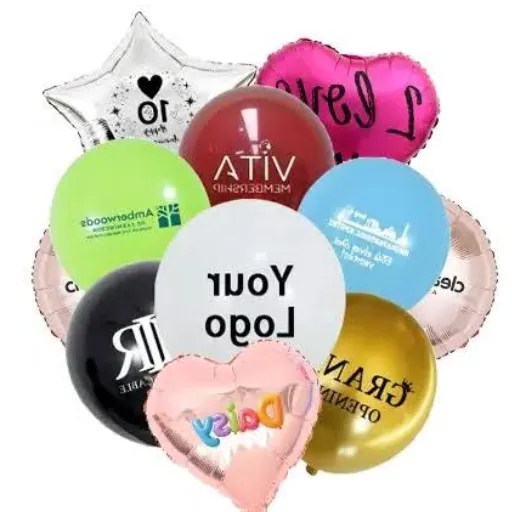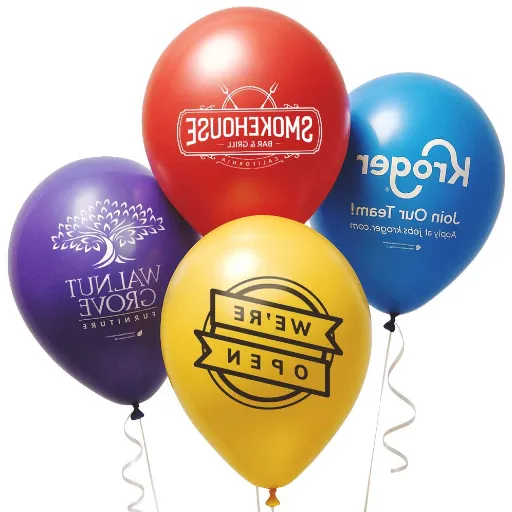


Eco-friendly printed balloons are not automatically eco-friendly. Whether you search for eco friendly printed balloons, biodegradable printed balloons, or custom printed biodegradable balloons, the question is the same: which of the three claims can you prove? Material, ink, and disposal are separate promises.
Natural latex with water-based ink, popped and binned, is the defensible default. PLA+PBAT foil with a lab report is real but narrower. Standard foil with solvent ink is the one to avoid.
That distinction matters more than it did a year ago. Since 27 September 2026, EU green-claims rules require a recognised certification scheme or public-authority label behind generic terms like “eco-friendly.” Most listings did not change. They still put the word in the title and send a raw-latex certificate as proof.
This guide separates the claims, compares the materials, names the documents to request, and explains what you can legally say in the EU and the US. It is for buyers who have to defend the claim, not just print it.
Key Takeaways
- A printed balloon is eco-friendly only if the material, the ink, and the disposal all hold up. One good claim does not rescue the other two.
- Natural latex with water-based ink is the defensible default. PLA+PBAT foil is real, but it carries a single-sample lab result and an OEM minimum around 10,000 pieces.
- Since 27 September 2026, EU rules restrict generic claims like “eco-friendly” unless a certification scheme or public-authority label backs them.
- Print the heroes and buy the volume blank. Fewer printed balloons means less ink, lower cost, and a simpler claim.
If you already know the material and quantity you need, request a quote and we will tell you which documents the run can support.
Are Eco-Friendly Printed Balloons Actually Green?
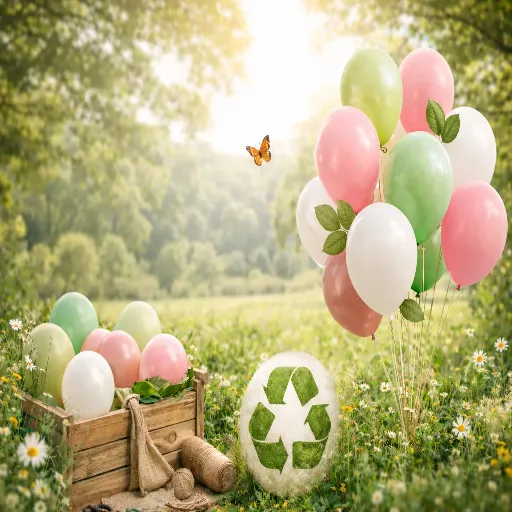
Eco-friendly printed balloons can be genuinely green, but the balloon alone does not decide it. Three things matter: whether the material is natural latex or a biodegradable film, whether the ink is water-based or solvent-based, and how the balloon is disposed of. A natural-latex balloon with water-based ink, popped and binned, is the defensible default.
The material claim
The material claim is the one buyers check first, and the one suppliers answer most loosely. Natural latex is renewable and biodegradable in principle. Standard foil does not biodegrade. PLA+PBAT foil has lab data, but the data covers a sample, not a category.
The ink claim
The ink is the part most suppliers skip. The material still biodegrades. The print is the variable.
Water-based ink is the lower-impact default. Solvent ink gives stronger colour and adhesion, but a higher VOC load and a harder claim to defend.
The disposal claim
The disposal claim is behaviour, not chemistry. At least ten U.S. states restrict intentional releases, and the EU banned plastic balloon sticks in 2021.
Pop latex and bin it the same day. Deflate and store foil for reuse. Never release, even a “biodegradable” one. The responsible disposal guide covers the steps.
The three-part test
A pass on one claim does not rescue a fail on another. PLA+PBAT foil passes on paper, but the report covers one sample. A balloon is only as green as its weakest claim.
| Claim | What it actually means | Document to ask for |
|---|---|---|
| “Biodegradable latex” | Natural latex, capable of breaking down under the right conditions | Latex origin record plus a third-party test on the finished product |
| “Eco-friendly ink” | Usually water-based; may mean low-VOC or heavy-metal-free | Ink spec sheet plus an EN 71-3 migration report |
| “Biodegradable foil” | PLA+PBAT film with a lab biodegradation result | ISO 14855 report with the SKU and scope stated |
| “Compostable” | Certified to EN 13432 or ASTM D6400, which is rare for balloons | Certificate with the balloon in scope |
| “Recyclable” | Almost never true for balloons | Do not use this claim |
| “Non-toxic” | Passes a migration test, not a biodegradation test | EN 71-3 report |
Maya, a brand manager at a skincare company, learned this the hard way. She briefed her printer for “eco-friendly branded balloons.” The balloons arrived on natural latex, exactly as ordered. Then legal killed the campaign headline.
The fix was one sentence naming the material, the ink, and the disposal route.
Material: Natural Latex vs Standard Foil vs PLA+PBAT Foil
Every custom printed balloon starts with one of these four materials, and the material decides most of the environmental story.
Natural latex
Natural latex is tapped from Hevea brasiliensis, the rubber tree. It is renewable, and it biodegrades under the right conditions. Those conditions matter.
A 2020 University of Tasmania study found little degradation after 16 weeks in freshwater, saltwater, or industrial compost: about 1% to 2% mass loss. Landfill is slower and less studied.
That finding is not an argument against latex, but against the word doing too much work. Latex is the best volume material for eco-friendly printed balloons. It takes screen, digital, and gravure printing, and most custom printed latex balloons are made from it.
Standard foil
Standard foil is a metalized plastic film, usually PET/PE or PA/PE with an aluminium layer. It doesn’t biodegrade; it fragments into microplastics. The metallic surface conducts electricity, which is why foil balloons cause power outages and, in dry conditions, wildfires.
Foil has one real advantage: it is reusable. Deflate and store it for the next event; reuse it five times and the per-use impact drops sharply. The latex vs foil comparison covers the full trade-off.
PLA+PBAT “biodegradable foil”
PLA+PBAT foil is a new commercial category and the most misunderstood product on the market: a composite film made from plant-based polyester. One manufacturer, FAIR (Kunshan Fair Craft), publishes an ISO 14855-1:2012 result showing 77.8% biodegradation after 45 days. The report ID is SHMR220700361301.
The caveats matter more than the headline:
- ISO 14855 is a lab method. It measures biodegradation under controlled composting conditions, not in a field, a landfill, or the ocean.
- A test report is not a certification. FAIR says this itself. The report covers the sample and scope stated in it.
- EN 13432 and ASTM D6400 are packaging frameworks. They require 90% biodegradation within 180 days. A balloon is not packaging.
- The OEM minimum is around 10,000 pieces. It’s a B2B option, not a party order.
- Ink adhesion differs from latex. Confirm the print spec with the factory.
Daniel, a promotional-products distributor in Rotterdam, compared the two options for a 10,000-piece retail campaign. Standard foil was cheaper and reusable. PLA+PBAT foil carried the lab report his client wanted but added cost and a six-week lead time.
He chose the eco film for the flagship store and standard foil for the secondary displays. The claim drove the decision, not the unit price.
The honest summary: biodegradable foil is a lab result and a supply-chain document, not a licence to release.
Silicone and reusable options
Silicone balloons are not biodegradable, but they are reusable, a different environmental argument. For a venue that repeats the same display monthly, silicone can beat single-use latex on total impact.
| Material | Source | End-of-life evidence | Typical MOQ | Best use |
|---|---|---|---|---|
| Natural latex | Rubber tree | Biodegrades under favourable conditions; UTAS caveat | 100+ (1 colour) | Volume decor, events, most printed orders |
| Standard foil | PET/PE or PA/PE plus aluminium | Does not biodegrade; reusable | 100–500 | Keepsakes, reusable displays |
| PLA+PBAT foil | Plant-based polyester blend | ISO 14855 lab data; no field data | ~10,000 | Distributor and B2B eco ranges |
| Silicone | Silicone | Not biodegradable; reusable | 100–500 | Reusable installations, retail |
For the science and the decomposition timelines, see the biodegradable balloons guide.
Ink: The Part Most Suppliers Skip

Water-based screen ink
Water-based screen ink carries a lower VOC load and is easier to defend. The trade-off is colour. On dark latex it needs a white underlay, and the palette is narrower than solvent.
Ask for the ink spec sheet, not the adjective. “Eco-friendly ink” is a claim. A spec sheet with a VOC number and an EN 71-3 report is evidence.
Solvent inks
Solvent inks give a wider colour range and stronger adhesion. They also carry a higher VOC load. If a supplier proposes solvent ink for an eco-positioned campaign, ask what the solvent is and whether the finished print has a migration report.
Metallic, glitter, gloss, and foil finishes
These finishes work against the eco story. Metallic and glitter add materials that do not break down with the latex; heavy gloss adds a coating that changes the end-of-life behaviour. They look premium and complicate the claim.
What EN 71-3 actually tests
EN 71-3 is a safety standard, not an environmental one. It tests the migration of 19 elements under simulated stomach-acid conditions. The current version is EN 71-3:2019+A1:2021. The 2021 amendment tightened the aluminium limit for scraped-off coatings to 28,130 mg/kg.
Passing EN 71-3 means a balloon is safer for a child to mouth. It does not mean it biodegrades. Those are different claims with different documents.
| Ink or finish | Breakdown impact | Colour range | MOQ | Best use |
|---|---|---|---|---|
| Water-based screen | Low; the lower-impact default | Moderate, needs underlay on dark latex | 100+ | Eco-positioned campaigns |
| Solvent screen | Higher VOC load | Wide | 100+ | Maximum colour on a budget |
| Metallic | Adds non-degrading material | Metallic only | 250+ | Premium accents |
| Glitter | Adds non-degrading material | Sparkle only | 250+ | Party and retail |
| Heavy gloss | Adds a coating | Wide | 250+ | High-shine displays |
Do not claim that water-based ink “biodegrades alongside the latex” unless a test report supports it. Say it is the lower-impact choice, and ask for the ink spec.
Designing Eco-Friendly Printed Balloons: Colours, Minimums, and Price
Artwork that survives the stretch
A balloon is printed flat and inflated round. The imprint grows by about 25% to 30%. A 4-inch imprint becomes about 5.25 inches on a 9-inch balloon. Artwork that looks balanced on screen can wrap around the curve and disappear from the camera.
Keep text inside 60% to 70% of the print area and put the name or logo near the centre. White ink on dark latex needs an underlay, which adds a production step.
Every additional colour adds a screen, a setup charge, and ink. It also complicates the eco story. One printed motif in two colours usually looks more designed than five custom colours, and it costs less. That’s the design rule that also protects the claim: fewer colours, less ink, lower MOQ, simpler evidence.
Setup costs and minimums
Screen printing has fixed costs: setup, screens, ink mixing, and machine time. The 30th balloon costs almost nothing; the first one costs the setup. That’s why a 30-piece order can cost more per balloon than a 100-piece order.
| Design | Typical minimum | Why |
|---|---|---|
| 1 colour, 1 side | ~100 | One screen, one setup |
| 2 colours, 1 side | ~250 | Two screens, two setups |
| Second side or added colour | ~1,000 | Additional pass and registration |
| 4+ colours | ~5,000 | Four or more screens and passes |
| Gravure | ~2,000+ | Cylinder engraving cost |
Price and lead time
Indicative 2026 pricing for 12-inch, one-colour screen print: about 1.10eachat100pieces,about1.10eachat100pieces,about0.15 at 20,000. The bands are not linear. Setup, freight, and ink choice move the number more than the balloon itself.
Lead times: 5 to 10 working days for screen print, about three weeks with more colours, and up to two months for gravure. Shelf life is about a year, so order for the campaign, not the warehouse.
The green option usually costs 5% to 15% more, not 30%. The gap narrows at volume. Water-based ink can reduce the colour range, which may reduce the screen count and offset part of the premium. Ask for a quote with the material, ink, quantity, and destination.
The takeaway is simple: MOQ and ink choice, not the word “eco,” decide the price of eco-friendly printed balloons.
Eco-Friendly Printed Balloons for Events
Weddings and celebrations
Natural latex, water-based ink, one printed motif, and air-filled displays where the venue allows. Air-filled garlands avoid the helium cost and the float clock.
Corporate and brand events
Logos, QR codes (test the code on an inflated sample), and a retrieval plan. Reuse frames, weights, and ribbons. The eco-friendly balloons for corporate events guide covers the procurement checklist.
Quantity by use and size mix
Print the name, logo, or motif on 40 to 60 pieces. Buy the rest in stock colours. A 150-balloon garland does not need 150 printed balloons. The printed pieces carry the design; the blank pieces carry the volume.
Priya, an event planner in Manchester, built a 30-guest first birthday this way. She printed 60 balloons with the baby’s name and a small rainbow motif, then bought 140 blank pastel balloons for the garland and ceiling. The printed pieces cost less than the helium she did not buy.
Retrieval and reuse
Retrieval is the strongest eco behaviour on this page. It beats material choice. Plan who collects the balloons, where they go, and which hardware is reused. A retrieved and stored display has a lower impact than a composted one.
Sustainable Balloon Branding Without Greenwashing
What changed on 27 September 2026
Directive (EU) 2024/825, the Empowering Consumers for the Green Transition directive, has applied to businesses since 27 September 2026. It bans generic environmental claims such as “eco-friendly,” “green,” “environmentally friendly,” and “sustainable” unless the claim is demonstrated and recognised under a certification scheme or a public-authority label. The rule applies to any trader selling eco-friendly printed balloons to EU consumers, wherever the trader is based.
The US rule is different
The FTC Green Guides require “competent and reliable scientific evidence” for environmental claims. They define “biodegradable” as complete breakdown within a reasonably short period after customary disposal. An unqualified degradable claim for an item destined for landfill is presumptively deceptive.
Say this, not that
| Risky claim | Defensible version |
|---|---|
| “Eco-friendly balloons” | “Natural latex balloons printed with water-based ink” |
| “Biodegradable” | “Natural latex, biodegradable under industrial composting conditions; dispose of in general waste” |
| “Biodegradable foil” | “PLA+PBAT film with an ISO 14855 lab result on the stated sample; not certified compostable” |
| “Compostable” | “Certified to EN 13432” only if you hold the certificate and the balloon is in scope |
| “Non-toxic” | “Passes EN 71-3 migration testing” |
| “Carbon neutral” | Do not use unless the claim is based on real reductions, not offsets |
The verification trail
Ask for three documents: the ink spec sheet, a third-party report on the printed finished product, and a latex origin record. The report must cover the printed balloon, not just the raw latex.
The biodegradable balloon certification guide explains how to read each document and spot the gaps.
Why we would rather tell you this
A weaker claim is easier to sell and harder to defend. We would rather give you a sentence that survives legal review than a slogan that does not.
Frequently Asked Questions
Are printed balloons eco-friendly?
They can be, if material, ink, and disposal all hold up. Natural latex with water-based ink, popped and binned, is the defensible default.
Are printed balloons biodegradable?
The latex can be. The print is the variable. Ask for a report on the finished printed product, not just the raw latex.
Do the inks affect biodegradability?
Yes. Water-based ink is the lower-impact choice. Metallic, glitter, and heavy gloss add materials that do not break down with the latex.
Are biodegradable foil balloons real?
PLA+PBAT foil exists and has lab data, but the result covers one sample under ISO 14855 conditions, not a field guarantee or a compost certification.
Can printed balloons be recycled?
Almost never. Balloons jam recycling machinery. Pop latex and bin it; deflate and reuse foil.
Is “eco-friendly” a regulated term?
In the EU, yes. Since 27 September 2026, generic claims need a certification scheme or public-authority label.
What certification should I ask for?
For eco-friendly printed balloons, ask for an ink spec sheet, a third-party report on the printed product, and a latex origin record. For compostability, ask for EN 13432 or ASTM D6400 with the balloon in scope.
Eco-friendly printed balloons are a material claim, an ink claim, and a disposal claim. Get all three right, and the green story holds. Get one wrong, and the whole claim is exposed.
Natural latex with water-based ink is the default. PLA+PBAT foil is real but narrow. Standard foil with solvent ink is the one to avoid. Since 27 September 2026, the EU has required evidence behind generic claims, so ask for the documents before you approve the artwork.
If you are ready to price a run, request an eco-friendly printed balloon quote. Send the material, ink preference, quantity, artwork, destination, and the claim you intend to make. We will tell you what the documents support, and what they do not.
For the ordering process, see how to order custom balloons. Retailers can start with custom printed balloons wholesale.