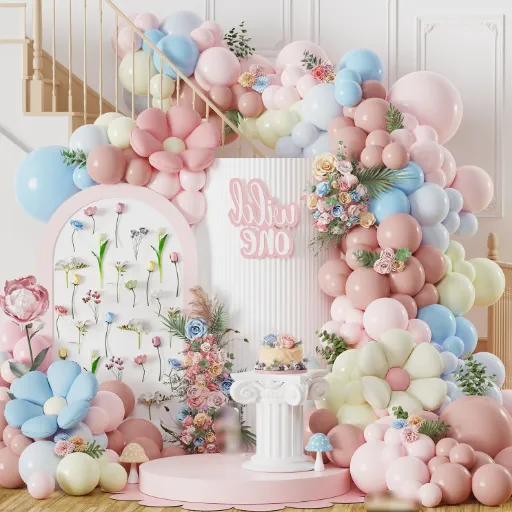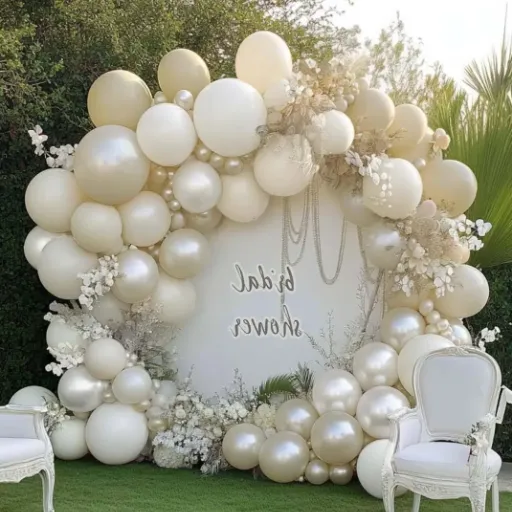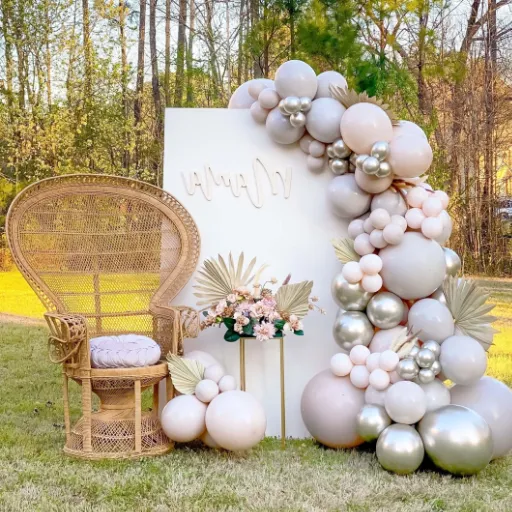
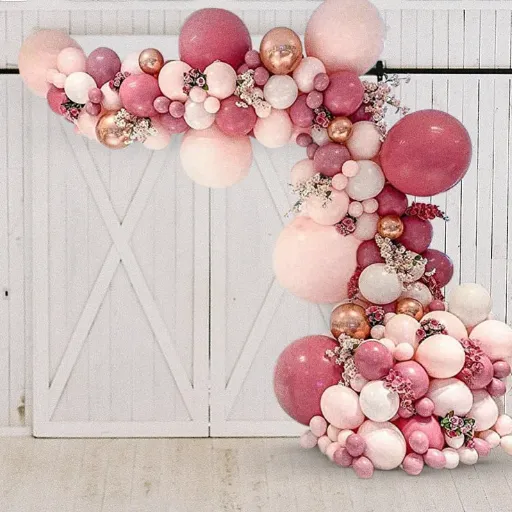
An organic balloon arch is a mixed-size, asymmetrical arch built from roughly 70% 11-inch, 25% 5-inch and 5% 16-inch-or-larger balloons. An 8-foot arch needs about 72 to 91 balloons in that mix, and it costs roughly $45 to $90 in loose balloons, $60 to $130 as a kit, or $325 to $885 installed at home scale.
Those numbers settle the shopping list. They do not settle the look.
A hundred balloons sounds like an arch. It is about nine feet of one, and a 10-foot doorway needs closer to 120 once spares are counted. That is why “is 100 balloons enough” keeps appearing under this keyword, and why so many arches are finished at midnight, two feet short of the doorway.
The second trap is subtler. Organic is not a shape. It is a set of decisions about size, inflation, symmetry and spacing. Get those right and a cheap bag looks custom; get them wrong and a professional frame looks like a school fete.
Key Takeaways
- Organic means mixed sizes, uneven clusters and deliberate gaps, not simply “curved”.
- Use roughly 70% 11-inch, 25% 5-inch, 5% 16-inch or larger. Organic builds take 20 to 30% more balloons than a structured arch of the same length.
- Budget 6 to 10 balloons per foot of span in 11-inch latex, or about 9 to 13 per foot once you mix in filler sizes, plus 10 to 15% spares.
- A 10-foot span is about 12 to 14 feet of actual curve, and reference tables usually allow for it. Measure the span.
- Expect roughly $45 to $90 DIY, $60 to $130 as a kit, or $325 to $885 installed at home scale, with a US median of $450.
If you would rather buy the arch than build it, we manufacture the balloons and quote to your span and palette.
What Is an Organic Balloon Arch?
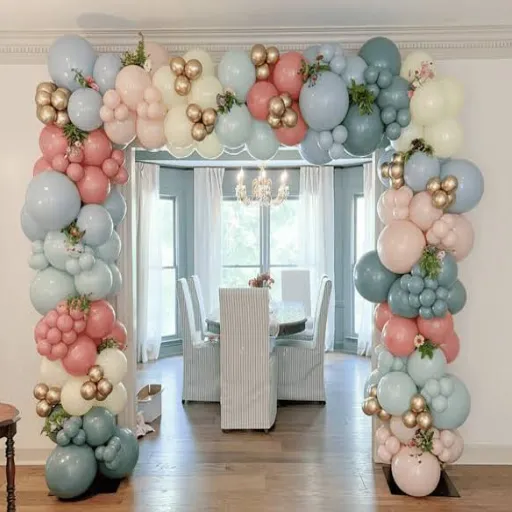
An organic balloon arch is a curved structure built from several balloon sizes in uneven clusters, with deliberate gaps and no repeating pattern. The asymmetry is planned rather than accidental.
Four formats get called “balloon arch”, and three of them are not organic.
Classic spiral. Two or three colours wound in a repeating pattern around a frame. Uniform inflation, even spacing, mirrored on both legs. Our guide covers the family.
Garland. A flexible cluster that drapes. The difference between a garland and an arch is the object, not the technique; our page sets out where each earns its cost.
Structured arch. Multiple sizes on a rigid frame, evenly spaced. This is the most common fake organic: the spacing is regular even though the sizes aren’t.
Organic. Mixed sizes, clustered unevenly, under-inflated in places, with visible gaps.
What that costs in materials is public. prices a classic arch at $18 or more per foot with “up to 5 balloons in a row”, and an organic arch at $23 or more per foot with “up to 12 balloons in a row”. Same foot of arch, more than twice the balloons.
The Five Rules That Make an Arch Look Organic
Each of these is a decision you make before you inflate anything.
Rule 1: Use three balloon sizes, minimum
The working ratio is 70% medium, 25% small, 5% statement. Medium means 11 or 12 inch. Small means 5 inch. Statement means 16 inch or larger, and 24 inch and 36 inch both work on a wide span.
We make from 5 inch through 36 inch for exactly this reason. A single-size build can’t produce the look however many balloons you use, because the eye reads size variation as texture.
The 5-inch balloons are structure. They cover the gaps that appear once the medium balloons are tied in, so skipping them leaves the arch thin at the frame.
Rule 2: Under-inflate to change the silhouette
A fully inflated latex balloon stretches into an oval with a narrow neck. A balloon inflated to about 90% stays rounder, softer and shorter.
That rounded shape makes an organic cluster read as clouds rather than eggs. Inflate, let a little air out before you tie, and press the balloon gently between your palms. Do this for most medium balloons and all statement ones.
It’s the cheapest improvement available: nothing to buy, and it changes the finished piece more than any colour choice here.
Rule 3: Break the symmetry on purpose
A mirrored arch reads as classic no matter how many sizes you use. Organic means one shoulder is heavier, the apex sits off-centre, and the legs differ.
Place your largest statement balloon between a third and a half of the way along, not at the centre. Build one side to roughly 60% of the volume and the other to 40%. Offset each cluster a few inches rather than sitting it dead on the line.
If your event wants symmetry, build a spiral and save the balloons.
Rule 4: Leave negative space
Gaps are the design. A dense uniform sausage reads as a garland; a sparse one reads as unfinished. Organic sits between, with open pockets where the wall shows through.
Fill gaps last, from a distance, after the arch is standing, and leave some.
Rule 5: Cap the palette at two to four colours plus one finish
More than four colours reads as a jumble at any distance. The rule across our guide is a 60-30-10 split: 60% dominant, 30% secondary, 10% accent or metallic.
Finish counts as a colour. A matte base with one chrome or pearl accent looks more expensive than five flat colours, because the finish does the work the extra colours were meant to do.
The honest trade-off: rules 1 and 4 are why organic costs more. More balloons, more sorting, more placement decisions, more leftover partial bags. If those costs buy you nothing at your event, read the comparison before you commit.
How Many Balloons for an Organic Arch?
Short answer: 6 to 10 balloons per foot of span in 11-inch latex for an organic build, against 5 to 7 for a structured one. In 5-inch balloons it rises to 12 to 16 per foot; in 16-inch balloons it falls to 3 to 5 per foot. Organic arches use 20 to 30% more balloons than a structured arch of the same length. These bands come from , which publishes counts by both balloon size and arch span.
Build a mixed arch, though, and you need one number that covers all three sizes. Start from the 11-inch organic figure for your span, multiply by about 1.3 to allow for filler and statement balloons, then split the total 70/25/5.
| Arch span | 11″ baseline (organic) | Mixed build total (about ×1.3) | 11″ (70%) | 5″ (25%) | 16″+ (5%) |
|---|---|---|---|---|---|
| 6 ft | 40–50 | ~52–65 | ~36–46 | ~13–16 | ~3 |
| 8 ft | 55–70 | ~72–91 | ~50–64 | ~18–23 | ~4–5 |
| 10 ft | 80–100 | ~104–130 | ~73–91 | ~26–32 | ~5–6 |
| 12 ft | 95–120 | ~124–156 | ~87–109 | ~31–39 | ~6–8 |
A mixed organic arch therefore runs about 9 to 13 balloons per foot of span at 8 to 12 feet. The 11-inch baseline column is sourced; the multiplier and the split are our working estimate from building and quoting these arches, so treat the right-hand columns as planning figures rather than published standards.
Four things move that number.
Density is a choice. The same 8-foot arch is about 72 balloons loose and about 91 full. That is the difference between a $60 arch and an $85 arch, and both are correct.
Span is not run. Measure base to base. A 10-foot span produces roughly 12 to 14 feet of curve, the most common mistake in this build. Tables like the one above already allow for the curve, so apply the 1.2 to 1.4 multiplier only when working from your own per-foot estimate.
Spares are not optional. Add 10 to 15%. Balloons pop, mis-tie, and arrive at inconsistent sizes.
Height adds length. A tall 5-foot peak carries more curve than a low one. Add another 10 to 15% for a dramatic apex.
A worked example: the 10-foot doorway
You have a 10-foot doorway and a 7-foot ceiling.
The table gives 80 to 100 balloons in 11-inch. Multiply by 1.3 for 104 to 130 total. Split that 70/25/5 and you need about 73 to 91 medium, 26 to 32 small and 5 or 6 statement balloons. Add 12% spares and you are ordering around 120 to 145 balloons.
Then the ceiling intrudes. A 7-foot arch in a 7-foot room has no clearance, so the apex drops to 6.5 feet and the span narrows to 9 feet. That is about 90% of the balloons you just calculated, or 110 to 130.
Measure the room, then the span, then the count. Doing it the other way costs a second order or a shorter arch. That is why “is 100 balloons enough” has no single answer: 100 balloons is roughly nine to eleven feet of arch, depending on how full you build it. For any span not in the table, with the per-foot bands above.
Organic vs Classic: What Actually Changes
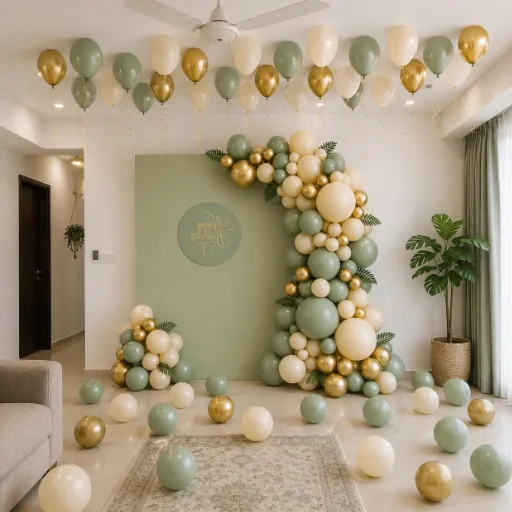
The two styles are not better and worse. They are different tools, and the price gap buys you one specific thing: how forgiving the build is.
| Classic spiral | Organic | |
|---|---|---|
| Balloon sizes | One or two, uniform | Three or more, mixed |
| Pattern | Repeating, mirrored | Asymmetrical, clustered |
| Balloons per row (decorator pricing) | Up to 5 | Up to 12 |
| Balloons per foot, 11″ | 5–7 | 6–10 |
| Balloon volume vs the other | Baseline | +20 to 30% |
| Build difficulty | Easy to plan, easy to make look wrong | Hard to plan, easy to make look good |
| Best for | School events, sports, grand openings, kid parties | Weddings, showers, brand events, photo backdrops |
| Typical installed price per foot | $18+ | $23 to $26+ |
The per-foot row is the only public pair on this SERP: at $18+ classic versus $23+ organic, and at from $26 per linear foot plus delivery.
Read the difficulty row twice, because it inverts the usual advice. A spiral is easier to plan, since the count is predictable. But it is easier to get wrong visually, because any inconsistency shows against a regular pattern. An organic arch is harder to plan and far more forgiving to execute, because irregularity is the goal.
The decision is not “which is cheaper” but “which failure mode can I live with”. Choose classic when the event is bright, full of children and the arch is background. Choose organic when the arch is the photograph.
If you have already decided to build, cover construction; the next section is about choosing a route.
How to Make an Organic Balloon Arch
Three routes cover almost every build. They differ in how much control you get over the curve, and in what happens when a venue won’t let you attach to a wall.
| Route | Needs | Best for | Limitation |
|---|---|---|---|
| Balloon strip | Strip, glue dots, pump | First-timers, indoor, fast build | The strip fixes the curve; deep clusters are hard |
| Fishing line | Line, hooks or frame, pump | Fullest organic look, wall-mounted | Slower; needs two people above 8 feet |
| Frame or stand | Frame, ballast, panels | Freestanding, outdoor, no-fix venues | Highest cost; needs transport |
An organic balloon arch stand costs more than the other two routes and solves the one problem they can’t: venues that forbid wall fixings. Buy it once and it pays back over three or four events.
The strip deserves a note, because demand for it is larger than demand for the arch itself. “Balloon garland strip” searches at 1,000 a month in the US, more than double “organic balloon arch” at 480. The reason is practical: the strip lets one person build a straight-ish run in an hour. Our covers it end to end.
The order of work is the same on all three routes:
- Inflate in three size piles, under-inflating most balloons.
- Build clusters, pairing same-size balloons and twisting pairs together.
- Attach clusters along the run, rotating sizes and colours as you go, then stand or hang the arch.
- Fill gaps last, with 5-inch balloons, standing back to judge.
Two rules prevent most failures. Above 8 feet, use two people. On a hot day, under-inflate by about 10%, because latex expands as it warms and pops without warning.
If you would rather follow a garland build, the walks through the same size ratio and cluster logic for a draped format.
Organic Balloon Arch with Flowers and Greenery
Flowers separate a balloon arch from a balloon display, and they go on last.
Three placements work reliably. A single asymmetric floral cluster at one shoulder. Trailing greenery down to the base, which also hides frame legs and sandbags. A single statement bloom near the apex.
Build balloons first, structure second, flowers last. Moving a finished arch sheds petals and knocks balloons loose, so position everything before you decorate.
Fresh, artificial and dried all work, and the choice is mostly about heat. Fresh stems wilt in a marquee without air conditioning and cost the most; dried and artificial tolerate sun better. One caution: latex and moisture do not mix. Wet stems pressed against balloons soften the rubber and cause early failures, so wrap the stems or leave a gap.
Professional florals add roughly $30 per linear foot when a decorator supplies them, which for an 8-foot arch is a material line item rather than a detail. covers the garland version of the same problem.
Organic Balloon Arch Kits: What to Buy
A kit is the right purchase for most first builds, and most “organic” kits are wrong.
A kit that can actually produce this style needs four things: at least three balloon sizes, glue dots or a strip, a pump, and enough 5-inch balloons to fill gaps. If the box lists one balloon size plus a small bag of 5-inch, it cannot produce the look, because size variation is the entire style.
Observed prices on this query’s own search results, all captured on 2026-11-13:
- $12.09 for a 110-piece biodegradable arch kit (Efavormart, sold via Walmart)
- $18 to $45 for Etsy DIY organic garland kits
- $84.99 for a three-colour organic arch kit (Inflate Decorate Celebrate)
The $12 kit is a bag of balloons with a strip. It’s not a bad purchase at a small span, but it isn’t the same product as the $85 kit, and the difference is mostly balloon count and size range.
covers frame kits versus strip kits, and the parts that go missing.
What an Organic Balloon Arch Costs
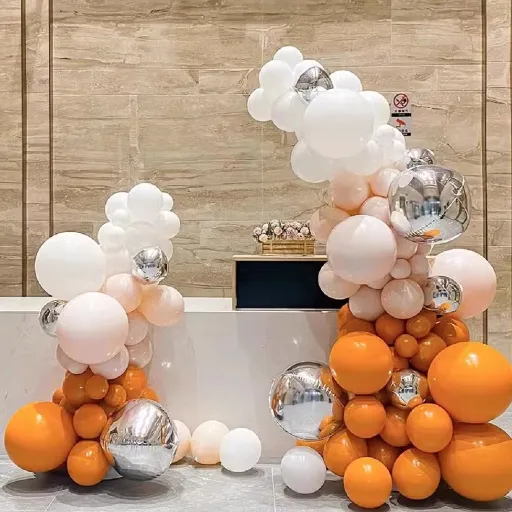
Three routes, one span. Here is the 8-foot arch priced three ways, with the installed figures taken from real US listings rather than a rule of thumb.
| Route | What you are paying for | Typical cost |
|---|---|---|
| Loose balloons (DIY) | 72–91 balloons, 70/25/5 mix | $45–$90 |
| Kit | Balloons, strip, glue dots, pump | $60–$130 |
| Frame or stand, DIY | Reusable frame, ballast, balloons | $90–$200 |
| Installed, small (6×6 ft) | Decorator, delivery, setup | $325–$400 |
| Installed, mid (8×8 to 10×6 ft) | Decorator, delivery, setup | $450–$750 |
| Installed, large (8×12 ft and up) | Decorator, larger install, florals optional | $885–$1,390+ |
The installed rows come from named listings on the SERP: a 6×6 ft organic arch at $345 (Long Beach Balloons), 8×8 ft at $690 (Memo Balloons), 10×6 ft at $725 and 8×12 ft at $885 (Pink Flamingo Party Co.), a 10-foot arch at $845 (BalloonPlanet) and an XL at $1,390 (Memo Balloons).
Across 124 organic arch product listings on these results, the median price is $450, with a quarter below about $206 and a quarter above about $683. That median is the number to quote back to a decorator, because it is what the market charges rather than what a range implies.
The organic balloon arch price you are quoted will move with three things: the span, whether the palette needs balloons bought specially, and whether the arch has to travel. Two decorators quoting the same 8-foot arch will differ by two or three hundred dollars, which is why the median matters more than any single quote.
The three reasons organic costs more than classic:
- More balloons. 20 to 30% more at the same span, before spares.
- More labour. Sorting three sizes and placing clusters unevenly takes longer than winding a uniform spiral.
- More waste. Mixed-size builds leave partial bags of the sizes you used least.
covers the wider market. Our own cost page publishes very few per-size figures, which is the gap this table fills.
If you plan to build more than one arch, the frame is the line item that pays for itself. We supply in the size ranges these builds need, and if the arch carries a name or a logo.
Making It Last, and Making It Responsible
Air-filled latex looks its best for two to four days indoors and around 24 hours outdoors in heat or direct sun. Under-inflate on a hot day, keep the arch out of sunlight, and build as late as the schedule allows.
Helium is the wrong gas for this format. An arch needs structure, not lift. Air-filled balloons last longer, cost less per balloon, and can be built on a reusable frame. Helium belongs in a floating ceiling cloud, not in a garland.
Natural latex is renewable and does degrade in the right conditions, but “biodegradable” describes what a balloon is made of, not a promise about how fast it disappears. Foil doesn’t degrade the same way. Our guide sets out what can’t honestly be claimed.
Two rules matter more than the material choice. Never release balloons; deliberate releases are banned or restricted in many places, and cover where. And reuse the structure, not the balloons: frames, strips, pumps and weights last for years, while the balloons are single-use.
Organic Balloon Arch FAQs
What is an organic balloon arch? An organic balloon arch is a curved structure built from several balloon sizes in uneven clusters, with deliberate gaps and no repeating pattern. The asymmetry is planned. It differs from a classic spiral, which uses uniform sizes in a mirrored repeating pattern.
How many balloons do I need for an organic balloon arch? About 6 to 10 balloons per foot of span in 11-inch latex, or roughly 9 to 13 per foot once filler and statement sizes are mixed in. An 8-foot span needs about 72 to 91 balloons. Add 10 to 15% for pops and mis-ties. Mixed sizes are what separate an organic balloon arch from a single-size build, so the count assumes all three grades.
How many balloons per foot is an organic arch? Six to 10 per foot in 11-inch balloons for organic, against 5 to 7 for a structured build. In 5-inch balloons it rises to 12 to 16 per foot; in 16-inch balloons it drops to 3 to 5. Organic uses 20 to 30% more than structured.
What sizes of balloon do I need? Three minimum: 11-inch as the body, 5-inch as filler, and 16-inch or larger as statement pieces. Split them roughly 70/25/5. A single-size build cannot produce the look, however many balloons you inflate.
Can I make an organic balloon arch without a frame? Yes. A balloon strip fixed to a wall works, and so does fishing line between two hooks or two weighted columns. Without a frame you are limited on height and curve control, and you need a wall or floor anchor the venue allows.
How much does an organic balloon arch cost? About $45 to $90 in loose balloons, $60 to $130 as a kit, or $325 to $885 installed at home scale. The median across 124 US listings is $450. Frames, delivery, greenery and number balloons are the add-ons people forget.
How long does an organic balloon arch last? Two to four days indoors for air-filled latex, and around 24 hours outdoors in heat or direct sun. Under-inflate by about 10% on a hot day. Helium is not needed and shortens useful life rather than extending it.
Is an organic arch harder to make than a classic one? No, and this surprises people. Organic is harder to plan, because mixed sizing makes the count less predictable, but easier to execute, because irregularity is the goal. A spiral is easier to plan and much less forgiving of a wobbly cluster.
Conclusion
An organic balloon arch comes down to four decisions, in this order.
Set the span against the room, allowing 12 inches of clearance under the ceiling. Convert the span to a count using 6 to 10 balloons per foot in 11-inch latex, then multiply by about 1.3 for a mixed build and split it 70/25/5. Choose the route: loose balloons, a kit, or a frame, each with a different cost and a different amount of your evening. Then apply the five rules, of which under-inflating and breaking the symmetry do the most visible work.
Everything else, the palette and the flowers and the finish, is styling. The numbers are what make the styling possible, and they don’t take long to work out before you order anything.
An organic balloon arch rewards the ten minutes you spend measuring over the four hours you spend inflating. If you want the arch built to your colours, with a name or a date printed on the balloons, send us the span, the palette and the date. We’ll tell you what is realistic and what it costs at your scale.