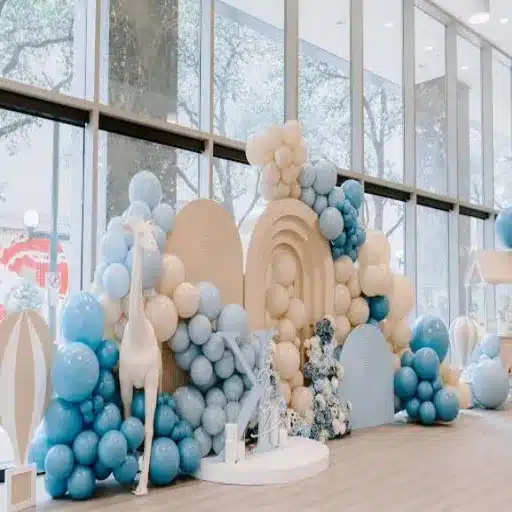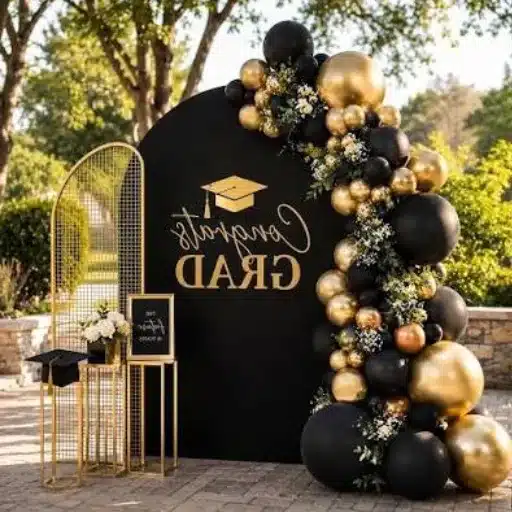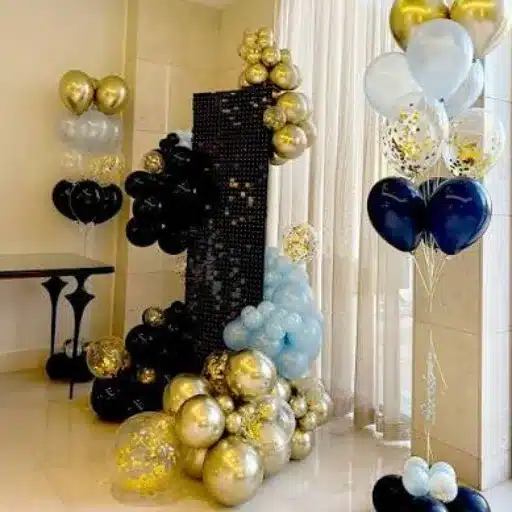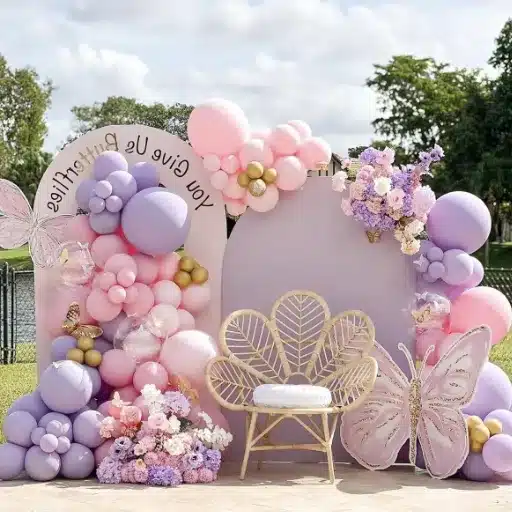

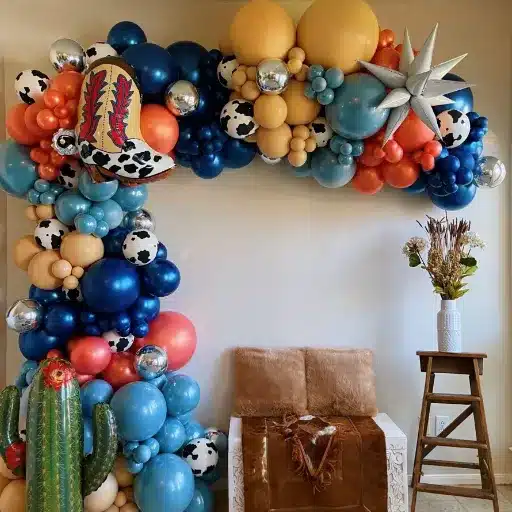
A balloon arch is a freestanding, curved structure built on a rigid frame, while a balloon garland is a flexible, air-filled arrangement that drapes across walls, tables, and backdrops. That’s the balloon garland vs arch difference in one line: an arch stands alone and commands attention, while a garland flows through a space and needs a surface to hang from. For most events, a garland is cheaper, faster, and more beginner-friendly, but an arch creates the biggest wow factor at entrances and photo moments.
The two terms get used interchangeably, and it drives event planners crazy. You save a photo of a towering curved balloon arch for your wedding entrance, then order something you thought was the same thing, and end up with a wall hanging instead.
Here’s the truth: they are different structures with different costs, setup times, and best uses. This balloon garland vs arch guide breaks down every factor so you can pick the right one on the first try, or combine them for a show-stopping event. Reach Trading Shanxi Co., Ltd. for durable balloon garland solutions with flexible design options.
Key Takeaways
- An arch is a freestanding, framed structure that makes a bold entrance or focal point; a garland is a flexible, attached arrangement used on walls, tables, and backdrops.
- Garlands are cheaper to DIY (about 20to20to60 versus 40to40to100 for a comparable arch) and take roughly half the setup time.
- Arches use 80 to 120 balloons per 8-foot span, while garlands use 60 to 90, so arches cost more in balloons alone.
- Air-filled garlands last days, even two weeks or more indoors, while helium arches fade in about 8 to 12 hours.
- You don’t have to choose. A classic move is an arch at the entrance with garlands across the dessert table, staircase, or photo wall.
Balloon Arch vs. Balloon Garland at a Glance
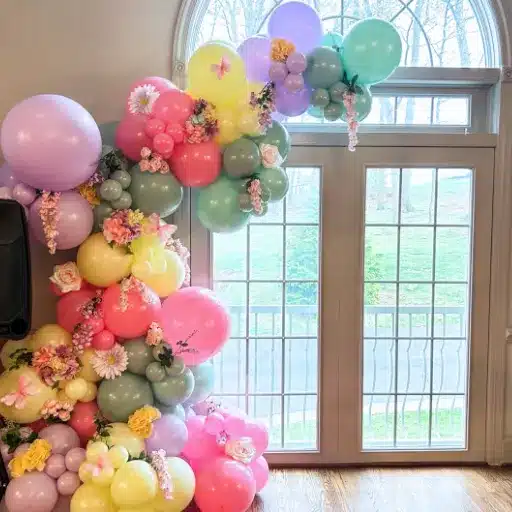
Here is the fastest way to see the difference. Bookmark this table before you plan your next event.
| Factor | Balloon Arch | Balloon Garland |
|---|---|---|
| Structure | Curved, freestanding, built on a rigid frame | Flexible, organic, draped or attached to a surface |
| Stands alone? | Yes, with weighted base plates | No, needs a wall, frame, or rail to hang from |
| Balloons (8 ft) | 80 to 120 | 60 to 90 |
| DIY setup time | 60 to 90 minutes | 30 to 60 minutes |
| Skill level | Moderate, uniform inflation matters | Beginner-friendly, uneven inflation looks natural |
| DIY cost | 40to40to100 | 20to20to60 |
| Hardware | Frame or arch kit, 15to15to60, reusable | Decorating strip, 3to3to8, single-use |
| Longevity | 8 to 12 hours if helium-filled | Days to 2+ weeks if air-filled |
| Best for | Entrances, stages, photo backdrops | Walls, dessert tables, stair rails, ceilings |
| Vibe | Polished, classic, statement-making | Modern, organic, editorial |
The short version: if you need something that stands on its own and stops people at the door, build an arch. If you want decor that flows through the room and works almost anywhere, use a garland. Contact Trading Shanxi Co., Ltd. →
What Is a Balloon Arch?
A balloon arch is a curved balloon structure that stands on a rigid frame made from PVC pipe, metal conduit, or a commercial arch kit, anchored with weighted base plates at each end.
Because the frame holds the shape, an arch provides 360 degrees of balloon coverage. It creates a clear visual boundary and a destination. Guests know exactly where to walk, where to stand, and where to take photos.
Common arch styles:
- Classic or rainbow, with uniform rows of same-size balloons
- Spiral, with two or more colors twisted around the frame
- Organic, with mixed sizes and an intentionally asymmetrical look
- Half arch, which anchors to a single point instead of spanning a doorway
- Full arch, which forms a complete freestanding curve
Best Use Cases for an Arch
Choose an arch when you want a bold, freestanding statement. It shines at grand entrances, stage framing, corporate grand openings, and ceremony backdrops where there’s no wall to attach anything to. It also reads as more formal and polished, which is why you see it at galas and weddings.
Pros and Cons of an Arch
Pros: Creates the biggest visual impact, stands on its own, looks clean and professional, and works outdoors where there’s nothing to hang from.
Cons: Costs more, takes longer to set up, requires a frame (either bought or built), and needs uniform inflation for a clean look. A helium-filled arch also fades within hours. For a full arch tutorial, our guide on how to make a balloon arch without a stand and our PVC frame arch tutorial cover both DIY routes.
What Is a Balloon Garland?
A balloon garland is a flexible arrangement of balloons threaded onto a decorating strip or fishing line and hung, draped, or attached to a wall, table, staircase, backdrop, or ceiling line.
A garland has no frame and no rigid shape. It flows like a ribbon through a space, using varied balloon sizes and inflation levels to create texture and depth. The look is modern, organic, and highly photogenic.
Where garlands shine:
- Dessert and candy tables
- Welcome signs and archways in hallways
- Stair railings and banisters
- Photo booth backdrops
- Ceiling lines and window frames
- Bar and lounge areas
Best Use Cases for a Garland
Choose a garland when you have surfaces to decorate and want flexibility. It works in smaller spaces and under low ceilings, where a bulky arch feels cramped. It’s also the smarter choice for events with several decor touchpoints, because you can stretch one garland style across the whole room for a cohesive look.
Pros and Cons of a Garland
Pros: Cheaper, faster, and easier to build than an arch. Mistakes in inflation look like design choices. It uses fewer balloons because it’s front-facing only, and it lasts longer because it’s air-filled.
Cons: It can’t stand on its own, so it needs a surface or frame to attach to. Some venues restrict hooks or wall attachments, which can be a problem. And a dense organic garland can actually cost more per foot than a standard arch because it uses more balloons and hand labor. Our complete balloon garland tutorial guide walks through the full build if you want the details.
Balloon Garland vs Arch: Cost Comparison
Cost is usually the first question, and the answer depends on whether you DIY or hire a professional.
DIY Cost
For a comparable 8-foot display, a DIY arch runs about 40 to 100, while a DIY garland runs about 20 to 60. The gap comes from hardware and balloon count.
- Arch hardware: a frame or arch kit costs 15 to 60, but it’s reusable. After two or three events, the frame pays for itself.
- Garland hardware: a decorating strip costs 3 to 8, but it’s single-use.
The arch also needs more balloons (80 to 120 versus 60 to 90 for an 8-foot span), and those add up fast. When you factor in a few extra bags of balloons plus the frame, the arch is simply the more expensive project.
Professional Cost
Hiring a professional flips some expectations. According to industry pricing, classic framed arches typically start around $ 350 to $ 850, while custom or luxury organic pieces run $ 550 to $ 1,650 and up. Professional decorators often price classic arches by the linear foot at about $ 25 to $ 40, and organic garlands at $ 35 to $ 55 or more, because dense garlands use more balloons and require hand sculpting on site.
That means a dense, hand-built organic garland can cost more per foot than a standard arch, even though a beginner DIY garland is cheaper than a beginner DIY arch.
The quality factor: As a balloon manufacturer, we see one thing that changes the whole cost equation: balloon quality. Retail-grade latex pops and fades, forcing you to buy replacements and redo sections. Commercial-grade latex holds its shape and color for days, so your money goes further. It’s why we recommend high-quality latex balloons for both arches and garlands, even when the upfront cost is a little higher.
Priya planned a 200-guest wedding with a strict budget. She priced a professional arch at $650 and balked. Instead, she spent $180 on a garland kit, built a garland over the dessert table, and draped a second one along the stair rail. The result looked intentional and editorial, and she kept $470 in her pocket for flowers.
Connect with Trading Shanxi Co., Ltd. for creative balloon garlands in customized sizes and colors.
How Many Balloons Do You Need?
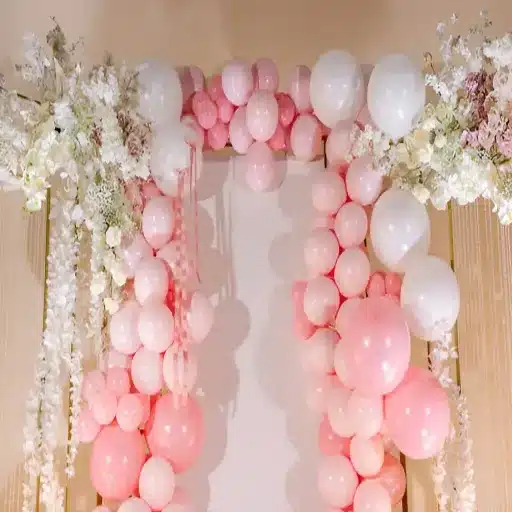
Balloon count drives both cost and setup time, so plan for it before you buy.
- Arch: roughly 80 to 120 balloons for an 8-foot span, or about 100 to 120 per 10 feet.
- Garland: roughly 60 to 90 balloons for an 8-foot span, since it only needs a front-facing layer.
One caveat: a dense, lush organic garland can use far more balloons per foot than a standard spiral arch. The thick, clustered look you see on Pinterest isn’t cheap. For any design, always buy 10 to 15 percent extra to cover pops, defects, and last-minute additions. Our balloon quantity guide covers sizing by garland length if you want exact numbers.
Balloon Garland vs Arch: Setup Time and Skill Level
Time is the second thing people underestimate.
- Arch, DIY: 60 to 90 minutes for an 8-foot display. You assemble the frame, inflate balloons to a consistent size, and attach them evenly. Uniform inflation matters; uneven balloons in an arch read as mistakes.
- Garland, DIY: 30 to 60 minutes. You thread balloons onto a strip or fishing line and hang it. Varied inflation looks intentional, which makes garlands far more forgiving for beginners.
Professionals flip the equation in some cases. A pre-built arch frame can be covered in 30 to 60 minutes on site, while a complex organic garland might take 2 to 4 hours of hand tying and sculpting. If you’re hiring, ask your decorator how they price and time each format.
Marcus, a first-time DIYer, tried an arch for his daughter’s birthday. He spent two hours wrestling with a PVC frame and a pile of half-inflated balloons, and the result sagged in the middle.
The next weekend he built a garland over the cake table in 40 minutes. It looked fuller, took half the time, and he actually enjoyed the process. If you’re new to balloon decor, start with a garland.
Balloon Garland vs Arch: Which Lasts Longer?
This is where the two formats really diverge, and it surprises a lot of people.
An air-filled garland lasts longer. Fresh, high-quality latex balloons inflated with air stay full for days, and garlands can easily last two weeks or more indoors. Because a garland is air-filled, there’s no helium to leak out.
A helium-filled arch fades fast. Untreated latex helium balloons typically float for only about 8 to 12 hours. An arch filled with helium is a day-of-only display, and it’s risky outdoors, where wind tangles balloons and sun speeds up deflation.
If your event runs all day or across multiple days, or if it’s outdoors, an air-filled design is almost always the safer choice. And balloon quality matters here more than anything. Properly stored, commercial-grade latex resists the porosity and oxidation that make cheap balloons shrivel overnight. Our guide on how long balloon garlands last covers timing and storage in detail. Talk to Trading Shanxi Co., Ltd. about professional balloon garland production for weddings, parties, and events.
Balloon Garland vs Arch for Weddings, Birthdays & Corporate Events
The best choice depends on your event type. Here’s a quick cheat sheet.
Weddings
- Arch: a ceremony arch creates a memorable backdrop for the vows and the first kiss photos. It’s the classic choice for a formal venue.
- Garland: garlands across the sweetheart table, the stair rail, and the dessert table keep the reception cohesive and elegant.
Most wedding planners use both, with the arch at the ceremony and garlands flowing through the reception. If the budget only allows one, many couples pick the arch for the ceremony photos and keep the reception simple.
Birthdays
- Garland: the clear winner for home parties. It fits small spaces, hangs over the cake table, and won’t dominate a living room.
- Arch: save it for milestone birthdays in rented venues where you want a big entrance moment.
Corporate and Branded Events
- Arch: a logo arch at the registration desk or product launch makes a strong first impression.
- Garland: brand-color garlands across the stage, photo wall, and lounge areas keep the room on-message.
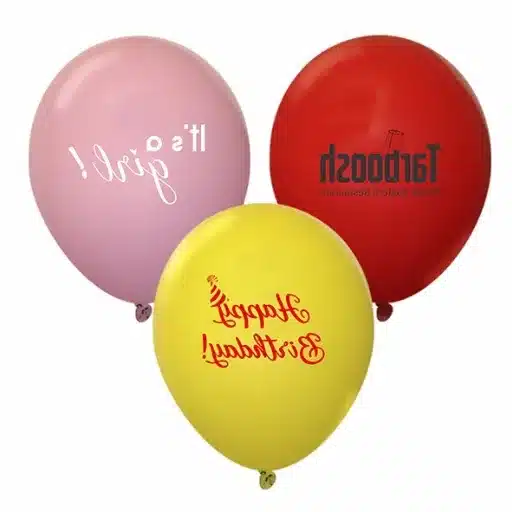
For corporate events, you also have the option of custom-printed balloons. A branded arch or garland turns decoration into marketing, and event companies often order these in volume for repeat activations.
Can You Combine an Arch and a Garland?
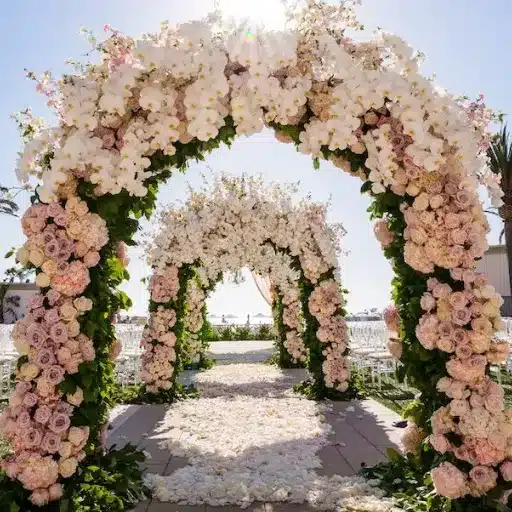
Yes, and it’s one of the most effective design tricks in the industry.
- Drape a garland over an arch frame: attach a garland across the top curve of an arch frame to get the arch’s structure with the garland’s organic texture.
- Build a garland-style arch: shape a garland into an arch and pin it to a doorway frame or a freestanding arch kit. You get the arch silhouette without buying arch-specific balloons.
- Layer your space: use an arch at the entrance for impact, then repeat the same colors as garlands throughout the room for cohesion.
Combining both lets you stretch your budget. The arch delivers the wow factor, while garlands provide the volume of decor that makes a space feel fully styled. Need help planning the mix? Our team designs custom balloon installations that combine both formats for weddings, corporate events, and large celebrations. Contact Trading Shanxi Co., Ltd. →
5 Questions to Decide: Balloon Arch or Garland?
If you’re still torn, run through these five questions. Each one points you toward a clear answer.
- Does it need to stand on its own? If there’s no wall, frame, or rail to attach to, choose an arch.
- Do you have surfaces to decorate? Walls, tables, stair rails, and backdrops favor a garland.
- What’s your setup time? Have less than an hour and no experience? Build a garland.
- What vibe do you want? Polished, classic, and formal leans arch. Modern, organic, and editorial leans garland.
- What’s your balloon budget? Garlands use fewer balloons and cheaper hardware for DIY, so they’re the budget-friendly default.
If you answer mostly arch, build an arch. If you answer mostly garland, build a garland. If you’re split, do both.
Balloon Arch vs. Balloon Garland for Wholesale Buyers
Event companies and retailers planning to stock balloon decor face a different version of this decision, and it’s worth a dedicated note.
- Arches: the frame is a one-time capital cost that’s reusable for years, making arches attractive for rental companies that build the same structure repeatedly.
- Garlands: strips are a consumable, so garlands create recurring supply orders. They also sell well as DIY kits for consumers.
For wholesalers, the smart play is usually to stock both and let the customer decide. The key is consistent quality. When you source balloons in volume, thin or inconsistent latex becomes a real problem, because a bad batch ruins dozens of builds.
That’s why bulk buyers value working directly with a manufacturer who controls the latex quality from the start. We offer bulk order discounts and reliable global shipping for event companies, retailers, and distributors that order balloon supplies in volume.
FAQs: Balloon Garland vs Arch Questions Answered
What is the difference between a balloon arch and a balloon garland?
A balloon arch is a curved, freestanding structure built on a rigid frame with weighted bases. A balloon garland is a flexible, organic arrangement draped or attached to a wall, table, staircase, or backdrop. Arches stand alone and create bold entrances; garlands flow through a space and need a surface to hang from.
Are balloon garlands cheaper than arches?
Yes, for DIY. A comparable 8-foot garland costs about 20 to 60, while an arch runs 40 to 100, because arches need a frame and more balloons. Professionally, a dense organic garland can cost more per linear foot than a standard arch due to the balloon volume and hand labor involved.
Do balloon arches need a frame?
Yes. A balloon arch needs a rigid frame, usually PVC pipe, metal conduit, or a commercial arch kit, held up by weighted base plates. The frame carries the structure, which is why arches can stand on their own. Garlands, by contrast, need no frame and hang from surfaces.
Do balloon garlands need helium?
No. Balloon garlands are almost always air-filled, which is why they last for days. Using air instead of helium also makes garlands cheaper and more stable. Helium is typically reserved for floating balloons and some arch designs.
Which lasts longer, an arch or a garland?
An air-filled garland lasts longer, often two weeks or more indoors with quality latex. A helium-filled arch fades in about 8 to 12 hours because the helium escapes. For multi-day or outdoor events, an air-filled design is the safer choice.
Conclusion
The balloon garland vs arch decision comes down to structure, budget, and where the decor needs to live. An arch is a freestanding statement piece for entrances and formal moments. A garland is a flexible, affordable, beginner-friendly option that works almost anywhere.
Remember the three deciding factors: arches stand alone but cost more and take longer to build, garlands are cheaper and faster but need a surface to hang from, and air-filled garlands outlast helium arches by days. For most events, a garland is the smarter default, and combining both gives you the best of each.
No matter which side of the balloon garland vs arch debate you land on, start with quality balloons. High-quality latex holds its shape, keeps its color, and lasts through the entire event. Browse our latex balloon collection to stock up, or contact our team for a custom arch or garland designed for your event. With the right structure and the right balloons, your decor will look like it was handled by a professional, even if you built it yourself. Contact Trading Shanxi Co., Ltd. →