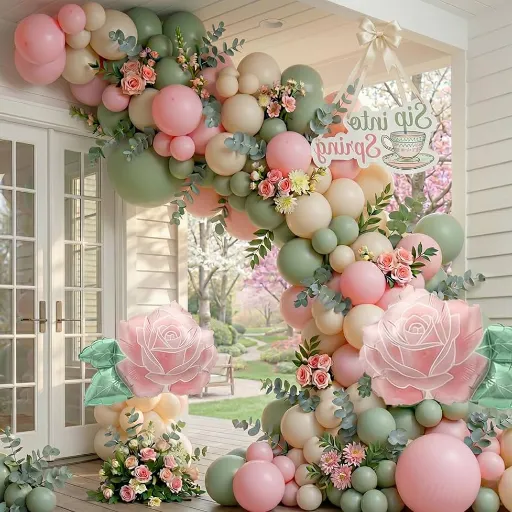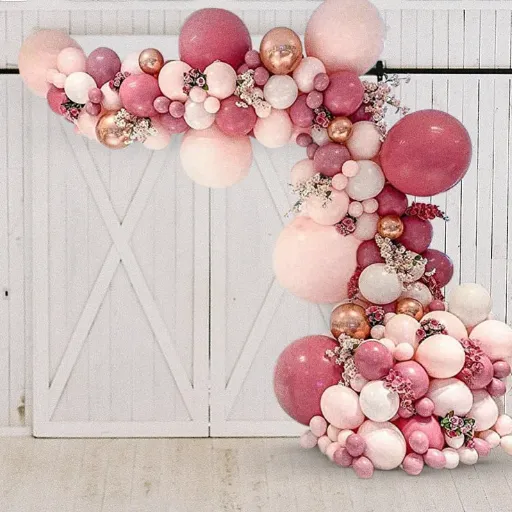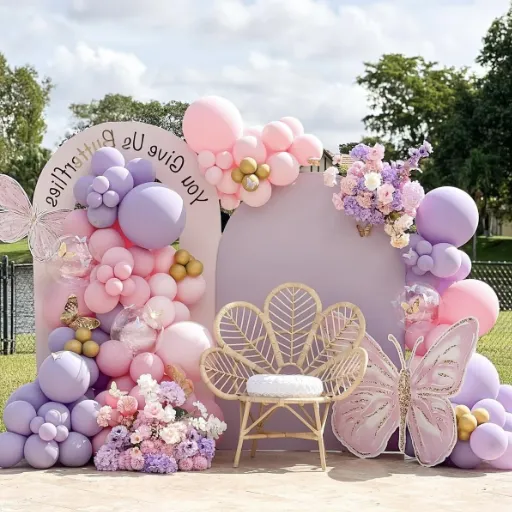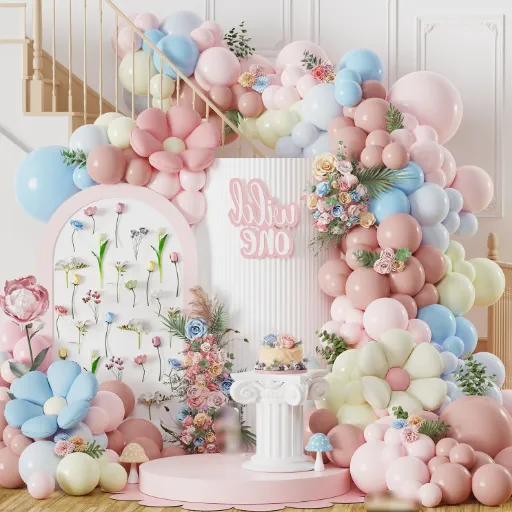
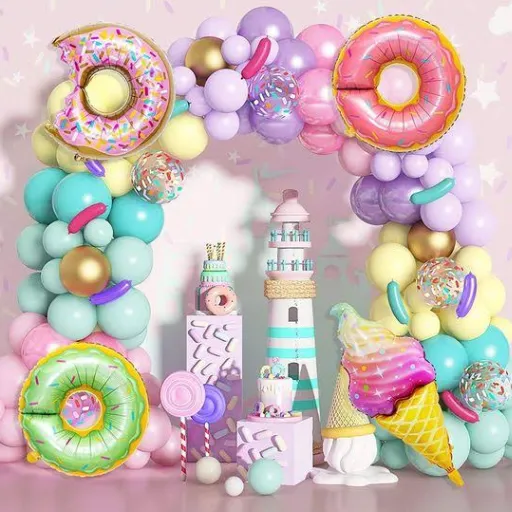
There are seven main types of balloon arches: classic spiral, organic, half (demi), string of pearls, link-o-loon, packed multi-row and foil. What separates them is how the balloons attach. That one detail decides the balloon count, the build time and the price far more than the colour scheme does.
Two arches can look identical in a photograph and differ by $600 on the invoice. One is a single line of 18 balloons. The other is 300 packed five deep around a frame. Both are “a balloon arch” in the caption.
That’s the problem with this question. Search for types of balloon arches and you get six different lists. Google’s own answer mixes frames, strings, density and foil as if they were interchangeable. So people come away unsure whether “string of pearls” is a type or a technique.
It’s both. This guide sorts the balloon arch types out in one place, with the counts and price bands the other guides leave out.
Key Takeaways
- The seven types split across three attachment methods (frame, line, self-linking) and two densities (single row, packed). Name both and you can describe any arch you see.
- Type sets the count before anything else: a classic spiral runs 7 to 10 balloons per foot, an organic build 9 to 13, a string of pearls about 1.
- Half (demi) arches are the most common format in real listings, and they use roughly half the balloons of a full arch.
- Live US listings run from $85 for a single-line arch to $1,000 for a mega organic, with a median near $450.
- Foil, link-o-loon and string of pearls are material or attachment choices, not shapes. Any of them can be built as a classic or an organic.
If you’re specifying an arch for a venue or a retail order, we manufacture the balloons and quote to your span, type and palette.
What Counts as a Balloon Arch?
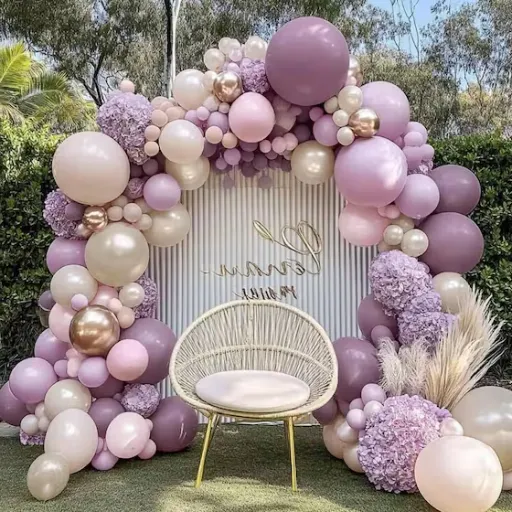
A balloon arch is a curved balloon structure that spans an opening, a table or a stage, either freestanding on a frame or suspended from a line or ceiling. The curve is the defining feature, and it’s what makes an arch different from a garland. Balloon arch shapes vary enormously within that definition.
Garlands and arches share balloons, cluster technique and most of the vocabulary, but they’re different objects. A garland drapes and attaches to a wall, table edge or backdrop. An arch stands, or appears to. Our guide to covers that line in detail.
Three things vary independently within arches. Almost every confusing list online mixes them up:
- How the balloons attach. To a rigid frame, to a line or strip, or to each other with no support at all.
- How densely they are packed. A single row, a four-balloon cluster, or a multi-row mass thick enough to hide the frame.
- What the balloons are made of. Latex, foil, or a specialty latex with a built-in tail.
Hold those three axes and every type name you meet fits somewhere. If you want the picture-led version first, our page shows each one built.
The 7 Types of Balloon Arches
Every type below follows the same five questions: what it is, how the balloons attach, how many per foot, what it costs, and how it fails. That consistency is deliberate. Once you can answer all five for any arch you see, the names stop mattering.
1. Classic Spiral Arch
The classic spiral balloon arch is balloons of one size, inflated to a consistent diameter and wound in a repeating pattern around a frame. It’s the arch most people picture when they hear the word, and the most forgiving first build.
Balloons attach to a PVC pipe, a metal conduit or a freestanding base, usually in four-balloon clusters tied at even intervals. The spiral effect comes from rotating each cluster slightly as you go, which is why two colours read as a barber’s pole.
Count depends on spacing, and this is where published figures disagree. A classic spiral runs about 7 to 10 balloons per foot of span, depending on how tightly you space the clusters. The reference table puts a 10-foot arch at 80 to 100 balloons in its 11-inch column, which is 8 to 10 per foot and lands inside that band.
Observed US listing prices run $120 to $640, with a median around $437 across 18 listings we captured on 14 November 2026. A 7-foot classic typically sits near $400. A 40-foot spiral sits near $580.
It fails by sagging at the apex. That’s a frame problem, not a balloon problem, and it’s why the frame matters more than the balloons here. It’s also the one classic balloon arch problem you can spot from the doorway before the guests arrive.
2. Organic Balloon Arch
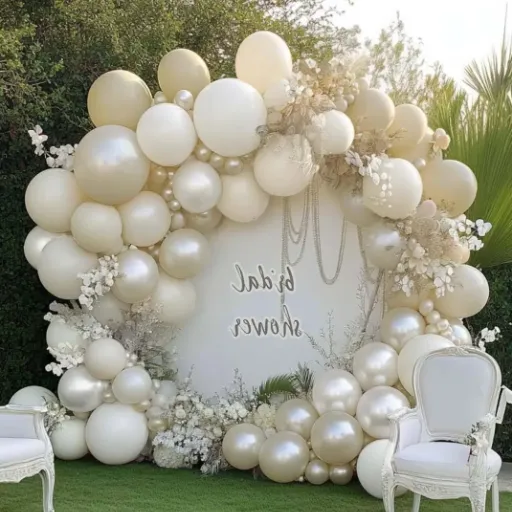
The organic balloon arch uses mixed sizes, uneven clusters and deliberate gaps. Five-inch balloons fill between 11-inch ones, and a few 16-inch or larger pieces act as anchors. Nothing repeats.
The attachment is usually a decorating strip or a flexible frame, and the balloons are packed rather than spiralled. Because there is no pattern to follow, the builder makes placement decisions the whole way along, which is the real reason this type costs more.
It also takes more balloons. Industry guidance puts organic builds 20 to 30 percent above a structured arch at the same span. In practice that means 9 to 13 balloons per foot once fillers are counted, against 7 to 10 for a spiral.
Prices run higher too. Across 22 organic listings, observed prices ran $300 to $1,000, median $505. A 6×6-foot organic arch sits near $345. A “mega” organic sits at $1,000.
The failure mode is specific and worth knowing: a badly mixed organic arch reads as a lumpy tube. Uniform 11-inch balloons in irregular clusters look worse than a clean spiral, because the eye wants either order or genuine variety and rejects the in-between. The size ratio does the work, and our walks through the mixing.
3. Half (Demi) Arch
A half arch rises from one anchor and stops, or tapers, rather than completing the span. It’s the cheapest balloon arch type per usable foot and, in the listings we captured, the most common format sold without saying so.
Attach it like a full arch, on a frame or strip, but anchor only one end. The other floats against a wall or tapers into a cluster at table height.
Balloons drop by roughly half: cut the full-arch count and you’re close. A 6-foot half arch sits around 20 to 25 balloons in an 11-inch build, and a 10-foot half around 40 to 50.
Prices in the captured listings ranged from $150 for a half arch to $750 for a 30-foot organic demi, with most organic halves landing between $450 and $500.
It fails by looking unfinished if the taper is abrupt. A half arch needs its low end to resolve, either into a table arrangement or into a deliberate cluster, or it reads as an arch someone abandoned.
4. String of Pearls Arch
A string of pearls balloon arch is a single line of evenly spaced balloons on a thin line, with no clusters and no dense packing. It’s the minimalist option, and the cheapest type by a wide margin.
Balloons attach to monofilament or a similar clear line, spaced roughly one balloon apart, with weighted clusters at each end. They can be air-filled or helium-filled; helium versions float above the line rather than hanging from it.
Count is the easiest of any type: about one 11-inch balloon per foot of line, per . A 10-foot span needs about 10 balloons, plus the end clusters.
Observed prices ran $85 to $200, median $144 across seven listings. A nine-balloon single line at $85 and a 18-balloon line at $165 both appeared on the same search page.
It fails by dangling. Spacing that looks even on a workbench rarely looks even once the line is under tension, and a single slipped knot is visible from across the room.
5. Link-o-Loon (Linking) Arch
Link-o-loon balloons have a built-in tail at the top, so they knot to each other end to end with no frame and no line. The result is a continuous chain that holds its own curve.
This is the only type where the attachment is the balloon itself. It’s also the one most often mislabelled a “no-frame arch”, which is true but incomplete: the balloons do structural work, not just decoration.
Counts track the string of pearls closely, since it is one balloon per link, though the curve needs more balloons than a straight line at the same span. Most guides put a 10-foot link-o-loon arch at 12 to 16 balloons in 12-inch, with 6-inch versions needing roughly double.
We didn’t capture enough link-o-loon listings to publish a reliable price band, and we’d rather leave a gap than invent one. Treat pricing requests as a quote, not a catalogue figure.
It fails when the chain twists. Because there’s no frame to correct against, a link-o-loon arch that rotates during install can’t be pulled straight again without re-threading.
6. Packed (Multi-Row) Arch
Packed, or multi-row, arches are built from several rows of clusters, layered until the structure is thick and opaque. The pattern on the surface can be a spiral, a zig-zag, an arrow, a square block or a colour-blocked sequence.
Balloons attach to the same frames as a classic arch, but each cluster point carries two, three or four clusters instead of one. That is the whole difference.
Count rises accordingly. Expect roughly 1.5 times a single-row arch, so about 10 to 15 balloons per foot on an 11-inch build.
Pricing follows density. Captured listings for packed and multi-row builds ran $650 to $800 for a 40-linear-foot mixed arch. That tracks the balloon volume, not the span alone.
It fails by going convex. Over-packing a lightweight frame bows it outward in the middle, and the arch starts to look like a bridge that is about to give. Frames rated for the load are the fix, and that is a specification issue, not a decorating one.
7. Foil (Mylar) Arch
A foil balloon arch is built wholly or partly from metallic foil balloons rather than latex. Foil holds air and helium far longer than latex and keeps a high-shine finish that latex loses as it oxidises.
Attachment is normally a frame or a pre-formed foil arch kit, since foil balloons don’t cluster or tie the way latex does. Many foil arches are sold as shaped kits rather than built from loose balloons. Our covers the mylar and shaped formats.
Foil has the least reliable public data. One foil arch listing appeared in our capture, at $799.99, and a single observation isn’t a band. What’s defensible: foil is chosen for heat resistance and longevity, not cost, and it’s usually an accent on a latex build rather than the whole structure.
It fails by creasing. Foil doesn’t recover from a fold, and an over-inflated foil balloon in a warm room will split along the seam rather than stretch.
Table 1: The seven types at a glance
| Type | How balloons attach | Balloons per foot (11-inch) | Typical span | Observed US price |
|---|---|---|---|---|
| Classic spiral | Frame, 4-balloon clusters | 7–10 | 6–10 ft | $120–$640 (median $437) |
| Organic | Strip or flexible frame, packed | 9–13 | 8–12 ft | $300–$1,000 (median $505) |
| Half (demi) | Frame or strip, one end only | ~3.5–5 | 4–8 ft | $150–$750 |
| String of pearls | Clear line, spaced | ~1 | 6–12 ft | $85–$200 (median $144) |
| Link-o-loon | Balloons link to each other | ~1.2–1.6 | 6–12 ft | Quote only |
| Packed multi-row | Frame, multi-cluster | 10–15 | 8–20 ft | $650–$800 at 40 ft |
| Foil | Frame or pre-formed kit | Varies by kit | 4–10 ft | Insufficient data |
How to Choose Between Types of Balloon Arches for Your Space
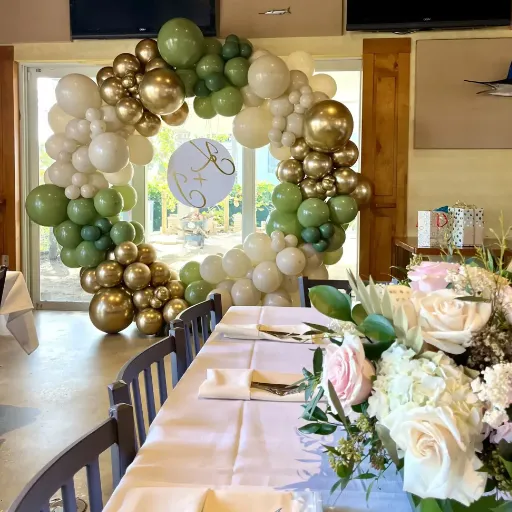
Start with the room, not the mood board. The space eliminates most balloon arch styles before taste gets involved.
Ceiling clearance. Leave at least 12 inches between the apex and the ceiling. In a room with an 8-foot ceiling that caps the peak at 6.5 to 7 feet, which rules out a full-size classic arch.
Doorway width. A standard doorway is 3 feet wide. Add 6 inches of overhang per side and you have a 4-foot span, which is a half arch or a minimal string of pearls.
Walk-under height. If guests pass through, clearance under the apex needs to be 6.5 feet minimum. That is a different number from the span. A 10-foot span produces roughly 12 to 14 feet of curve, which the explains.
Indoors or out. Foil holds up better outdoors. Latex under-inflated by about 10 percent survives a hot afternoon that would split a fully inflated one.
Then match the type to the occasion.
Table 2: Type by occasion and setting
| Occasion | Best type | Second choice | Avoid |
|---|---|---|---|
| Wedding ceremony or reception | Organic | Half arch (demi) | Packed multi-row, too heavy for most venues |
| Birthday party | Classic spiral | Organic | String of pearls, reads as too plain |
| Baby shower | Organic | Half arch | Foil, wrong texture for the setting |
| Corporate or grand opening | Classic spiral | Packed multi-row | Organic, reads informal for brand events |
| Photo backdrop | Organic or half arch | Packed multi-row | String of pearls, too sparse in photos |
| Retail window or entrance | Packed multi-row | Classic spiral | Link-o-loon, too light for the volume |
How Many Balloons Does Each Type of Balloon Arch Need?
The first number to fix is balloons per foot of span, not of curve. Span is base to base. Curve is longer, and reference tables already allow for it.
The table below derives from the 11-inch column of the HICO reference table, the only externally published span-based count we could verify, adjusted by a stated multiplier per type. It’s a planning figure, not a quote.
Table 3: Balloon count by type and span (11-inch basis)
| Type | 6 ft | 8 ft | 10 ft | 12 ft |
|---|---|---|---|---|
| Classic spiral | 40–50 | 55–70 | 80–100 | 95–120 |
| Organic, mixed sizes | 52–65 | 72–91 | 104–130 | 124–156 |
| Half (demi) arch | 20–25 | 28–35 | 40–50 | 48–60 |
| String of pearls | 6–7 | 8–9 | 10–11 | 12–13 |
| Packed multi-row | 60–75 | 82–105 | 120–150 | 142–180 |
Read the columns as balloons, and the rows as the four build densities. Classic is the HICO figure unchanged. Organic is 1.3 times classic, which covers the filler balloons. Half is half of classic, which is the cut HICO recommends. Packed is 1.5 times classic, for the extra rows.
One adjustment applies on top of the table: add 10 to 15 percent for breakage and inflation variation. The mixed-size uplift is already in the organic row, which is why it runs 1.3 times classic rather than level with it.
For a fixed number, the site’s takes a span and returns a count, if you’d rather not work through the table by hand.
A worked example: a 10-foot organic arch is 104 to 130 balloons, plus 10 percent spares, so about 115 to 143. Split that 70 percent 11-inch, 25 percent 5-inch and 5 percent 16-inch and you have your shopping list.
The range is wide because density is a choice, and the balloon count is how you decide which one you’re building.
What Do the Different Types of Balloon Arches Cost?
Cost tracks the count far more than the span, which is why a 6-foot organic arch can cost more than a 12-foot spiral.
We captured 133 de-duplicated product listings from these search results on 14 November 2026, then grouped them by type. Those are US decorator and retail listings, not our prices, and delivery and installation are often extra.
Table 4: Three routes at roughly 8 feet
| Route | Classic spiral | Organic | String of pearls |
|---|---|---|---|
| Loose balloons (DIY) | $30–$60 | $45–$90 | $10–$20 |
| Kit | $33 median | $60–$130 | Not sold as a kit |
| Installed | $437 median | $505 median | $144 median |
The kit median of $33 covers 28 listings, and it’s worth understanding what that buys. Most sub-$40 kits contain 100 to 150 balloons in three sizes plus a strip, which builds a 6 to 8 foot organic or classic arch and no more. Kits at $85 and above contain enough for a 10-foot build, and often a frame.
The spread from a $10 listing to a $1,000 listing is not a pricing scandal. It’s the difference between a bag of balloons and a delivered, installed, insured installation at a venue. Our breaks down what sits inside each tier.
Which Type of Balloon Arch Should You Order?
If you’re sourcing for a venue, a retail line or a chain of events, the type decision is a specification decision. It has four fields: span, type, palette and quantity. Get those four into a brief and the rest follows.
A few practical notes from the manufacturing side. Mixed-size organic builds need three or four sizes in proportion, so order by size rather than by total count. Packed arches stress the frame, so specify the load alongside the count. Foil and latex in the same palette rarely match exactly, because foil is metallic and latex is matte.
Our covers 5, 9, 11, 16, 24 and 36 inch sizes, with custom sizing from 9 to 36 inches. Print, colour matching and packing by size are all part of a order.
Frequently Asked Questions
What are the different types of balloon arches? Seven: classic spiral, organic, half (demi), string of pearls, link-o-loon, packed multi-row and foil. They differ mainly in how the balloons attach and how densely they are packed.
How many types of balloon arches are there? Most guides say two, traditional and organic, because those are the two patterns. Once you count attachment methods and materials separately, the practical number of balloon arch types is seven.
What is the difference between a classic and an organic balloon arch? A classic arch uses one balloon size in a repeating pattern. An organic arch uses several sizes in uneven clusters with deliberate gaps. Organic takes 20 to 30 percent more balloons and costs more to build.
What is a string of pearls balloon arch? A single line of evenly spaced balloons on a clear line, about one balloon per foot. It is the cheapest arch type and the sparsest.
What is a link-o-loon arch? An arch made from balloons with built-in tails that knot end to end, so it needs no frame and no line. The balloons themselves hold the structure.
What is a demi or half balloon arch? An arch that rises from one anchor and tapers rather than completing the span. It uses roughly half the balloons of a full arch and is the most common format sold by decorators.
Which type of balloon arch is cheapest? String of pearls, at about one balloon per foot and observed prices from $85. A half arch is the cheapest way to get a full-looking arch.
Can you make a balloon arch without a frame? Yes. String of pearls, link-o-loon and any arch attached to a wall or ceiling need no freestanding frame. Classic, organic and packed arches normally need one.
Conclusion
Seven types, three attachment methods, two densities. That’s the whole vocabulary, and it’s enough to describe any arch you see in a photograph or a supplier catalogue.
The decision order matters more than the names. Set the span against the room and the ceiling, then pick the density you can build or afford. Choose the type that gets you that density with the balloons you have. Colour and finish come last, because they change the look without changing the cost.
The number that decides everything else is balloons per foot. A classic spiral runs 7 to 10. An organic build runs 9 to 13, and a string of pearls runs about 1. Everything else here follows from that.
If you are building to a space and want the balloons cut and packed to your mix, send us the span, the type and the palette. We will tell you what the count comes to and what it costs at your scale.