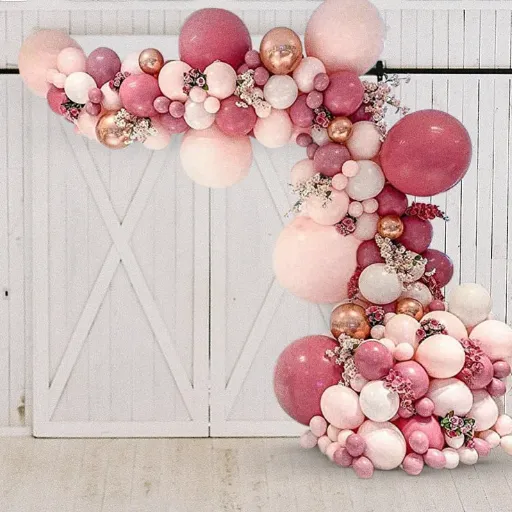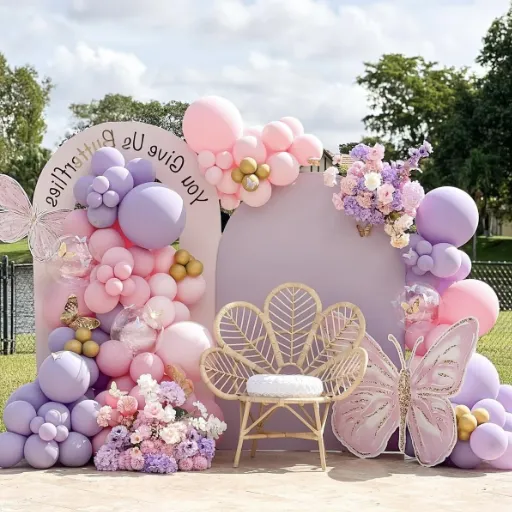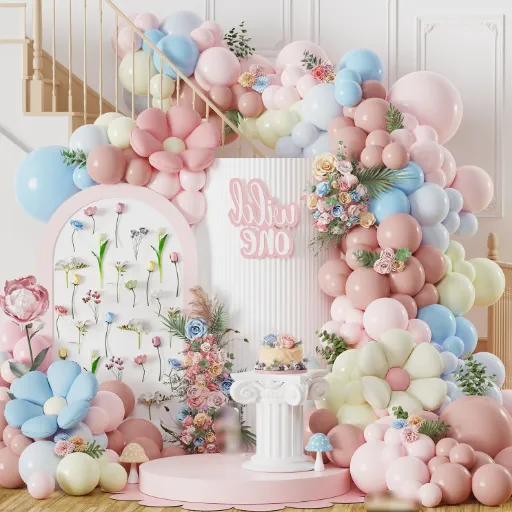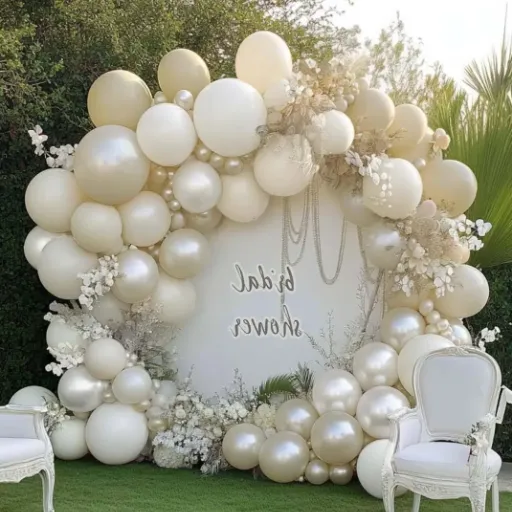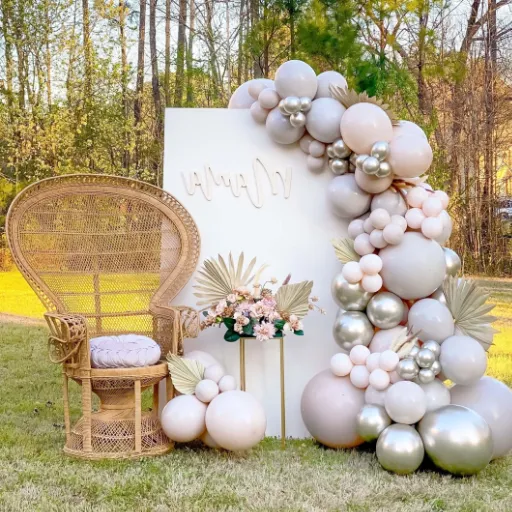
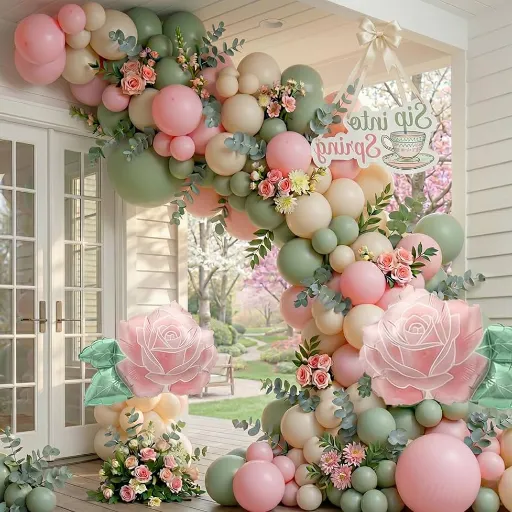
A balloon arch with flowers is an air-filled balloon arch with fresh, artificial, dried, paper, or balloon flowers worked into three to five focal zones. The flowers attach to the frame or balloon strip, not to the balloon surface, and they should cover roughly 20 to 30 percent of the visible structure.
That ratio is the difference between a designed arch and a decorated one. Most first attempts fail on placement, not on flower choice. The blooms get spread evenly, the greenery gets tucked into every gap, and the arch starts to look like a hedge with balloons inside it.
You’ve probably seen that arch at a party. You may have built it. The good news is that the fix is simple and cheap: fewer flowers, better placed.
This guide covers the decisions in the order they matter. First the structure, then the flower type, then the stem count, the attachment method, the occasion, and the budget. By the end you will know exactly what to buy and where each stem goes.
Key Takeaways
- Put flowers in 3 to 5 focal zones, not evenly around the arch. They should cover about 20 to 30 percent of the visible structure.
- A 10-foot arch at medium coverage needs roughly 8 to 12 greenery stems, 12 to 20 focal blooms, and 10 to 15 filler stems.
- Use artificial flowers for advance builds, fresh flowers for short events, and add fresh stems 2 to 6 hours before guests arrive.
- Attach flowers to the frame or strip with floral wire or zip ties. Never pierce a latex balloon, and never use hot glue on one.
- Budget $40 to $250 for flowers on a 10-foot DIY arch, depending on type. A professionally installed arch with flowers typically runs $250 to $1,500.
If you already know your color palette, start with the balloons. Our come in sizes from 5 to 36 inches and can be color-matched to your flowers.
What Is a Balloon Arch With Flowers?
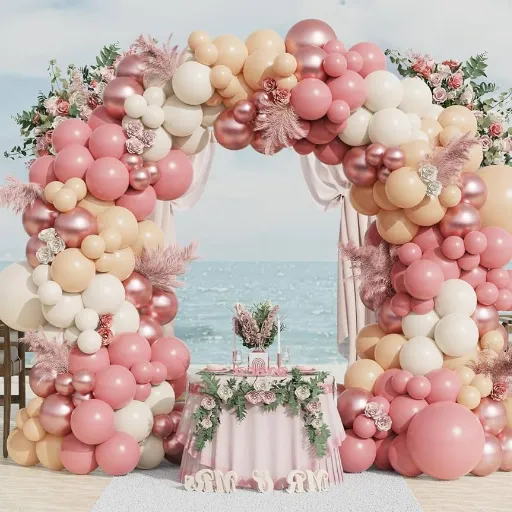
A balloon arch with flowers combines two structures: a curved balloon base and a floral layer that follows the same curve. The balloons create volume and height. The flowers add texture, scale, and a focal point for photographs. You’ll also see it called a flower balloon arch or a floral balloon arch; the build is the same.
The term gets confused with a balloon garland with flowers. A garland is a flexible strand that drapes across a wall, table, or backdrop. An arch is a shaped structure, usually built on a frame, a strip, a hoop, or a wall-mounted grid. The flower technique is similar, but the structure changes how you attach and balance the weight.
If you want the draped version, our guide covers that build step by step. This page focuses on the arch.
There are four common arch structures:
- Strip arch. A plastic decorating strip curved into shape and anchored at both ends. Light, cheap, and best for garlands and half arches.
- Frame arch. A reusable metal or fiberglass frame with a base. Strong enough for heavy greenery and fresh flowers.
- Hoop arch. A circular frame, often used for photo backdrops and baby showers. Needs even weight distribution.
- Wall-mounted arch. A strip or wire grid fixed to a wall. Good for flat backdrops, limited for deep flower clusters.
The structure decides how much flower weight you can carry. A strip arch can handle light faux stems and small water tubes. A frame arch can handle floral foam, heavy palm leaves, and a full floral side.
Imagine Priya, planning a 10-foot baby shower arch in a rented hall. She bought 120 balloons, 18 roses, and 10 eucalyptus stems. She placed one rose every few balloons and filled every gap with greenery. The arch looked busy and a little flat.
She pulled the flowers out, grouped them into three zones, and rebuilt it in 40 minutes. Same materials. The second version looked designed because the flowers had somewhere to be.
That’s the whole design principle. Flowers are accents with a job, not decoration sprinkled on top. Partner with Trading Shanxi Co., Ltd. to make every celebration stand out.
Fresh vs Artificial Flowers: Which Works Best?
The short answer: artificial flowers win for advance builds, multi-day displays, and outdoor events. Fresh flowers win for short events where scent and texture matter.
Dried flowers suit boho and fall palettes. Paper flowers are the budget and craft option. Balloon flowers are the theme option.
Most professional-looking DIY arches use a hybrid: faux greenery for structure and volume, plus a few fresh focal blooms added at the end. That gives you the best of both materials without the wilt risk.
Fresh flowers
A balloon arch with real flowers looks better than any imitation. It also has a clock on it. Once cut stems are out of water, water loss outpaces uptake, and blooms can flag within hours, especially in a warm room. notes that cut flowers need water, food, sanitation, and cool temperatures to last, and that vase life varies by species: carnations can hold for one to two weeks, while roses have a shorter window.
On an arch, treat fresh flowers as a short-event material. Plan for four to eight hours of good appearance in a cool room, and two to four hours outdoors in heat. Add them last, use water tubes for the important blooms, and keep a mister handy.
Preparation matters more than the flower choice. Buy two to four days ahead so buds can open, trim stems at an angle, strip leaves below the water line, and condition the stems in clean water with flower food. Remove thorns and sharp points before they go near latex.
Artificial flowers
Artificial flowers for a balloon arch are the practical choice for most builds. They weigh little, hold their shape for days, don’t wilt under lights, and can be reused. Quality varies enormously.
A cheap stem looks flat and shiny under flash photography. A better one has layered petals, wired stems, and a realistic center.
Look for flexible wire stems. They let you bend a bloom toward the camera and tuck the stem into a gap without a support. Trim the stem to 4 to 6 inches, group two or three blooms with a few leaves, and wrap the base in green floral tape to make an insertable pick.
The tradeoffs are dust, UV fading, and storage. Keep faux flowers in a lidded bin, away from direct sun, and fluff them before each use. Outdoors, secure every stem to the frame. A light silk rose will leave on the first gust.
Dried flowers and grasses
Dried pampas, bunny tails, preserved eucalyptus, and dried palm spears give an arch the loose, textured look that photographs well in boho and fall settings. They’re light, reusable, and need no water.
They’re also brittle. Dried grasses shed, snap when bent, and droop in humid weather. Keep them away from open flames, candles, and heat lamps. A dried arch near a fire pit is a fire hazard, not a design choice.
Paper flowers
A balloon arch with paper flowers is the cheapest way to add a lot of color and scale. Paper is lightweight, easy to make, and available in any color. It also hates rain, crushes in storage, and burns. Use paper indoors, away from candles, and plan to replace it after one event.
Paper works best as a focal accent, not as full coverage. A cluster of five oversized paper blooms at the base of an arch can carry the whole design.
Balloon flowers
Balloon flowers are made from twisting balloons, usually 260s, around a small round balloon or a clip. They need no water, match the arch exactly, and survive heat better than fresh blooms. The cost is labor: each flower takes a few minutes, and a full arch can need 20 or more.
They suit birthday parties, circus themes, and photo backdrops. They’re less convincing at a black-tie wedding. Use them where the playful look fits.
Flower type comparison
| Type | Look | Longevity on an arch | Weight | Cost band for 10 ft | Best for |
|---|---|---|---|---|---|
| Fresh | Best texture and scent | 4 to 8 hours cool, 2 to 4 hours hot | Heavy, needs water | $80 to $250 | Weddings, short photo shoots |
| Artificial | Consistent, reusable | 1 to 3 days indoors | Light | $40 to $120 | Most DIY arches, outdoor events |
| Dried | Textured, boho | Months if kept dry | Very light | $50 to $150 | Fall, boho, desert themes |
| Paper | Bold, craft | Indefinite indoors | Very light | $20 to $80 | Budget parties, indoor backdrops |
| Balloon | Playful, on-theme | As long as the balloons | Light | $15 to $60 plus labor | Birthdays, kids’ parties |
Best stems by role
Choosing balloon arch flowers by role is more reliable than choosing by color alone. You need three jobs filled: focal, filler, and greenery.
- Focal blooms: roses, peonies, dahlias, orchids, sunflowers, hydrangeas. Use three to seven per focal zone.
- Filler blooms: baby’s breath, chrysanthemums, solidago, waxflower, small daisies. Use them to soften the edge between flowers and balloons.
- Greenery: eucalyptus, Italian ruscus, ivy, palm fronds, monstera leaves, fern. Use it to trail outward and downward.
- Dried accents: pampas, bunny tails, preserved palm, dried lagurus. Use sparingly, one texture per zone.
If you need balloons printed to match a brand color or a specific flower, our page explains the color-matching process.
How Many Flowers and Balloons Do You Need?
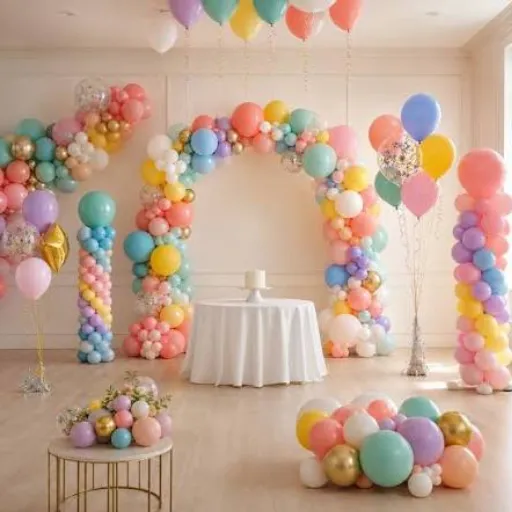
Start with the balloon count, because the flowers fill the gaps the balloons leave. A classic arch needs about four to six balloons per foot. A fuller organic arch needs eight to ten per foot. Our guide to breaks that down by balloon size.
For flowers, use coverage level rather than a single rule. Light coverage means flowers in three zones with visible balloon between them. Medium coverage means fuller zones with greenery trailing out. Full coverage means roughly half the arch reads as floral.
| Arch length | Light coverage | Medium coverage | Full coverage |
|---|---|---|---|
| 6 ft | 4 to 6 greenery, 6 to 10 focal | 6 to 10 greenery, 10 to 16 focal | 12 to 18 greenery, 20 to 30 focal |
| 10 ft | 6 to 8 greenery, 8 to 12 focal | 8 to 12 greenery, 12 to 20 focal | 18 to 25 greenery, 30 to 45 focal |
| 15 ft | 10 to 12 greenery, 12 to 18 focal | 12 to 18 greenery, 20 to 30 focal | 25 to 35 greenery, 45 to 65 focal |
| 20 ft | 12 to 16 greenery, 15 to 24 focal | 16 to 24 greenery, 25 to 40 focal | 35 to 50 greenery, 60 to 90 focal |
Add 10 to 15 percent extra stems for breakage and design changes. Add the same buffer to balloons, especially in warm weather when dark colors pop in direct sun.
The focal zone count scales with length:
- 6 to 10 feet: three zones
- 12 to 15 feet: four zones
- 18 to 20 feet: five zones
Put the largest zone where the arch is fullest, usually a lower corner. Put the second zone diagonally opposite, higher on the other side. Let greenery trail outward and down from each zone. Leave the space between zones mostly balloon.
If you’re building from a kit, our explains what is included and what you still need to buy. Most kits supply the frame or strip and the ties, not the flowers.
How to Attach Flowers to a Balloon Arch
Attach flowers to the arch structure, not to the balloon surface. The balloons are under tension. A wire, pin, or hot glue joint concentrates stress at one point and shortens the life of the balloon.
Step 1: Build and hang the balloon base first
Finish the balloon arch before you open a single flower. Inflate, attach, hang, and adjust the shape. You need to see the final gaps before you can place anything.
Under-inflate balloons to about 85 percent. They sit closer together, feel softer against stems, and pop less often. Use three sizes, typically 5-inch, 11-inch, and 16-inch, and place the largest balloons first.
Step 2: Map the focal zones
Step back from the arch and mark three to five zones with painter’s tape on the floor or a light touch on the frame. Mark the center of each zone, not its edges.
A zone is roughly 12 to 18 inches wide on a 10-foot arch. It should follow the curve, not sit as a circle pasted onto it. The biggest zone goes at the fullest part of the arch.
Step 3: Add greenery first
Greenery creates the structure the flowers sit in. On a balloon arch with flowers and greenery, start with the longest stems and let them trail outward and downward. Tuck the stem ends into gaps between balloon clusters until they reach the strip or frame, then secure them.
Don’t pierce a balloon to hold a stem. If a stem won’t stay, wire it to the strip or zip-tie it to the frame. For light faux greenery, a loop of floral wire around the strip works well.
Step 4: Add focal blooms
Place the largest blooms first, then medium, then small. Aim for three to seven focal blooms per zone on a 10-foot arch, with the largest at the center of the zone. Turn each bloom slightly toward the viewer.
Group blooms in odd numbers. A cluster of three roses reads better than two or four. Mix one large bloom with two smaller ones and a spray of filler.
Step 5: Fill gaps and step back
Add filler stems where the transition between flowers and balloons looks abrupt. Step back every few minutes. The arch looks different from three feet away than it does from ten.
Stop before the arch looks full. The balloons should still lead. If you can see more flower than balloon, remove a stem.
Attachment methods by structure
| Structure | Best method | Avoid | Notes |
|---|---|---|---|
| Strip arch | Floral wire around the strip, tuck stems into gaps | Piercing balloons, hot glue | Keep clusters light; the strip carries less weight |
| Frame arch | Zip ties, floral wire, floral foam cage for fresh | Tape alone | Best choice for heavy greenery and fresh flowers |
| Hoop arch | Zip ties at balanced clock positions | Weight on one side | Weigh the bottom or anchor the base |
| Wall-mounted | Wire grid, command hooks, zip ties | Adhesive tape on painted walls | Plan the removal before installation |
Fresh flower mechanics
Fresh flowers need water. Use floral water tubes for individual blooms, or a soaked floral foam cage for a dense cluster. Hide the tube behind a balloon or inside the greenery. Refill tubes on site with a small squeeze bottle.
If you use floral foam, soak it fully before adding stems. Dry foam pulls water from the stems and speeds wilting. Keep the foam out of direct sun and check it every few hours.
Five mistakes that ruin the look
- Hot gluing flowers to balloons. The heat weakens latex and causes pops, often hours later.
- Piercing balloons with wire or pins. A single puncture can bring down a cluster.
- Spacing flowers evenly. Even spacing looks mechanical. Group them.
- Using too much greenery. Greenery should frame the balloons, not replace them.
- Leaving heavy stems unsupported. A wet foam cage or a heavy palm frond needs a frame, not a strip.
Safety notes
Latex balloons pose a choking hazard. The requires a warning that children under eight can choke or suffocate on uninflated or broken balloons, and that adult supervision is required. Keep uninflated balloons and broken pieces away from young children.
Weight the frame, especially outdoors. A 10-foot arch with flowers catches wind like a sail. Use water or sand bags on both feet, and guy-line the frame if the venue allows it.
Keep dried flowers, paper flowers, and tissue accents away from candles, heaters, and fire pits. If the venue uses open flame, choose fresh or artificial blooms and keep them clear of the flame zone.
Imagine Marcus, building a 12-foot wedding arch in a garden. He hot-glued silk roses directly to the balloons because it was fast. By mid-afternoon, nine balloons had popped and the glue marks were visible.
He rebuilt the focal zones with floral wire and zip ties in about an hour. The second version survived the ceremony and the photos.
Balloon Arch With Flowers Ideas for Weddings, Showers, and Parties
The occasion sets the palette, the flower scale, and the coverage level. A wedding arch usually wants restraint. A birthday arch can carry more color and novelty. For shapes and color stories beyond flowers, browse our gallery.
Wedding
Use white, ivory, blush, champagne, or sage. Roses, peonies, dahlias, and orchids carry the focal zones. Eucalyptus and ruscus trail down the sides. A full arch frames the ceremony; a half arch frames the sweetheart table.
Keep the flower load to medium coverage so the balloons still read. Add a monogram or date balloon only if the couple wants it. Our guide covers sizing and venue rules.
Baby shower
Pastel palettes work: blush, sage, butter yellow, cream, and soft blue. Dahlias, baby’s breath, and faux wildflowers suit the soft look. A hoop arch with flowers at the top and bottom is a strong photo backdrop.
Use faux flowers if the shower runs longer than four hours or the room is warm. Our page has more palette and setup ideas.
Birthday
Birthdays allow bold color and novelty. Wildflower arches, sunflower and daisy clusters, and dried grasses all work. Add number balloons or a name banner if the birthday person wants a focal point.
For a kids’ party, keep flowers high and secure. Avoid wire ends at child height, and skip latex balloons near children under eight.
Corporate
Corporate arches need a tight palette and a clean line. Use brand colors, white orchids, monstera leaves, and minimal filler. Custom-printed balloons can carry the logo without adding another visual element.
Keep the flower count low and the architecture sharp. A corporate arch should look like a brand activation, not a garden.
Seasonal
- Spring: tulips, ranunculus, cherry blossom branches, pastel balloons.
- Summer: tropical leaves, orchids, bright coral and teal.
- Fall: pampas, dried palm, rust and terracotta, sunflowers.
- Winter: evergreen, white roses, burgundy, silver and ice blue.
Our guide has palette pairings for each season.
Balloon Arch With Flowers Cost, Timeline, and Longevity
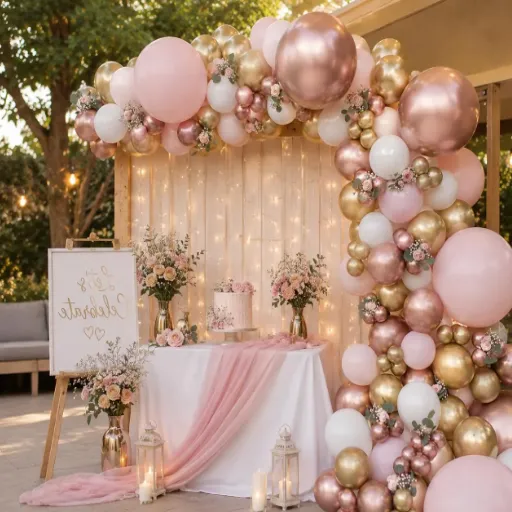
Flowers are usually the second-largest line in an arch budget, after labor. The balloon cost is predictable. The flower cost depends on type, season, and how much coverage you want.
What flowers cost for a 10-foot arch
These are planning estimates for medium coverage, not quotes. Prices vary by season, source, and stem size.
| Flower type | Flower and greenery cost | Mechanics | Total |
|---|---|---|---|
| Artificial | $40 to $120 | $10 to $25 | $50 to $145 |
| Fresh | $80 to $250 | $15 to $40 | $95 to $290 |
| Dried | $50 to $150 | $10 to $20 | $60 to $170 |
| Paper | $20 to $80 | $5 to $15 | $25 to $95 |
| Balloon flowers | $15 to $60 | $5 to $10 | $20 to $70 plus labor |
Add the balloon cost. A 10-foot DIY arch typically needs 70 to 100 balloons for a standard look, or 100 to 150 for a fuller organic look. Our covers balloons, frames, and installation separately.
A professionally installed arch with flowers typically runs $250 to $1,500, depending on size, flower type, and market. Fresh statement blooms and a tall frame push the number toward the top of that range.
Timeline that works backward from the event
- 7 to 10 days out: order flowers and balloons. Confirm colors and quantities.
- 2 days out: build and hang the balloon base. Keep it indoors, away from heat and sun.
- 1 day out: add faux greenery and artificial flowers. Check the shape.
- Event day, 2 to 6 hours before: add fresh flowers, water tubes, and final filler.
- 1 hour before: mist fresh blooms, check water, and step back for a final look.
If the event is outdoors in heat, shorten the fresh-flower window to two hours and keep the arch in shade until the ceremony.
How long it lasts
- Artificial flowers: one to three days indoors; bring them in overnight if the event is outdoors.
- Fresh flowers: four to eight hours in a cool room; two to four hours outdoors in heat.
- Dried flowers: months if kept dry and out of sun; avoid humidity.
- Paper flowers: indefinite indoors; replace after rain or crushing.
- Balloon flowers: as long as the balloons hold air, usually one to three days indoors.
Fresh flowers are sensitive to temperature, water stress, and ethylene. notes that cut flowers need consistent cold, clean water, and separation from ethylene sources. Keep the arch away from fruit bowls, especially bananas and apples, and away from direct sun and drafts.
For transport, build the arch in sections if possible. Carry it flat, support the frame, and reassemble on site. A fully dressed arch doesn’t fit through most doors.
If you need custom balloons for a large or brand-sensitive build, . We can match colors and print logos before the arch is built.
Conclusion: Plan the Flowers Before the Balloons
A balloon arch with flowers looks expensive when the flowers have a plan. Choose the type first, then the coverage, then the attachment method, then the timing. Those four decisions prevent most of the problems that show up on event day.
Use three to five focal zones. Keep flowers to 20 to 30 percent of the visible structure. Attach to the frame or strip, never through a balloon. Add fresh blooms last, and keep water and shade on your side.
The balloons are the easy part. They’re also the part you can customize. If you want a palette that matches your flowers exactly, explore our or send us your colors and quantities for a quote.
A balloon arch with flowers should look like it belongs in the room, not like a craft project that landed there. Plan the flowers, and the rest follows.
Frequently Asked Questions
How do you attach flowers to a balloon arch?
Wire the stem to the balloon strip or zip-tie it to the frame. Tuck light faux stems into gaps between clusters, and use water tubes for fresh blooms. Never pierce a balloon or use hot glue on latex.
Should I use real or artificial flowers on a balloon arch?
Use artificial flowers for advance builds, multi-day displays, and outdoor events. Use fresh flowers for short events where scent and texture matter, and add them two to six hours before the event. A mix of faux greenery and fresh focal blooms works well.
How many flowers do I need for a 10-foot balloon arch?
At medium coverage, plan on 8 to 12 greenery stems, 12 to 20 focal blooms, and 10 to 15 filler stems. At light coverage, cut that by about half. At full coverage, roughly double it.
How far in advance can I add flowers?
Add artificial and dried flowers one day ahead. Add fresh flowers two to six hours before the event, or two hours before an outdoor event in heat. Keep fresh stems in water until they go on the arch.
What greenery works best on a balloon arch?
Eucalyptus, Italian ruscus, ivy, palm fronds, monstera leaves, and fern are the most useful. Choose a trailing green for the edges and a broad leaf for the focal zones. Avoid any plant with thorns or sharp stems near latex.
Can I add flowers to a helium balloon arch?
Yes, but helium arches are harder to weight and anchor. Flowers add weight and catch wind. Use lightweight artificial stems, secure them to the frame rather than the balloons, and tether the arch. For most event builds, an air-filled arch is easier to control.
How much does a balloon arch with flowers cost?
A 10-foot DIY arch typically costs $120 to $400 in balloons, flowers, and mechanics. Artificial flowers sit at the low end; fresh statement blooms sit at the high end. Professional installation with flowers usually runs $250 to $1,500.
Can I make flowers out of balloons?
Yes. Twist 260 balloons into petals around a small round balloon or a clip. Balloon flowers need no water, match the arch exactly, and suit birthdays and playful themes. Allow a few minutes per flower and make extras for pops. They’re a practical way to add color to a balloon arch with flowers when fresh stems aren’t an option.