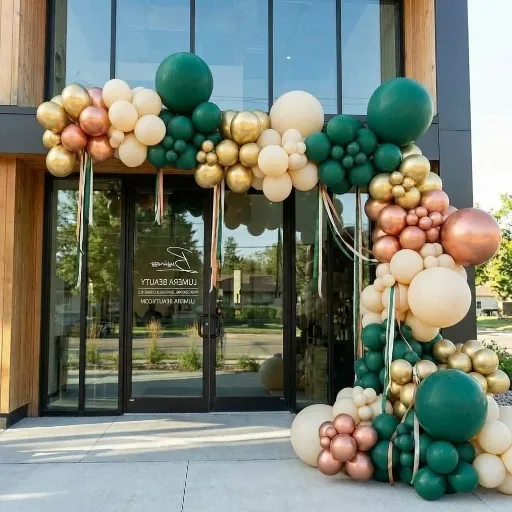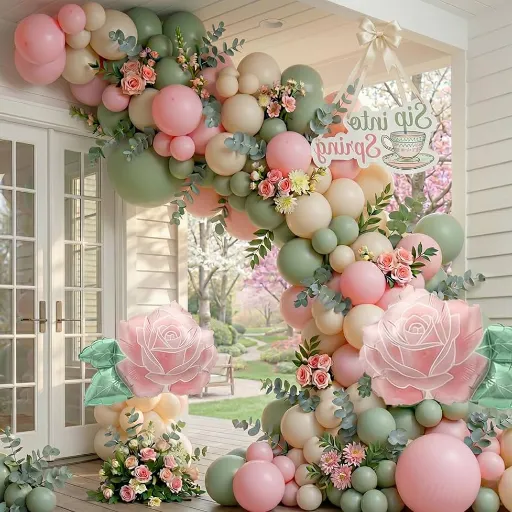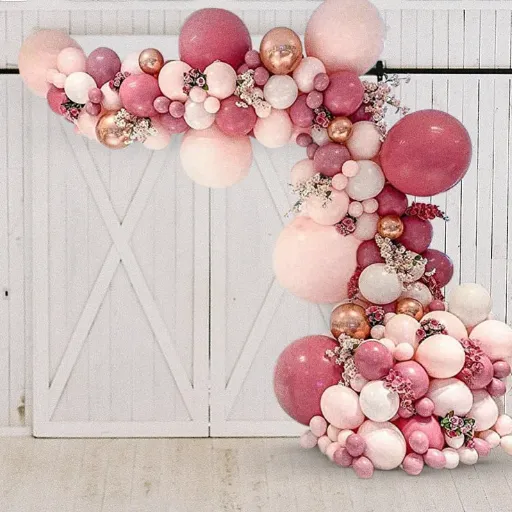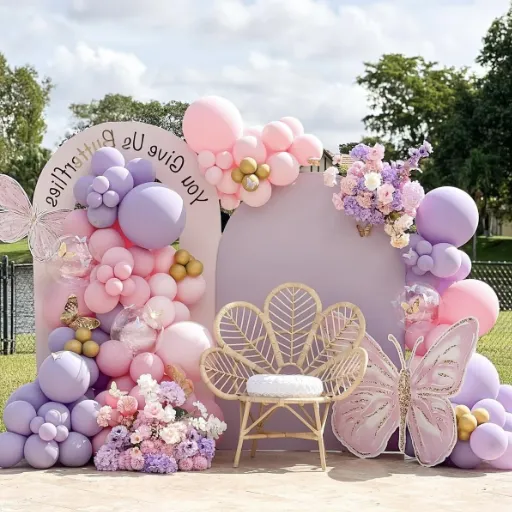

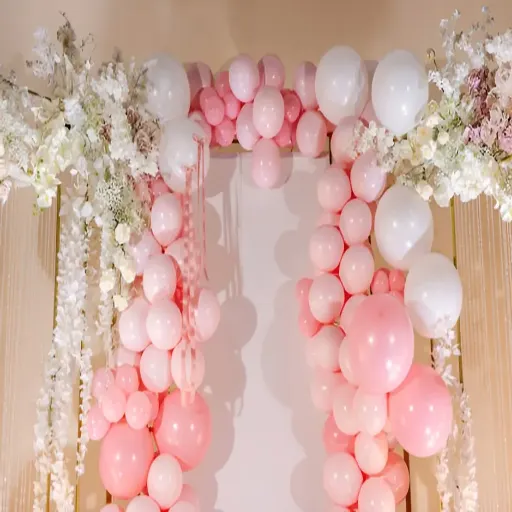
For a standard 10-foot arch built from 11-inch balloons, you need 80 to 100 balloons. That’s roughly 5 per foot of arch curve in a four-balloon cluster, or 7 per foot in a five-balloon cluster, plus a 10 to 15 percent buffer.
That single number is where every other guide stops, and it is also why those guides appear to disagree with one another when you read them side by side.
Search the question and you’ll find one page saying 5 to 7 per foot, another saying 8 to 10, a third saying 10 to 12. Read them closely and the real problem appears: none states which foot it is measuring or how many balloons it assumes per cluster. The straight line between the bases and the curve the balloons actually cover are different lengths. Once you know that, the numbers stop contradicting each other and start agreeing.
This page shows the arithmetic, so you can reproduce the number for any span, size and style instead of trusting a figure whose assumptions were never disclosed. You get one formula, a count table by span, worked examples and a buy list that accounts for the pops.
Key Takeaways
- A 10-foot span with a 7-foot peak has about 17 feet of curve to cover. That gap between span and curve is why published per-foot figures disagree.
- The working rate is 5.2 balloons per foot of curve for 11-inch balloons in four-balloon clusters, or 6.9 in five-balloon clusters.
- A 10-foot arch needs 82 to 96 balloons structured, 106 to 125 organic, so buy 150.
- Mixed-size organic builds use 20 to 30 percent more balloons than single-size structured builds at the same span.
- Buy in retail packs, not by the unit. A 150-balloon order means three 50-packs, or two 100-packs with spares.
If you’re specifying arches for a venue, a retail rollout or a decorating business, we manufacture the balloons and quote to your span and palette.
How Many Balloons for a Balloon Arch: The Short Answer by Span

Find your span in the left column. The count columns assume a typical arch height for that span, which is what the curve length depends on.
| Span (base to base) | Typical height | Curve length | 11″ structured | 11″ organic | Buy |
|---|---|---|---|---|---|
| 4 ft | 3 ft | 7 ft | 34–40 | 44–51 | 60 |
| 6 ft | 4.5 ft | 10.5 ft | 51–59 | 66–77 | 90 |
| 7 ft | 5 ft | 12 ft | 58–68 | 75–88 | 110 |
| 8 ft | 6 ft | 14 ft | 67–79 | 88–103 | 120 |
| 10 ft | 7 ft | 17 ft | 82–96 | 106–125 | 150 |
| 12 ft | 8 ft | 20 ft | 96–113 | 125–147 | 170 |
| 15 ft | 10 ft | 25 ft | 120–141 | 157–184 | 220 |
| 20 ft | 12 ft | 32 ft | 154–181 | 200–235 | 280 |
Two notes before you use it. First, structured means one balloon size in an even four-balloon cluster, which is the classic spiral look. Second, organic means mixed sizes in loose clusters with deliberate gaps, and it takes the higher figure. The Buy column takes the top of the organic range and adds 15 percent, then rounds up to a pack-friendly number.
If your span isn’t listed, the formula below takes thirty seconds and gives you a better answer than interpolation.
Why “How Many Balloons for a Balloon Arch” Answers Disagree
Three variables explain almost all of the spread. Separate them, and the disagreement disappears.
Span and curve are different lengths
Span is the straight line from base to base, and it’s what you measure in the room. Curve length, or run, is the distance a balloon actually travels. A 10-foot span with a 7-foot peak carries about 17 feet of curve.
So a guide quoting 8 balloons per foot of span and a guide quoting 5 per foot of curve can be describing the identical arch. Neither is wrong. However, they are using different rulers and not saying which.
Convert span and height to curve length with three cases, the same approximation Omni Calculator’s publishes:
- Wider than tall: curve = width + height
- Roughly square: curve = (1.5 × height) + width
- Taller than wide: curve = (2 × height) + width
A doorway arch 6 feet wide and 4.5 feet at the peak is wider than tall, so the curve is 10.5 feet. That is the number you multiply.
Cluster size changes the rate
Balloons attach in clusters. A four-balloon cluster is two tied pairs twisted together, and a five adds one more. The count follows directly:
- Four-balloon cluster: balloons = 4.8 × curve ÷ balloon diameter
- Five-balloon cluster: balloons = 6.3 × curve ÷ balloon diameter
The diameter and the curve have to be in the same unit. For 11-inch balloons, which is 0.917 feet, that works out to 5.2 balloons per curve foot in a four-cluster and 6.9 in a five-cluster. That’s the honest origin of the “5 to 7 per foot” figure you see quoted.
Density and mix set the multiplier
A structured arch is the baseline. An organic build needs 20 to 30 percent more balloons, because mixed sizes fill the gaps between large balloons and create the layered look. Therefore, use 1.3 as the multiplier unless you’re building deliberately sparse.
Balloon size then moves the piece count in the opposite direction. Smaller balloons mean more of them. The filler mix shifts the total as well, because a 5-inch balloon covers less than a quarter of the surface area of an 11-inch balloon. The table below holds the curve constant and changes only the balloon:
| Balloon size | Balloons per foot of curve (4-cluster) |
|---|---|
| 5 inch | 11.5 |
| 9 inch | 6.4 |
| 11 inch | 5.2 |
| 16 inch | 3.6 |
This is why a 5-inch arch costs more in material than it looks. The same run takes more than twice as many pieces.
A single-row arch breaks the pattern. A “string of pearls” arch, one balloon spaced along a line, runs about 0.9 balloons per foot, roughly one ball every thirteen inches. uses the same 4.8 and 6.3 constants and shows the single-row case beside them, the clearest illustration of how much attachment method matters.
The Formula, Worked Through
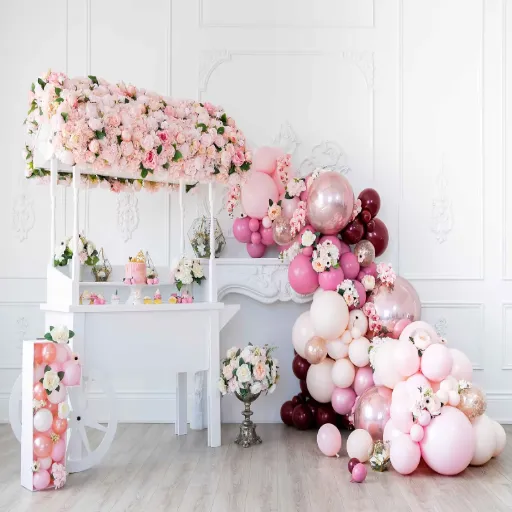
Here’s the whole method in four steps. Run it once and you’ll never need the table again.
Step 1: Measure span and height
Measure base to base for the span, and floor to the top of the curve for the height. Don’t try to measure along the curve with a tape; it sags, it slides, and you’ll over-order. Use the formula instead.
Common mistake: measuring the curve directly. A 10-foot span is already about 17 feet of curve, so measuring along the arch and then multiplying by a per-foot rate double-counts the difference.
Step 2: Convert to curve length
Pick the case that matches your shape:
- 10 ft wide, 7 ft tall: wider than tall, so 10 + 7 = 17 ft of curve
- 8 ft wide, 8 ft tall: roughly square, so (1.5 × 8) + 8 = 20 ft of curve
- 6 ft wide, 9 ft tall: taller than wide, so (2 × 9) + 6 = 24 ft of curve
Step 3: Convert curve to balloons
Multiply the curve by 4.8, then divide by the balloon diameter in feet.
For the 10-foot arch with 11-inch balloons: 4.8 × 17 ÷ 0.917 = 89 balloons. That is the structured count, and it sits inside the 80 to 100 range that for the same span.
For a five-balloon cluster: 6.3 × 17 ÷ 0.917 = 117 balloons.
Step 4: Apply style and buffer
Organic build? Multiply by 1.3. Then add 10 to 15 percent for pops and mis-ties, and round up to the nearest pack. The table above uses 15 percent.
The 10-foot arch as an organic build: 89 × 1.3 = 116 balloons. Add 15 percent and you’re at 133, so you buy 150 to cover a natural pop rate and land on packs.
Find balloon arch solutions that match your event theme.
How Many Balloons for an Arch: Worked Examples by Span
These are the sizes people actually search for, run through the formula.
| Arch | Span | Peak | Curve | Structured | Organic | Buy |
|---|---|---|---|---|---|---|
| Doorway | 6 ft | 4.5 ft | 10.5 ft | 55 | 71 | 90 |
| Narrow entry | 7 ft | 5 ft | 12 ft | 63 | 82 | 110 |
| Party arch | 10 ft | 7 ft | 17 ft | 89 | 116 | 150 |
| Long garland | 20 ft | 12 ft | 32 ft | 168 | 218 | 280 |
| Half arch | 10 ft | 7 ft | 8.5 ft | 45 | 58 | 70 |
A 6-foot doorway arch, 4.5 feet at the peak. Curve is 10.5 feet, so 55 balloons structured or 71 organic. Buy 90, which is one 100-pack.
A 7-foot arch, 5 feet at the peak. Curve is 12 feet, so 63 structured or 82 organic. Buy 110, so two 50-packs plus a small filler pack.
A 10-foot party arch, 7 feet at the peak. Curve is 17 feet, so 89 structured or 116 organic. Buy 150.
A 20-foot garland, 12 feet at the peak. Curve is 32 feet, so 168 structured or 218 organic. Buy 280. This is a two-person job, and you’ll want an electric pump.
A half arch. A demi arch rises from one anchor and tapers instead of completing the span, and it’s the format most decorators sell. Halve the curve, not the whole count. A 10-foot half arch has about 8.5 feet of curve, so roughly 45 structured or 58 organic.
If you’re still choosing the shape, our guide to covers how each changes the count and build time, and explains why a garland uses more balloons for the same visual length.
How Many Balloons for a Balloon Arch to Buy, in Packs
Balloon counts are clean arithmetic. Balloon orders are not, because balloons ship in packs. Consequently, the number you calculate and the number you order rarely match.
Eleven-inch latex usually comes in 50s or 100s. Five-inch fillers often come in 100s. If your count lands at 133 and you order 133 individual balloons, you’ll pay per-unit pricing and probably receive a padded bag. Order 150 instead, in the pack sizes your supplier actually stocks.
Two things most guides leave out:
- Strip length. A balloon decorating strip holds balloons at fixed holes. For a 17-foot curve in 11-inch balloons you need about 17 feet of strip plus a foot of overhang at each end, so buy the 25-foot roll.
- Inflation time. puts a 10-foot arch at two to three hours for an experienced builder and three to four for a first-timer. Scale that up for a 150-balloon build and recruit help for anything past 8 feet.
Before you order, run this checklist:
- Curve length calculated from span and height, not measured along the arch.
- Cluster size confirmed at four or five balloons.
- Style set to structured or organic, so the 1.3 multiplier is applied or skipped.
- Buffer of 10 to 15 percent added on top.
- Pack sizes matched, so the order lands on 50s or 100s rather than a per-unit quote.
- Anchors, strip and pump counted as separate line items.
The rest of the build is in our . If you would rather not source every size separately, a bundles the strip, the pump and a matched balloon count, and the trade-off is that you rarely get to pick the mix.
Five Mistakes That Change the Count
Each of these adds or removes balloons from the same arch, and together they explain most of the surprise over-orders.
1. Measuring the curve instead of the span. The most common error. A 10-foot span is roughly 17 feet along the curve. Measure the curve, then treat it as a span, and you convert a 17-foot run into a 24-foot one, which is about 40 percent more balloons than you need.
2. Planning a structured arch and building an organic one. The two look similar in a photograph, but organic needs 20 to 30 percent more balloons, and running out mid-build is the failure people remember.
3. Mixing balloon sizes without recounting. Adding 5-inch fillers doesn’t top up an 11-inch arch; it changes the density. On a 17-foot curve at one filler per foot of gap, add 17 balloons on top of the base count.
4. Mixing brands within one arch. Qualatex, Sempertex and other makers inflate to slightly different diameters at the same pressure. On a small arch nobody notices; on a 20-footer it shows as a wavy line.
5. Forgetting the anchors. A freestanding arch needs weighted bases. Two sandbags or water weights are part of the specification, not an afterthought.
One final note on timing: an air-filled arch on a frame or strip holds for two to five days indoors, so building two days early is fine. Helium arches lose lift in 8 to 12 hours, so build those on the day. Both figures come from .
Frequently Asked Questions
How many balloons do I need for a 10 foot balloon arch? About 89 for a structured 11-inch arch, or 116 for an organic one. Buy 150 to allow for pops and pack sizes. The curve length is roughly 17 feet at a 7-foot peak, and that’s the number the count comes from.
What is the balloon arch formula? Curve length times 4.8, divided by the balloon diameter in feet, for a four-balloon cluster. Use 6.3 instead of 4.8 for a five-balloon cluster. Multiply by 1.3 for an organic build, then add 10 to 15 percent for pops.
How many balloons for a 6 foot arch? About 55 structured or 71 organic in 11-inch balloons, so buy 90. A 6-foot arch with a 4.5-foot peak carries 10.5 feet of curve.
How many balloons for a 7 foot arch? About 63 structured or 82 organic, so buy 110. Seven feet is the most common doorway span after six, and the curve runs about 12 feet at a 5-foot peak.
How many balloons for a 20 foot garland? About 168 structured or 218 organic, so buy 280. A 20-foot span with a 12-foot peak has 32 feet of curve. Plan on two people and an electric pump.
How many balloons for a half arch? About half the full-arch count for the same span, because a demi arch covers roughly half the curve. A 10-foot half arch needs about 45 structured or 58 organic.
How many balloons do I need for a balloon arch if I’m building it by hand? The same count applies whether you build by hand or on a frame: 89 for a 10-foot span in 11-inch structured balloons. Allow three to four hours if it’s your first build, and plan on help above 8 feet.
How do I calculate balloons for an arch from scratch? Measure the span and height, convert to curve length with width + height (if wider than tall), multiply by 4.8 and divide by the balloon diameter in feet. Multiply by 1.3 for an organic build, then add 10 to 15 percent. Any balloon garland calculator that uses the same two constants will match this method.
How many balloons per foot is a balloon arch? About 5.2 per foot of curve for 11-inch balloons in four-cluster builds, or 6.9 for five-cluster. In 5-inch balloons it rises to 11.5 per foot, and in 16-inch balloons it falls to 3.6. Always ask whether a source means per foot of span or per foot of curve.
Do balloon arches need helium? No. Most arches are air-filled and mounted on a frame, strip or line. Air-filled arches last two to five days, while helium arches lose lift in 8 to 12 hours. Use helium only when you need a floating effect and have no way to support the arch.
Conclusion
The count comes down to one measurement and one multiplication. Measure the span, convert it to curve length, multiply by 4.8, divide by the balloon diameter in feet. For a 10-foot arch that is 89 balloons structured, 116 organic and 150 to buy.
Everything else is a modifier. Organic builds add 30 percent, smaller balloons multiply the piece count, and a half arch halves the curve. A buffer covers the pops.
The reason the internet disagrees is that almost nobody states the denominator. If you take one thing from this page, take that: ask whether a per-foot figure refers to span or curve, and the rest of the arithmetic falls into place.
If you’re building to a specific space and want the balloons cut and packed to your size mix, send us the span, the height and the palette. We’ll confirm the count and quote it at your scale. For the money side of the same decision, our guide to covers installed and DIY pricing, and our runs from 5 to 36 inches with custom colours and if the arch carries a brand.