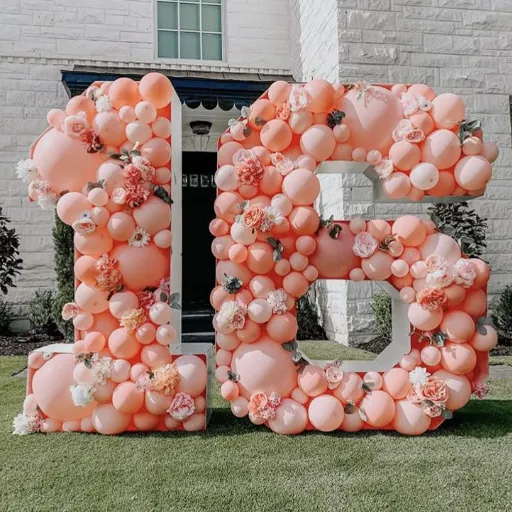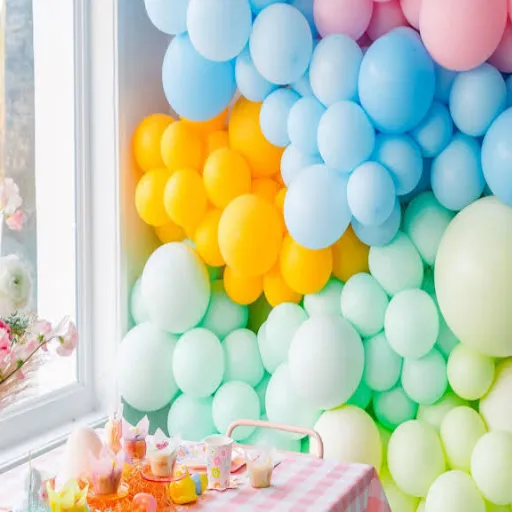
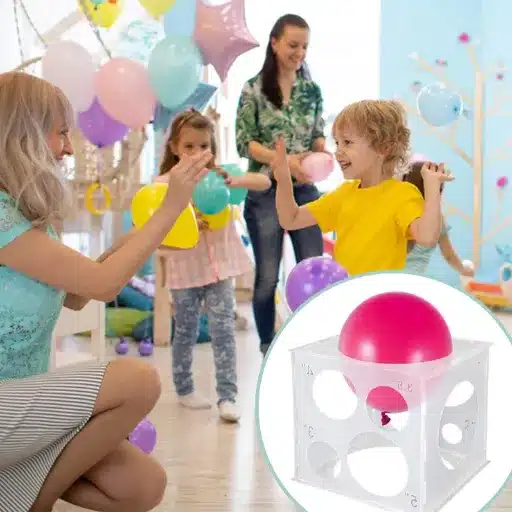
A balloon sizer is a template tool that controls the final diameter of an inflated latex balloon, so every balloon in a garland, arch, or column comes out the same size. You inflate slightly past the mark, slide the balloon into a hole or between two poles, and release air until it fits snugly. Sizing by eye leaves about 1.5 inches of variation between balloons; a sizer tightens that to a quarter inch or less.
When Dana built her sister’s baby-shower garland in July, she inflated ninety balloons by eye. The middle of the garland looked fine, but the ends looked ragged, some balloons were noticeably rounder than others, and three popped while she tied them. The next month, for a friend’s engagement arch, she bought a twelve-dollar collapsible sizer box. Every balloon came out the same diameter, not one popped, and the arch took half the time.
Whether you are hosting a birthday party, planning a wedding, or running an event company, this guide covers what a balloon sizer is, the four main types, how to use each one, what size balloons you need for garlands and arches, and the mistakes that waste helium, latex, and time.
Key Takeaways
- A balloon sizer caps the inflated diameter of a latex balloon so every balloon in a display is uniform; sizing by eye leaves about 1.5 inches of variation between balloons
- The main types are sizer boxes and cubes (2 to 10 inch holes, roughly 7to7to15), measuring rings, and sliding sizers that adjust from 1.5 to 36 inches
- Sizing with a tool cuts popped balloons from 8 to 12 per 100 down to 1 to 2 per 100, and trims the time to inflate 100 balloons from 90 to 120 minutes to 35 to 50 minutes
- For garlands, plan roughly 60 to 70 percent medium balloons (11 to 12 inch), 20 to 30 percent small fillers (5 inch), and about 10 percent large accents (16 to 18 inch)
- Professionals inflate to 80 to 90 percent of capacity, work in batches by size, and stick to one balloon brand for consistent results
What Is a Balloon Sizer and Why Do You Need One?
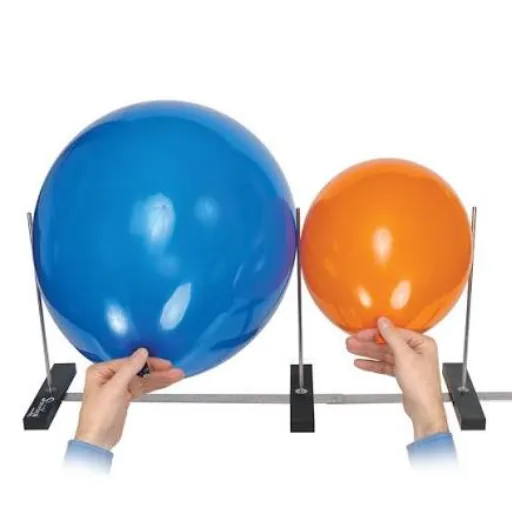
A balloon sizer is a template tool, typically a box or board with circular cutouts, or a ruler-style gauge with adjustable poles, that controls the final diameter of an inflated latex balloon. It gives every balloon in a garland, arch, or column the same size, so a display reads as crisp, even, and intentional.
The physics is simple. When you inflate by eye, your sense of “eleven inches” drifts as you work, especially after the fiftieth balloon. A sizer acts as a fixed reference: over-inflate, insert, release air, and the balloon settles at exactly the diameter of the guide.
According to AIHUA Balloon, sizing by eye leaves a diameter variation of about 1.5 inches between balloons, while a sizer box tightens that to roughly 0.2 inches. Popped balloons drop from 8 to 12 per 100 down to 1 to 2 per 100, and the time to inflate and size 100 balloons falls from 90 to 120 minutes to 35 to 50 minutes.
One clarification matters: consistency does not mean monotony. Professional garlands mix sizes on purpose, with medium cores, small fillers, and a few large accents. As Atlanta Balloon Designer puts it, organic does not mean random; it means intentionally varied, and the sizer keeps each size category consistent.
If you are tired of balloons that come out in three different sizes, the fix starts with the right tool and the right balloon supply. Our balloon accessories guide covers the full toolkit, from pumps and decorating strips to clips and stands.
Types of Balloon Sizers: Which Should You Choose?
Balloon sizers fall into four main categories, each fitting a different scale of work. The table compares them at a glance, then we break down each type.
| Sizer type | Best for | Consistency | Portability | Typical cost |
|---|---|---|---|---|
| Sizer box or cube | Garlands, arches, small-to-mid events | Very high | Foldable models travel well | 7to7to15 |
| Measuring ring | Quick batches, single sizes | High | Excellent, pocket-sized | Under $10 |
| Sliding or ruler sizer | Jumbo balloons, variable sizes | High | Compact, pole extenders available | 10to10to30 |
| Inflator with built-in sizing | High-volume work, 500+ balloons | Very high | Stationary | Cost of the inflator |
Sizer Boxes and Cubes
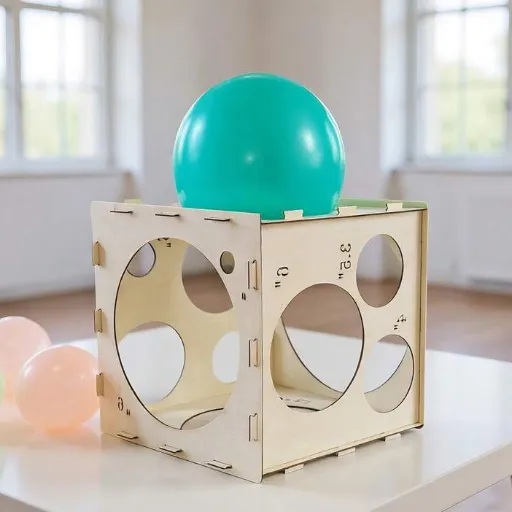
A sizer box or cube is a collapsible board with a row of circular holes, usually covering 2 to 10 inches; one common model has eleven holes spanning 5 to 25 centimeters. You inflate a balloon, place it in the matching hole, and release air until it passes through snugly. These are the most popular choice for garlands and arches because one box covers every size you need. Plastic versions sell for about 7to7to15 and fold flat for storage.
Measuring Rings
A measuring ring is a single-size template, often a plastic ring on a short handle, used by balloon artists and column builders. You inflate through the ring and stop when the balloon fills the opening. Five-inch, ten-inch, and eleven-inch rings are the most common. Rings are cheap, pocket-sized, and perfect when you only need one or two sizes, but you buy a separate ring for each diameter.
Sliding and Ruler-Style Sizers
Sliding sizers, like the CD-112 and the Slide-N-Size from Clik-Clik, use two adjustable poles that you set to the size mark you want. Inflate the balloon, then pass it between the poles until it just touches both. These sizers adjust from 1.5 to 36 inches, so a single tool covers everything from tiny filler balloons to jumbo statements, with pole extenders for the largest sizes. Clik-Clik publishes setup and use instructions for its Slide-N-Size models.
Inflators With Built-In Sizing
For high-volume work, some electric inflators include a sizing control that stops inflation at a set diameter. According to the Nicro buying guide, these inflators cut inflation time by 20 to 30 percent and reduce helium waste by 10 to 15 percent, because you never blow past the mark. Pair them with an electric balloon pump vs hand pump comparison to decide what fits your setup.
Which One Should You Buy?
Match the sizer to your project scale. For under 100 balloons, a measuring ring or a budget box is enough. For 100 to 500 balloons per event, invest in a durable sizing box with a wide range of holes. For 500 or more balloons per event, a high-volume inflator with sizing control will pay for itself in saved time and fewer bursts.
How to Use a Balloon Sizer (Step by Step)
The technique differs slightly by tool type, but the principle is the same: inflate past the target, use the sizer as a stop, and let air out until the balloon fits.
Using a Sizer Box or Cube
- Inflate the balloon slightly past your target size.
- Hold it in front of the matching hole and press it gently into the cutout.
- Release air slowly until the balloon passes through the hole with a snug fit, not forced.
- Check that the balloon is round and not pear-shaped.
- Tie off the knot while the balloon is still held in place.
Never force a balloon through a hole. If it does not pass with light pressure, it is too big. Deflate a little and try again.
Using a Sliding or Ruler Sizer
- Set the two poles to the size mark on the ruler.
- Inflate the balloon until it is clearly larger than the gap.
- Slide the balloon between the poles and let air escape until the widest point just touches both rods.
- Knot the balloon immediately.
The advantage is flexibility: one tool handles any size, from a 5-inch filler to an 18-inch accent.
Using a Measuring Ring
Inflate the balloon through the ring itself. When the balloon fills the opening and presses evenly against the edges, stop inflating and knot it. It is the fastest method of the three and the one column builders rely on.
Sizing Helium Balloons
Helium is expensive, so you do not want to waste it over-inflating. With a tank, hold the balloon in the sizer hole while you inflate, or use an extension hose on the tank so you can position the balloon at the sizer. Stop the helium flow the moment the balloon reaches the guide, then knot it.
Professionals add a few habits. Inflate to about 80 to 90 percent of capacity so balloons stay round rather than stressed. Work in batches, filling every balloon of one size before moving to the next. Use one brand of latex across a project, because different brands inflate to slightly different sizes at the same nominal number. Keep the sizer clean, since latex residue on the edges can catch a balloon and pop it.
Marcus, a wedding decorator in Denver, learned this the hard way. In May he inflated 500 balloons for a rooftop wedding using two brands he had mixed from leftover stock, and he sized by eye. The arch sagged in three places, the columns looked lumpy, and he reworked the display at 6 a.m. with eight balloons left in the budget. Three weeks later, with one brand of latex, a sliding sizer, and an electric pump, his team built the same scale of installation in half the time. Not one balloon popped.
For a visual walkthrough, Balloon Decoration Guide demonstrates the sizer box and measuring ring methods step by step.
What Size Balloons Do You Need? (Balloon Size Chart)
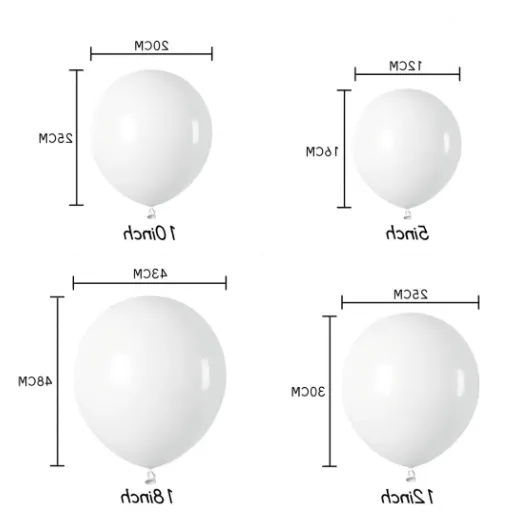
Once you have a sizer, the next question is which sizes to use. Latex balloons come in a few standard diameters, and each one has a job.
| Balloon size | Typical use |
|---|---|
| 5 inches | Small fillers tucked into garlands for texture |
| 9 inches | Secondary sizes and column details |
| 11 to 12 inches | Core balloons, the workhorse of most displays |
| 16 to 18 inches | Large accents and statement balloons |
| 36 inches | Giant statement pieces for entrances and ceilings |
For Balloon Garlands
Garlands look best when they mix sizes in a proven ratio. Plan roughly 60 to 70 percent medium balloons (11 to 12 inch), 20 to 30 percent small fillers (5 inch), and about 10 percent large accents (16 to 18 inch). A common rule of thumb is three to four five-inch balloons for every eleven-inch balloon. This mix gives an organic garland depth without looking chaotic, and it answers the “what size balloons for garland” question in practice.
Density matters as much as size. For a full, lush look, use five to six balloons per linear foot of garland. For a lighter, airier look, use three to four per foot. That range translates directly into how many balloons you need to inflate and size, so it pays to decide before you start.
For Balloon Arches and Columns
Arches and columns rely on uniform core sizes. Build the base with 11-inch balloons in a consistent size, and add 5-inch fillers to fill gaps and add depth. Column builders use 10-inch and 18-inch sizes to create the 10-by-18 and 18-by-24 inch columns you see framing entrances. The sizer’s job is to keep every core balloon identical, because even a half-inch difference becomes obvious in a straight line.
If you are building from a kit, our balloon arch kit guide covers how sized balloons fit specific kit components, and our balloon decorating strip guide shows how uniform sizes make garland assembly far faster.
How Many Balloons Do You Need?
Use this quick reference to plan quantities by garland or arch length, assuming the mixed-size ratio above. The ranges come from decorator guides and balloon calculators.
| Display length | Total balloons |
|---|---|
| 4 to 6 feet | About 50 |
| 8 to 10 feet | About 80 (110 to 130 for a dense organic look) |
| 12 feet | 90 to 120 |
| 16 to 20 feet | 130 to 200 |
One note about the numbers on the bag: nominal size is not a guarantee. Latex quality and brand vary, so an “11-inch” balloon from one supplier can inflate a half inch larger than the same size from another. That is why a balloon sizer, not the label on the pack, is the reliable tool. Consistent sizing also starts with consistent latex, which is why professionals buy from a single supplier they trust.
Common Balloon Sizing Mistakes to Avoid
Even experienced decorators make these six mistakes. Knowing them is half the fix.
Eyeballing instead of measuring. A half-inch difference is hard to spot on a single balloon but obvious across a finished garland or arch. The sizer exists because your eyes drift; use it.
Over-inflation. A balloon inflated past its limit turns translucent, develops an avocado-shaped tail, and pops easily. Inflate to 80 to 90 percent of capacity, and let the sizer catch the extra air.
Forcing the balloon through the hole. If it will not pass with light pressure, it is too big. Forcing it is the fastest way to lose a balloon and a minute of your time. Release air and try again.
Mixing balloon brands. Different brands stretch differently at the same nominal size, which produces the uneven displays you are trying to avoid. Pick one brand for the whole project.
Ignoring temperature. Heat expands inflated balloons. Outdoors or in a hot venue, size slightly smaller so the display does not swell past the target by the time guests arrive.
Fatigue. Your sense of “eleven inches” drifts after fifty balloons no matter how experienced you are. The sizer is your objective standard, and it does not get tired.
DIY Balloon Sizers and Alternatives
You can size balloons without buying a purpose-built tool, though the trade-offs are real.
Cardboard box method. Cut holes in a cardboard box at the diameters you need and use them like a sizer box. It works in a pinch and costs nothing, but the holes deform with use, and cardboard tears easily when damp. Fine for a single party, frustrating for repeat work.
Two chairs method. Set two chairs back-to-back at the target width and pass the inflated balloon between them until it just touches both seat backs. This hits a rough target, not a precise diameter, and it is hard to hold steady while you knot.
When a real sizer is worth the money. Any garland, arch, or column justifies the cost. A roughly ten-dollar sizer can save far more than that in popped balloons, wasted helium, and rework on a single event. As Purely Celebrations puts it, a sizer is “a 10investmentthatmakesa10investmentthatmakesa500 difference in the final result.” For a one-off party with a handful of balloons, the cardboard box is fine. For anything you want to look professional, buy the tool.
Ready to test the difference on your next display? Pair a sizer with consistent latex balloons and a decorating strip, and the results will speak for themselves. Browse our bulk balloons and accessories to stock up.
Balloon Sizers for Event Companies and Retailers (B2B)
Event companies get the most value from sizers, because the tool does more than improve one display. It standardizes how a whole team works.
Standardizing output across a team. Replace “inflate until it looks right” with an objective size mark. Every team member uses the same hole or ruler setting, so a garland assembled by three people looks like it was built by one.
Batch workflows. Fill every balloon of one size before moving to the next, and assign each person a single size in larger builds. This removes the stopping and starting that slows teams down.
Waste math. Fewer popped balloons and less wasted helium add up fast. A four-person outfit called Bright Events cut its waste from 12 percent to 2 percent after switching to a sliding sizer and an electric pump with a batch workflow. Their balloon count per arch became predictable, so estimates stopped eating into profit.
What to stock. Retailers should carry sizer boxes in common sizes, measuring rings for single-size decorators, and sliding sizers for jumbo work. Customers who size their balloons come back with fewer complaints about uneven garlands, and sizers become a repeat add-on sale.
For sealing sized balloons fast, our balloon clips guide covers the clip method, and our balloon stands guide explains how uniform-size balloons make columns and stands more stable. Together they complete the production line that starts with a sizer.
Conclusion
A balloon sizer turns balloon-by-balloon guessing into uniform, professional displays. Match the tool to your project scale, size your balloons against the chart, and avoid the over-inflation and brand-mixing mistakes that waste latex and helium. The numbers are clear: fewer popped balloons, faster setup, and a diameter variation of a quarter inch instead of an inch and a half.
The professional workflow is simple to adopt. Use one brand of latex, keep a sizer within reach, and inflate in batches by size. Build that habit and your garlands will come out even and your arches will stand straight, every time.
Need balloons that size true to the label? Explore our range of high-quality latex balloons and accessories, or contact our team for bulk pricing and custom solutions. We will help you stock the materials and tools for displays that look professionally made.