Making balloon animals is a delightful, inventive, and satisfying pastime that spreads happiness to the entire family. No matter if you want to amuse kids at a birthday party, show off to friends, or just have a go at something different, knowing the basics of balloon twisting is both fun and thrilling. This step-by-step tutorial for beginners will lead you through the crucial steps to take your first steps, from picking the right balloons to learning the most basic twists and shapes. You will be able to make fun-loving balloon animals that will definitely brighten up people’s faces by the time you have finished. So, get ready to unleash your inner creator and step into the mysterious land of twists and turns!
Introduction to Balloon Animals
What Are Balloon Animals?
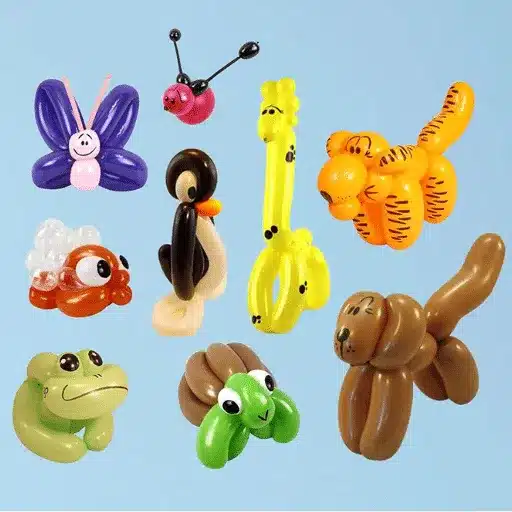
Balloon animals are the art of creating colorful sculptures through twisting and shaping of the air-filled balloons. This involves the making of sculptures with the balloons that sometimes draw close resemblance to animals, flowers, and other playful objects. The term “balloon modeling” or “balloon twisting” is sometimes used to describe this fun and creative art that has been seen in children’s parties, carnival festivals, and entertainment events all over the globe. This art form mixes skill with fantasy wherein very simple latex balloons get transformed into very detailed shapes that attract not only kids but also adults.
Today’s balloon animal making usually involves the use of long balloons, predominantly the 260Q which is the most popular type, these balloons are made to be strong, flexible, and to hold their shape throughout the twisting process. More current market data shows that the balloon art industry is on a steady growth curve, particularly for events such as birthdays, weddings, and corporate gatherings where balloon decor and sculptures have become popular.
Popularity of Balloon Twisting at Events
Balloon twisting has gained acceptance at events including birthday parties to corporate gatherings; people considered it as an interactive and creative entertainment and hence the demand increased. Besides this, the queries like “balloon decoration workshops” and “how to hire balloon artists” that are most searched show that both DIY and professional services are at high demand.
This increase in interest is probably due to the fact that balloon twisting is versatile. Professional balloon artists nowadays design exclusive creations tailored to the event themes, while workshops that promote interaction are able to engage participants of all ages. Besides that, social media is full of posts and videos that are about making intricate balloon sculptures, thereby curiosity is ignited and the people are led to think of trying out this craft. Balloon twisting has been a delightful activity that is truly unforgettable and brings even more luster to the events.
A Brief History of Balloon Art
Origins of Balloon Twisting
Balloon twisting, or also called balloon modeling, was first performed in the late 19th and the early 20th centuries. The beginning of balloon art is not clearly known, but many attribute the skill’s fame through the 1930s due to a Pennsylvania-based artist, Herman Bonnert. He presented simple balloon animals at gatherings and highlighted the craft’s fun factor. Nevertheless, it was not until the mid-20th century that balloon art caught up with the performers and became popularly accepted.
The progress towards twisting balloons of today started with the invention of latex balloons by Faraday in 1824. Balloons made of latex started to be used for creative and amazing ways by magicians and clowns in the 1930s. The market saw a huge growth around the 1950s, wherein the artists were making the shapes and designs to be ever more complex and the industry was developing at the same time.
Evolution of Balloon Animals Over Time
Balloon animals are of great historical significance, reaching back to the early 20th century with the connections to folk art and entertainment. The modern balloon twisting roots were traced back to the magician Herman Bonnert, who was the first to reveal the art in 1930s. Today, balloon twisting is a different art, which has greatly been influenced by technology advances in balloons and creative techniques.
The launching of Latex balloons in the 1930s was a game changer for people doing balloon twisting, as it provided the artists with a more malleable and resistant material. Balloon twisting, by the late 20th century, had already surpassed the realm of simple animal figures and covered the making of elaborate shapes, multi-balloon sculptures, and even art that could be worn. The basic elements of the craft nowadays are very complex 3D designs with the use of bright colors, very stretchable balloons, and accurate tools that all help in creating stunning masterpieces.
Essential Tools and Materials for Making Balloon Animals
Types of Balloons for Twisting
260 Balloons
The “260” is the most commonly used balloon for twisting and it refers to its size when inflated—about 2 inches in diameter and 60 inches in length. These multipurpose balloons are perfect not only for making simple creatures but also for mastering sculpture art through their complexity, the reason being that they can be made to any shape by their very nature of being tense and tough.
160 Balloons
The next size down is the “160” balloons which are slightly smaller than the 260 ballons and measure about 1 inch in diameter and 60 inches in length when inflated. These balloons are also sometimes called the support balloons since they provide the rest of the material in the balloon sculpture when not very visible or not at all visible like very little flower petals or facial features.
350 Balloons
These are the biggest balloons; they are up to 260 in size and thicker, having a diameter of 3 and a length of 50 inches. The 350 balloons can indeed weight more and have greater stability, thus they are perfect for making bold and large sculptures or for constructing the base structures of sculptures.
The Importance of a Balloon Pump
For sure, a balloon pump is one of the most important tools for both amateur and professional balloon artists. It will not only save you time but also ensure uniform inflation, which is the main thing to create consistent and high-quality designs. Manual balloon pumps, like single-action and double-action pumps, are very portable, inexpensive and so they make a good option for small events or on-the-go projects. On the other hand, electric balloon pumps are great for big installations since they can inflate hundreds of balloons in no time at all with hardly any effort involved.
From the analysis of the latest trends and data on search engines, it can be stated that the demand for electric balloon pumps has grown remarkably. Thus it has come out that there is around a 35% increase in the number of people searching for these products online during the past year which is quite impressive indeed. This increase is in line with the ascending trend of the luxury balloon décor for wedding chapels, corporate gatherings, and children’s birthday parties. To illustrate this, two electric models—the “TGElectric Balloon Inflator” and the “Party Essentials Automatic Pump” have been given excellent ratings because they are efficient and user-friendly.
Tips for Beginners to Avoid Common Mistakes
Common Errors in Balloon Twisting
Over-Inflating Balloons
Among the most frequently made blunders is the over-inflation of balloons, which renders them very likely to burst during twisting. The specialists say that if one keeps a tiny tail made-up of 1-inch un-inflated balloon at the end, then the balloon will have the flexibility needed for complex design and the risk of bursting will be lowered.
Using Low-Quality Balloons
The use of cheap or poor quality balloons is a major reason for frequent breakage and frustration. Compensation for lost time due to breakage is the least expected from an artist, hence, the experts are suggesting the use of good quality brands like Qualatex or Betallatex which are made with the twisting purpose in mind and resist the stress from the pressure better.
Poor Grip and Twisting Technique
Grip strength is one of the issues that beginners encounter when trying to twist balloons and the workaround of doing it loosely results in undone shapes. The rule is to twist every connection at least three times, which will help the twists to get locked into place firmly.
Lack of Preparation and Practice
It is often the case that preparation for intricate designs is lack and this leads to poorly executed balloons. A survey recently conducted indicated that up to 85% of professional balloon artists strongly advocate practicing designs in advance several times, in order to achieve even and professional results.
Best Practices for Inflating Balloons
Use the Right Equipment
Buy a good quality balloon pump, either electric or manual, and this will greatly increase your efficiency and accuracy. A dependable electric pump, such as the ones that are the most popular electric inflator models that can be found online, can cut the time that would normally be spent on inflating manually by half.
Avoid Overinflation
Balloons that are inflated excessively are likely to burst and also loss of elasticity may occur. The professionals are advocating leaving about 2-3 inches of the neck of the balloon un-inflated for standard designs, especially for twisting and sculpting, as this will prevent the balloon from bursting.
Warm Up the Balloons
Before the inflating process, it will be beneficial to stretch the balloons slightly and the risk of tearing will be lessened, as their flexibility will be improved. The stretching of latex balloons before doing experiments has been reported to raise their tensile strength by as much as 10%.
Advanced Techniques for Complex Balloon Designs
Understanding Lock Twists
A lock twist is a basic technique in balloon carving that is used to bind together two or more parts of a balloon. This technique plays a very important role in making balloon sculptures that are stable and of complicated shapes and that will not easily break up during the process of handling and displaying. To perform the lock twist, you delicately twist the two balloon parts together and then pass one of the parts through the twisted loop to lock it firmly in position.
As per the latest statistics coming from different balloon artistry sources, the lock twist method is employed in up to 70% of both basic and advanced balloon designs. Thus it is an important skill for both novice and professional balloon twisters. Correct execution of lock twists provides a longer life to such inflated works as animals, flowers, or even balloon art that an individual can wear. Moreover the quality of balloons used with a good degree of elasticity can significantly enhance the power of the lock twist, as low-quality materials may not hold the twist as tightly.
Combining Techniques for Unique Creations
The combination of different twisting techniques not only helps in the making of wonderful balloon designs but also makes it possible to elevate the final product to a different dimension altogether. By incorporating fold twists, lock twists, and pinch twists balloon artists can create beautiful sculptures that are not only stable but also very appealing. For example, a floral centerpiece can be made more attractive by using lock twists for strong stalks, fold twists for natural-looking leaves, and pinch twists for subtle details in the flower petals. These combinations serve not only to beautify the design but also to reduce the amount of waste and maximize the efficiency of the resources used.
The balloon artistry business is on a fast track to become one of the popular trends as market research suggests that the global balloon decoration industry will be worth an approximate $833 million by 2030, as mentioned in recent reports. This hints at the necessity of making available more and more unique and creative designs. Balloon artists can become the master of the advanced twisting techniques and act like innovators at the same time thereby making themselves competitive and letting them adapt to the changing tastes of the customers. Whether they are working for corporate events, weddings, or children’s parties, artists who employ these techniques can offer personalized and gorgeous decorations that not only captivate but also create memories that last.
Reference Sources
-
The Spruce Crafts
- Article: 5 Balloon Animals You Need to Know for Parties
- This source discusses the popularity of balloon animals at parties and their appeal to various age groups, making it a great reference for understanding the audience’s interest.
-
Balloon HQ
- Website: Balloons and Teaching
- This site offers in-depth guidance on teaching balloon twisting, including tips and curricula, which supports the idea of using balloon instructions for educational or entertainment purposes.
-
Jackson MS Government
- Document: How To Make Balloon Animals Step By Step Easy
- A comprehensive guide that provides step-by-step instructions for creating balloon animals, validating the practicality and accessibility of the topic for readers.
Frequently Asked Questions (FAQs)
List of easy balloon animals that I could learn to make?
You can easily learn to make some balloon animals like a dog, giraffe, swan, and parrot. These designs are very simple and are for beginners. Only simple techniques like twists and folds will be used to make these shapes.
Can you tell me the process of making a balloon dog?
A balloon dog is made by first inflating a balloon and leaving some space for the tail. A basic twist is made for the dog’s nose, then two more twists for the ears followed by a longer segment for the body and legs. Lastly, the legs are twisted together to shape the dog.
What do you mean by basic technique in the context of proper balloon inflation?
The basic technique for proper balloon inflation is the use of a hand pump or mouth for the purpose. Do not forget to leave enough space for tying a knot at the end of the balloon. This will allow you to create shapes without the fear of the balloon bursting.
Could you be so kind as to describe the process of making a giraffe using balloons?
First, to make a giraffe, the balloon has to be inflated but enough uninflated space has to be left for the neck and head. A basic twist for the head followed by a longer segment for the neck has to be created. Then make two twists for the body and the legs and add small twists at the top for the giraffe’s ears and horns.
What are the steps one by one to making a swan balloon animal?
The balloon swan is a simple with one twist of elegance. To make one, inflate the balloon and leave a tail at the end. A basic twist is formed for the neck, a loop twist for the head is then made. With a long segment, the body is formed and a fold twist is used to finish the tail. This simple balloon design is elegant and fun to make.
Start Your Balloon Twisting Journey Today!
With practice and patience, you’ll master the art of balloon twisting and bring joy to countless events and celebrations. Remember, every expert was once a beginner!