
To make an organic balloon arch, inflate latex balloons in three sizes, tie them into pairs and then quads, and attach the quads along a strip, a fishing line or a frame. A 10-foot span needs about 90 eleven-inch balloons, which is 8 to 10 balloons per foot of span, plus 10 to 15% spares.
Almost every guide on this subject stops there. Assorted sizes. Mixed clusters. Attach to a line. Then you stand in a kitchen at nine the night before with 120 balloons and no idea whether that’s too many or not enough.
You weren’t told how many, which fixing to use, or how long the build takes. This guide answers those three questions first and the technique second. You’ll get exact counts keyed to the span you can measure with a tape. You’ll get a route through the build that matches what you own, a timeline with hours in it, and the five failures that account for almost every arch that sags, pops or looks wrong by the morning.
Key Takeaways
- Count by span, not by curve. A 10-foot span is 12 to 14 feet of actual run, so buy 80 to 100 eleven-inch balloons plus 10 to 15% spares.
- Three sizes, one ratio. About 70% eleven-inch, 25% five-inch and 5% sixteen-inch; a 10-foot arch at 90 balloons is 63, 22 and 5.
- A quad covers roughly 10 inches. Four balloons tied into a quad, one quad every 10 inches along the run, and the arithmetic closes at 16 quads for a 10-foot arch.
- Two to four hours, not thirty minutes. A first-timer needs 3 to 4 hours for a 10-foot arch; build it 4 to 12 hours before the event and it holds 2 to 5 days indoors.
- Choose the fixing first. Strip, fishing line or frame decides how the arch is shaped, and a venue that bans wall fixings decides it for you.
How Many Balloons for a Balloon Arch
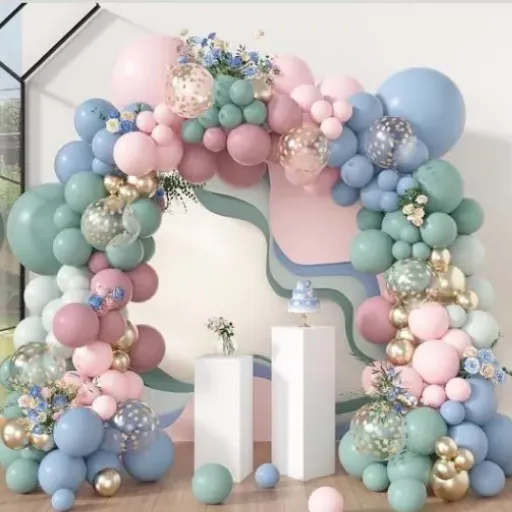
Before you learn how to make a balloon arch, you need the count, and three tape measures get confused in every guide on the internet, including three of ours. Name them before the numbers.
Span is base to base, measured flat on the floor. Run is the length of ribbon, line or frame the balloons actually hang on. It’s longer, because the arch climbs and comes back down. Strip foot is one foot of the plastic decorating tape, and it’ll hold a different number again, because every balloon is a separate knot in a separate hole.
HICO Memphis, a balloon decorator whose published count table is the most specific on this search result, states the conversion plainly: a 10-foot span produces 12 to 14 feet of run. That single line explains why one page says 6 balloons per foot and another says 12, and both’re right.
Here is the whole table, organic builds, with 10 to 15% spares on top.
| Span | Actual run | 5″ balloons | 11″ balloons | 16″ balloons |
|---|---|---|---|---|
| 4 ft | 5 to 6 ft | 40 to 50 | 25 to 35 | 12 to 16 |
| 6 ft | 7 to 9 ft | 60 to 75 | 40 to 50 | 18 to 24 |
| 8 ft | 10 to 11 ft | 80 to 100 | 55 to 70 | 24 to 32 |
| 10 ft | 12 to 14 ft | 100 to 125 | 80 to 100 | 30 to 40 |
| 12 ft | 14 to 17 ft | 120 to 150 | 95 to 120 | 36 to 48 |
| 15 ft | 18 to 21 ft | 150 to 185 | 115 to 145 | 45 to 58 |
| 20 ft | 24 to 28 ft | 200 to 250 | 155 to 195 | 60 to 80 |
Counts adapted from , fetched 23 November 2026. Ranges cover organic builds, which use 20 to 30% more balloons than a structured arch of the same length. If you want to model a span outside the table, runs the same run-length logic.
Now the worked example. Take a 10-foot doorway, which is the most common arch a person’ll build at home. The run is 12 to 14 feet. Budget 90 eleven-inch balloons, split as roughly 63 eleven-inch, 22 five-inch and 5 sixteen-inch.
Add 10 to 15% spares, so 100 to 104 balloons in the bag and 90 on the arch. That’s the whole shopping list, and every other number on this page is a variation on it.
The full list for a 10-foot organic arch, so nothing gets forgotten at 9pm:
- 63 eleven-inch latex balloons in two or three colours
- 22 five-inch latex balloons for the fill, plus a few spares
- 5 sixteen-inch or 24-inch balloons for the statement points
- One hand pump (electric if you’re building more than one arch)
- One strip at run length, or fishing line and two anchor points
- A pack of glue dots for the five-inch fill
- Tape measure, and a wall or doorframe you’re allowed to use
Need the count for a length this table doesn’t cover? Our runs the same arithmetic from 4 feet to 20 feet and across half arches.
How to Make an Organic Balloon Arch: Strip, Line or Frame
The fixing isn’t a preference. It sets the shape, the time and who can help, and it’s the first decision in any guide to how to make a balloon arch that survives the trip to the venue.
A strip is a clear plastic ribbon with punched holes. You push the tied neck of every balloon through a hole, hang the finished chain, then glue-dot five-inch balloons into the gaps. One person can build an arch this way and it’s the fastest route by a wide margin. If learning how to make balloon arch with strip is your goal, this is the method to practice first, because it forgives an uneven hand.
Fishing line is the fullest organic method. You tie clusters to the line as you go, which lets you rotate sizes and colours in three dimensions instead of flat against a strip. It needs two people above eight feet, and it needs something to anchor to: hooks, a rail, a doorway.
A frame or stand is the only route that works in a venue which forbids wall fixings. It also costs the most and it’s the one you can’t carry alone.
| Route | Needs | Best for | Limitation |
|---|---|---|---|
| Strip | Strip, glue dots, pump | First-timers, indoor, fast build | The strip fixes the curve flat |
| Fishing line | Line, hooks or rail, pump | The fullest organic look, wall-mounted | Slower above 8 feet |
| Frame or stand | Frame, ballast, panels | Freestanding, outdoor, no-fix venues | Highest cost, needs transport |
Say you’re decorating a rented hall that bans tape and nails, and you buy a strip anyway because it’s the cheap option. You’ve now got a beautiful 12-foot chain and nowhere to hang it. The frame costs more on the day and saves the build.
The strip route has its own guide, including the three strip types and the hole spacing that changes the finished look: . If wall fixings are the constraint and not the budget, the covers the frame build step by step.
How to Make an Organic Balloon Arch, Step by Step
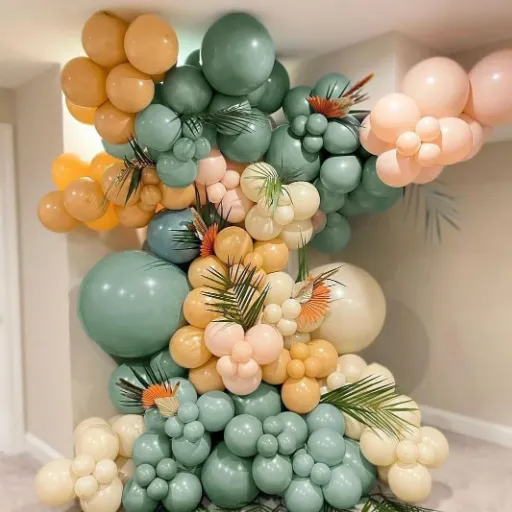
These seven steps assume the strip or line route and a 10-foot span. Scale the counts from the table above and nothing else changes.
- Measure the span, not the curve. Tape from base to base at floor level. Write the number down. Then add the height you want at the peak, because it changes the run: a tall peak eats more ribbon than a low one.
- Inflate in three piles. Pump the eleven-inch balloons to a consistent size, the five-inch smaller than you think, and the sixteen-inch just short of full. Vary the eleven-inch by a quarter inch either way so the arch isn’t machine-perfect.
- Make pairs, then quads. Tie two balloons by their necks to form a pair. Twist two pairs together for a quad. Four balloons per cluster, all the same size, is the unit every balloon arch cluster is built from, and it’s the only shape you need to master.
- Build the run. Cut your line or strip to the run length plus 2 feet of tail. If you’re on a strip, thread every hole and leave two or three empty in each section for the fillers later.
- Attach the balloon arch clusters along the run, alternating. Work from one end. Rotate colours and sizes so no pattern repeats in neighbouring quads. Keep the cluster face pointing at the viewer, not at the ceiling.
- Fill the gaps last. Stand back. Find the bald patches. Glue-dot a five-inch balloon into each, pressing it into the depression between two quads, not onto the surface.
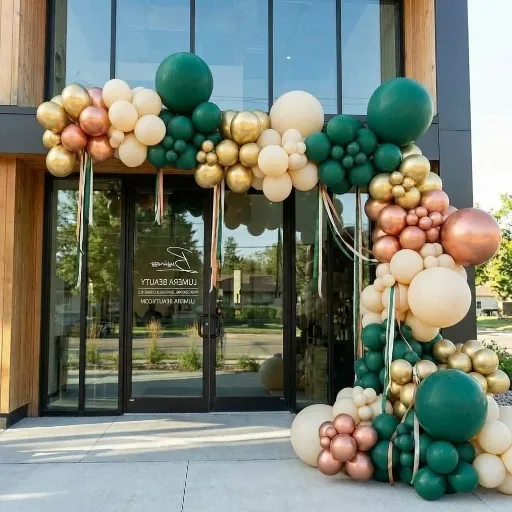
- Break the pattern on purpose. Move one quad a hand’s width off-centre. Push one sixteen-inch balloon out of line. The difference between organic and homemade is one deliberate irregularity, applied during the build, not after it.
A quad of four eleven-inch balloons covers about 10 inches of run. On a 13-foot run that’s 16 quads, which is 64 eleven-inch balloons, which is the 63 in the shopping list. When the arithmetic and the table agree, you’ve measured correctly.
If you would rather start from a kit than from loose balloons, our explains what the boxes actually contain and which ones short you on fillers.
What Size Balloons to Use for an Organic Balloon Arch
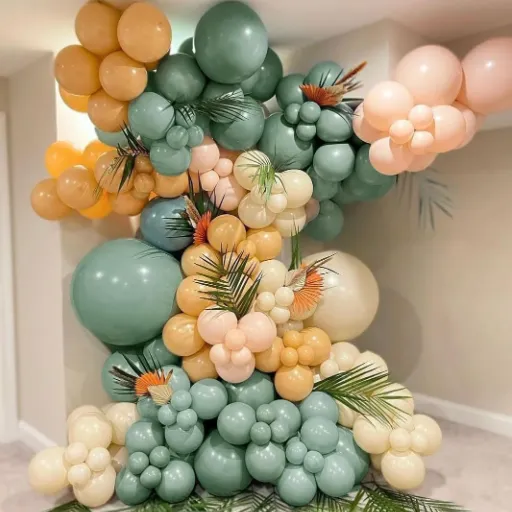
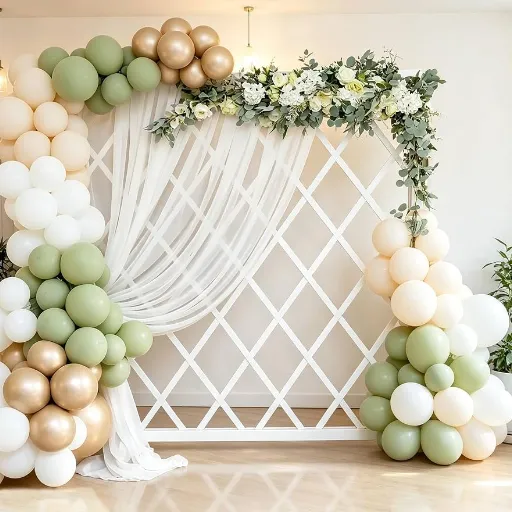
Three sizes is the whole trick. One size reads as a garland. Three sizes read as organic, and the mix is the answer to what size balloons for a balloon arch you should buy.
The ratio that photographs best, and the one we publish on our , is roughly 70% eleven-inch, 25% five-inch and 5% sixteen-inch or larger. The eleven-inch carry the structure, the five-inch fill the holes, the sixteen-inch break the silhouette. Put the same clusters on a shorter run, over a table or a backdrop, and it becomes a .
One technique worth stealing from the top of the search results: after inflating, let a small puff of air back out and press the balloon gently against a flat surface. It’ll settle into a rounder shape instead of the teardrop that screams “party shop”. Do this to the eleven-inch balloons and the arch instantly looks more expensive.
We make latex in 5, 9, 11, 16, 24 and 36 inch sizes, in custom colours and with printed logos, so the palette and the size mix can both be matched, not approximated. .
Five-inch balloons do the work nobody credits. Buy 25% more of them than the table suggests if your palette is dark, because dark balloons disappear into shadow and the gaps read as holes.
How Long It Takes, and When to Start
A 10-foot organic arch takes 2 to 3 hours if you’ve built one before, and 3 to 4 hours if you haven’t. That answers how long does a balloon arch take to make, and the number is a total, not an inflation time.
| Task | Experienced | First-timer |
|---|---|---|
| Inflate about 90 balloons with a pump | 45 to 60 min | 60 to 90 min |
| Assemble pairs and quads | 30 to 45 min | 45 to 60 min |
| Attach to the run, shape and fill | 45 to 60 min | 60 to 90 min |
| Total for a 10-foot arch | 2 to 3 hours | 3 to 4 hours |
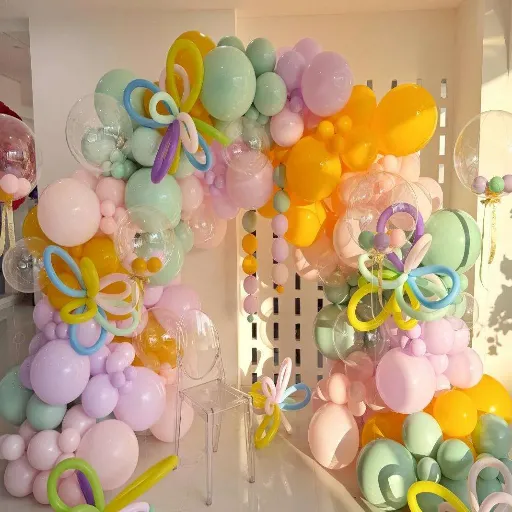
Picture a build that starts at 6am for a 2pm party. Inflating takes 90 minutes, the clusters take another hour, and the fill stage, the one that decides whether it looks organic, gets skipped because guests arrive. The arch in the photos is the one where the fill stage got its hour.
Build it 4 to 12 hours before the event. The night before is fine for an air-filled arch, which is what this method produces, and indoor arches hold 2 to 5 days. Helium is a different story: latex helium balloons lose float in 8 to 12 hours, which is why nobody builds a helium arch the night before. Our page covers the temperature and venue variables in full.
Troubleshooting: Five Things That Go Wrong
Balloons pop during inflation. Over-inflation and heat, almost always in that order. On a warm day, inflate to about 90% and let the latex expand into the room. Inflate where the arch will live, not at home, because a car ride changes the pressure.
The arch sags in the middle. Clusters are spaced too far apart, or the line isn’t tensioned. A quad every 10 inches with no gaps is what carries the shape. If the span is over 12 feet, add a second anchor point at the centre.
The strip curls. Work from both ends toward the middle instead of one end to the other, and let the strip hang for ten minutes before you load it.
Knots slip out of the holes. Push the knot through, then twist the balloon a half turn so the neck catches the plastic. A knot that only sits in the hole’ll drop as soon as the arch warms up.
It looks like a caterpillar, not an organic arch. This is a size problem, not a technique problem. If every balloon is the same size and every cluster is evenly spaced, no amount of filling’ll fix it. Go back to the three-pile mix and move one quad off-centre.
Frequently Asked Questions About How to Make an Organic Balloon Arch
Can I make an organic balloon arch the night before? Yes, if it’s air-filled. An air-filled arch on a strip, line or frame holds 2 to 5 days indoors, so building the evening before is normal practice. Keep the room cool and the arch away from direct sun and heating vents.
Do balloon arches need helium? No. An organic arch is air-filled and held by clusters on a fixing. Helium only matters if you need the arch to float, and helium latex drops in 8 to 12 hours, which rules out a night-before build.
Is it hard to DIY an organic balloon arch? The build is easy. The counting is where people struggle. Three sizes, 8 to 10 balloons per foot of span, clusters of four, and the rest is time and a pump.
How many balloons do I need for a 10-foot arch? About 80 to 100 eleven-inch balloons for an organic build, plus 10 to 15% spares. In a three-size mix that’s roughly 63 eleven-inch, 22 five-inch and 5 sixteen-inch, or 90 balloons total.
How do you attach balloons to a balloon arch? Learning how to attach balloons to arch is simpler than it looks. Tie balloons into pairs, twist pairs into quads, then attach the quads to the fixing.
On a strip, push each balloon’s knot through a hole. On a line, tie the quad to the line. On a frame, use the frame’s clips or tie directly.
What size balloons should an organic arch use? Three sizes minimum: eleven-inch as the base at about 70%, five-inch as fillers at about 25%, and sixteen-inch or larger as accents at about 5%. One size reads as a garland and not an organic arch.
How far in advance should I make a balloon arch? Four to twelve hours before the event is the sweet spot. The night before works for air-filled arches. Avoid more than 48 hours ahead unless the venue is cool and the arch is out of traffic.
Can I make an organic balloon arch without a stand? Yes. Fishing line anchored to hooks or a doorframe is the lightest option, and a strip hung from two points works indoors. A frame is only needed when the venue forbids wall fixings or the arch must stand free.
What to Do Next
Write down your span. That number, 4 to 20 feet, is the only input the whole build needs. The count comes from the table, the size mix comes from the 70/25/5 ratio, and the route comes from what the venue lets you attach to. That’s how to make an organic balloon arch without guessing at any stage.
Then buy 10 to 15% more balloons than the table says. The spare bag is the difference between finishing the fill stage and stopping at the silhouette, and it’s the one line most DIY organic balloon arch guides leave out.
For a 20-foot span the same arithmetic applies: 155 to 195 eleven-inch balloons, 36 quads along a 26-foot run, and a second pair of hands above eight feet. Scale the numbers, keep the ratio, and the arch still reads organic.
We manufacture latex balloons in the sizes, colours and printed finishes this build needs, and we quote to your span and palette, not to a fixed pack. and we’ll work out the count with you.