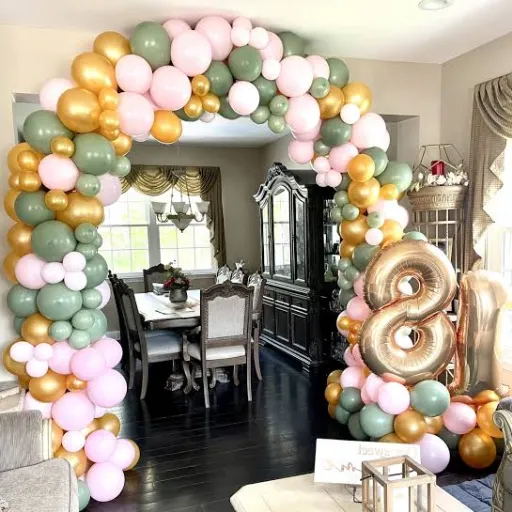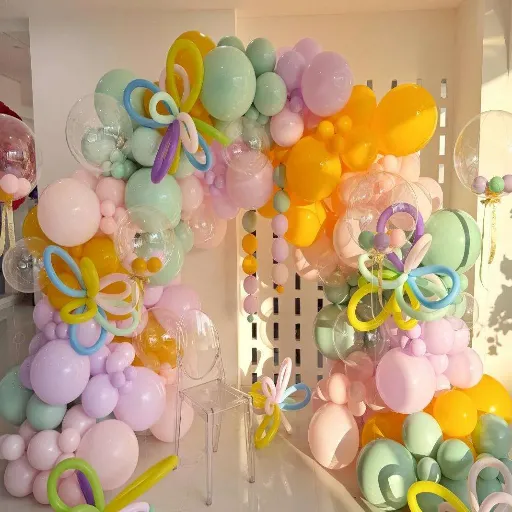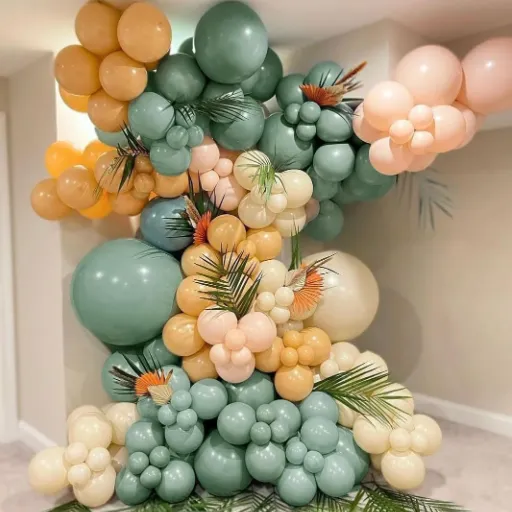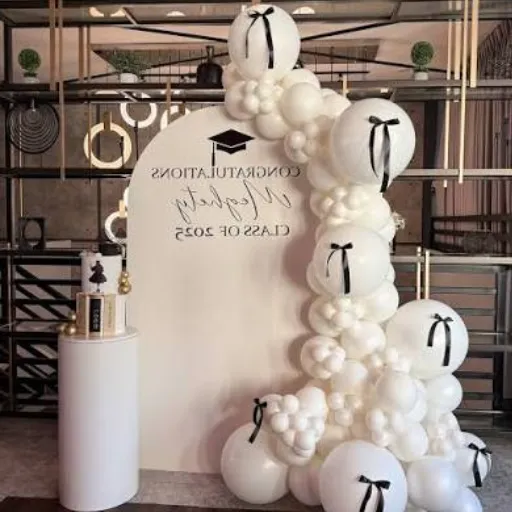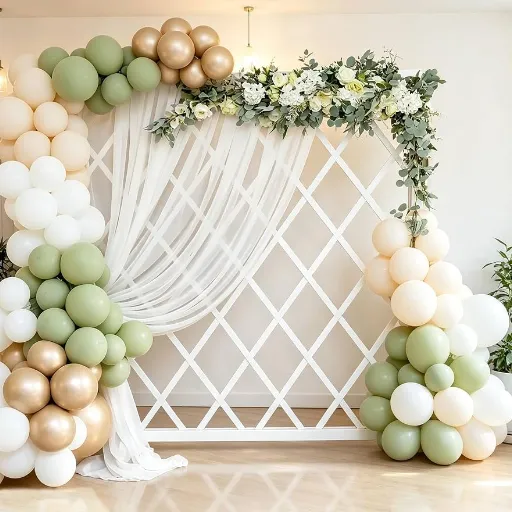
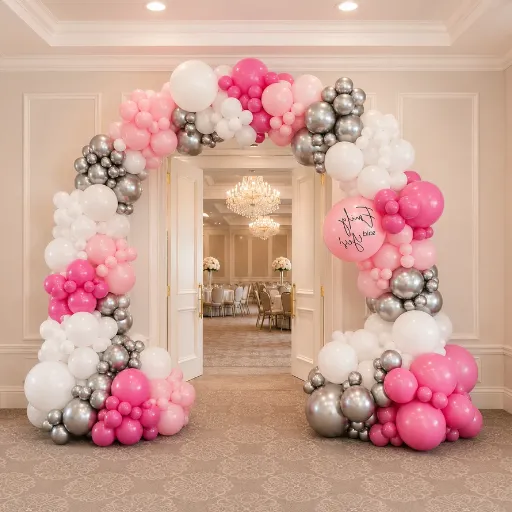
An organic balloon arch uses mixed balloon sizes in uneven, asymmetrical clusters. A classic balloon arch uses one or two sizes in a repeating, mirrored pattern, usually a spiral. The organic version needs 20 to 30 percent more balloons, costs 25 to 45 percent more per foot at shops that publish both rates, and reads as texture in photographs. The classic version is faster to plan, easier to quote and unmistakable as an entrance.
This organic vs classic balloon arch comparison is for the person holding two quotes and wondering why one is $250 higher. It’s also for the planner with a venue walkthrough next week, who needs to know whether the space can take a freestanding frame or only a wall anchor.
If you’re leaning organic, the construction details and size mix are in our guide to building an organic balloon arch. This page stays on the decision: count, cost, time and fit.
Key Takeaways
- Organic arches mix three or more balloon sizes; classic arches use one or two sizes in a repeated pattern.
- Organic needs 20 to 30 percent more balloons, and shops that price both styles add roughly 25 to 45 percent per foot.
- Classic is easier to plan but less forgiving visually; organic is harder to plan but hides gaps and popped balloons.
- Classic suits entrances, grand openings, school and sports events; organic suits weddings, showers, photo backdrops and brand events.
- A hybrid, a classic frame plus organic clusters, often buys the photo moment without doubling the whole decor budget.
What Is the Difference Between an Organic and a Classic Balloon Arch?
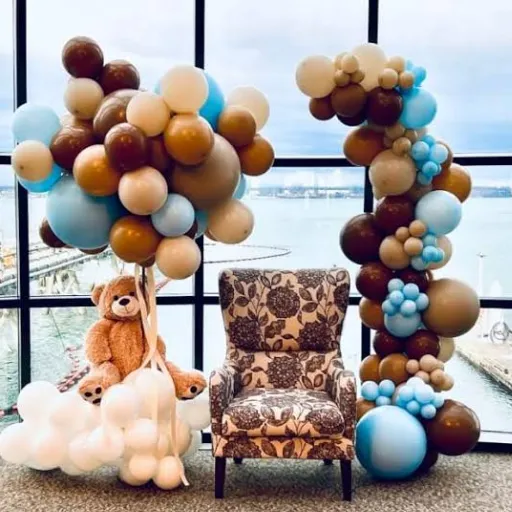
An organic balloon arch is a curved structure built from several balloon sizes in uneven, asymmetrical clusters, with deliberate gaps. A classic balloon arch uses uniform balloons in a repeating, symmetrical pattern, most often a spiral around a frame. The difference isn’t quality. It’s whether the eye reads pattern or texture.
| Feature | Classic balloon arch | Organic balloon arch |
|---|---|---|
| Balloon sizes | One or two, inflated to a consistent diameter | Three or more, often 5, 11 and 16 inch |
| Pattern | Repeating and mirrored, usually a spiral | Uneven clusters, no fixed repeat |
| Silhouette | Clean, symmetrical, formal | Full, irregular, off-center |
| Balloon count | Baseline | 20 to 30 percent more |
| Planning | Predictable count, easy to quote | Less predictable, more sorting |
| Execution | Less forgiving of gaps and size drift | More forgiving, irregularity is the goal |
| Typical event | Grand opening, school, sports, kids’ party | Wedding, shower, photo backdrop, brand event |
| Published decorator rate | $18+ per foot | $23+ per foot |
A classic balloon arch, or spiral balloon arch, is the shape most people picture. One or two colors wind around a frame in a consistent cadence. Uniform inflation is the whole trick, and it’s also the weakness.
A popped balloon leaves an obvious hole, and a cluster inflated half an inch small breaks the rhythm. The traditional balloon arch is the same idea under an older name.
An organic balloon arch replaces repetition with scale. Most builders use roughly 70 percent 11 inch, 25 percent 5 inch and 5 percent 16 inch or larger. The clusters sit at different depths and angles, and the legs are deliberately uneven. It looks casual, but it isn’t.
The seven types of balloon arches break down where this style sits beside half arches, packed arches and link-o-loon builds. Most balloon arch styles sit somewhere between the classic repeat and the organic cluster. Partner with Trading Shanxi Co., Ltd.
How Many More Balloons Does an Organic vs Classic Balloon Arch Use?
Organic arches need 20 to 30 percent more balloons than a structured arch of the same length. The extra balloons fill the gaps between mixed sizes and build the layered depth that defines the look. For a 10 foot arch in 11 inch balloons, plan 60 to 75 balloons for classic and 80 to 100 for organic, then add 10 to 15 percent for breakage and inflation variance.
| Span | Classic balloon arch | Organic balloon arch |
|---|---|---|
| 6 ft | 35 to 45 | 50 to 60 |
| 8 ft | 50 to 60 | 65 to 80 |
| 10 ft | 60 to 75 | 80 to 100 |
| 12 ft | 70 to 90 | 95 to 120 |
| 20 ft | 120 to 150 | 160 to 200 |
The 10 foot row is published by HICO Memphis in its size by size count guide. The other rows scale linearly from that count and assume a standard arch curve with a moderate peak.
Counts confuse people because some tables measure the span and others measure the curve. A 10 foot span produces about 12 to 14 feet of actual arch curve. A table that quotes 10 to 12 balloons per foot may be pricing the curve, which makes its total look far higher than a span based table. Ask which measurement the number uses before comparing two guides.
For a detailed per span calculation, use our balloon arch count guide. The practical rule is simpler: order the classic number, then add a quarter for organic, then add spares.
Organic vs Classic Balloon Arch Cost
The organic vs classic balloon arch cost gap starts at the balloon count and widens with labor. Published decorator rates begin at $18 per foot for classic and $23 per foot for organic. A second shop prices organic at $26 per linear foot. Balloon Art Studio includes delivery and setup at its rate; Party Perks adds both fees.
| Shop | Classic | Organic | What the rate includes |
|---|---|---|---|
| Balloon Art Studio, Tampa | $18+ per foot | $23+ per foot | Up to 5 balloons per row classic, up to 12 organic; 5 ft minimum; free delivery and setup |
| Party Perks STL, St Louis | From $200 per arch | From $26 per linear foot | Delivery and strike fees extra |
The two rows aren’t directly comparable. One is a per foot rate with a minimum, the other is a per arch minimum for classic and a per foot rate for organic. Read them as anchors, not as a single market price.
At Balloon Art Studio, the step from $18 to $23 is a 28 percent premium for the same foot of arch. In our November 2026 review of four shops that publish both styles, the median premium was about 45 percent, with a range from 8 percent to 150 percent. Balloonafied’s 150 percent jump was the outlier and reflected a much denser build. The full price breakdown sits in our balloon arch cost guide.
Three costs drive the premium:
- More balloons. A 20 to 30 percent count increase is latex, inflation time and glue points.
- More sizes. Small and giant balloons cost more per unit than the standard 11 inch, and they have to be sorted and inflated separately.
- More labor. Mixed clusters take longer to place than a repeating spiral, and uneven work is harder to delegate to a beginner.
Picture Dana, planning a 10 foot arch for a Saturday store opening. One quote is $420. The other is $610.
The $420 quote is a pickup garland with no frame, delivery or teardown. The $610 quote includes a weighted frame, installation and strike.
Both are normal prices for what they cover. The comparison only makes sense once the scope is on the table.
Use two filters on any quote. If organic adds less than 10 percent, ask what is being left out. If it adds more than 100 percent, ask what the extra buys: a denser build, a frame, florals or installation. Partner with Trading Shanxi Co., Ltd.
Which Style Fits Your Event?
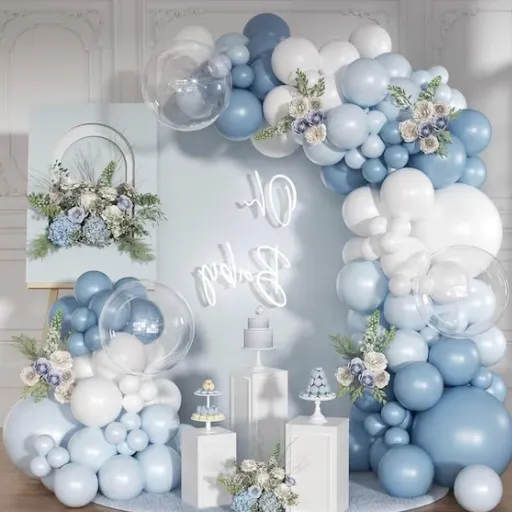
In an organic vs classic balloon arch decision, start with the job the arch has to do. Choose classic when the arch works as a sign: an entrance, a finish line, a brand color moment. Choose organic when the arch is the photograph. That single test resolves most events before budget enters the conversation.
| Event | Better default | Why |
|---|---|---|
| Wedding ceremony or reception | Organic | Soft texture suits florals, fabric and low light |
| Photo backdrop | Organic | Mixed sizes give depth in close up shots |
| Baby or bridal shower | Organic | The style is expected and photographs well |
| Adult birthday | Organic | Reads as a designed focal point rather than a party prop |
| Child’s birthday | Classic | Bright, bold and recognizable to kids |
| Grand opening | Classic | Clear gateway, strong brand colors, fast install |
| School or sports event | Classic | Durable, symmetrical and easy to read from a distance |
| Corporate entrance | Classic | Clean geometry and predictable branding |
| Brand activation or launch | Organic | Editorial texture for press and social photos |
| Tight budget across several zones | Classic | More coverage per dollar |
The table is a default, not a rule. A black tie wedding can use a classic arch at the ceremony door and an organic garland behind the cake. A school fundraiser can use a classic frame with organic clusters on the photo wall.
Picture a couple planning a 90 guest wedding with a $1,800 decor budget. A full organic arch at the ceremony and another at the reception would eat most of it. One organic arch behind the ceremony, plus two classic columns at the reception entrance, gives them the photograph and the threshold for less than two organic builds.
That is the hybrid most planners should price first. Put the organic work where the camera lands, and use classic structure where guests only need a clear edge. If a freestanding arch isn’t possible, an organic balloon garland may be the better object; our balloon garland vs arch comparison covers that choice.
Build Time, Skill and What Goes Wrong
Build time is where the organic vs classic balloon arch choice becomes a schedule problem. An experienced builder can finish a 10 foot arch in 2 to 3 hours. A first timer should plan 3 to 4 hours. Organic work sits at the top of that range because the clusters need sorting and balancing.
How Long Each Style Takes
Classic is faster to plan and faster to teach. The count is predictable, the pattern repeats, and a second pair of hands can copy the cluster in front of them. A simple classic build with an experienced crew is a short job.
Organic is slower to plan and slower to sort. Three sizes have to be inflated to different diameters, grouped into clusters and placed with intentional gaps. The placing is forgiving. The preparation is not.
What Goes Wrong
Classic fails visually. The apex sags if the frame is undersized, and any gap or size drift shows against the pattern. A popped balloon is obvious because the repeat is broken.
Organic fails by density. Clusters get packed too tightly at one shoulder, colors muddy together, or the gaps become holes instead of texture. The advantage is that a popped balloon or a thin patch disappears into the irregularity.
Venue Rules That Decide for You
A freestanding classic arch needs floor space and weight. Madcap Entertainment, a Kansas City decorator, puts typical base plates at 15 to 30 pounds each and recommends a walk through opening of about 7 to 8 feet high and 4 to 6 feet wide. The plates have to sit where guests will not trip over them.
An organic arch is often anchored to a wall, truss or backdrop instead. That preserves floor space, but the venue must approve the attachment method. Madcap also notes that suspended decor should stay at least 18 inches below sprinkler heads, and that outdoor classic arches act like sails in wind. The full rigging and venue guide is worth reading before a site visit.
On longevity, HICO puts air filled arches at 2 to 5 days indoors, against 8 to 12 hours for helium. Neither style is weatherproof. Heat, direct sun and wind shorten both.
Ordering Balloons for Your Organic vs Classic Balloon Arch
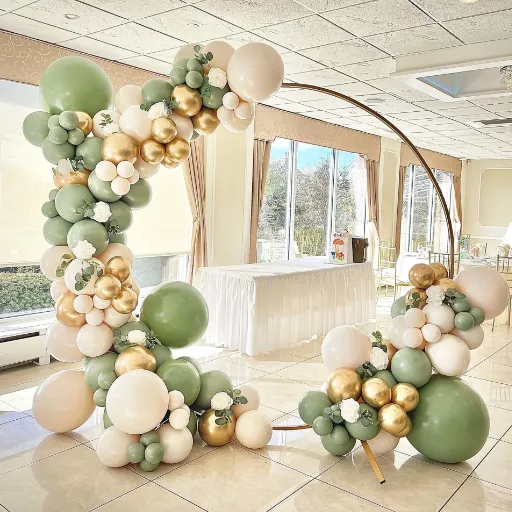
Whichever side of the organic vs classic balloon arch question you land on, the order changes by style.
For a classic arch:
- Buy one or two sizes and inflate every balloon to the same diameter with a sizer.
- Keep the pattern consistent; uniformity matters more than the brand.
- Add 10 to 15 percent spares, because a single undersized cluster is visible.
For an organic arch:
- Buy three sizes: 11 inch as the base, 5 inch as filler and 16 inch as the statement balloon.
- Use roughly 70/25/5 for an 8 to 10 foot arch.
- Add 10 to 15 percent spares and expect more leftovers in the small size.
Color is the other decision. Classic reads best with two or three bold colors in a fixed order. Organic reads best with a tight palette of three to five shades and a tonal gradient, because too many colors turn the texture into noise.
We manufacture latex balloons in 5, 9, 11, 16, 24 and 36 inch sizes, with custom colors, logo printing and full color printing. If you are sourcing for either style, send us your size mix and color list and we’ll quote the order.
Frequently Asked Questions
Is an organic or classic balloon arch better for a wedding? Organic is the better default for a wedding because mixed sizes suit florals, fabric and low light. A classic arch still works at a ceremony entrance if the couple wants a clear threshold or a traditional look. Many weddings use organic at the photo spot and classic at the door.
How many more balloons does an organic arch use? Plan on 20 to 30 percent more balloons than a classic arch of the same span. A 10 foot arch in 11 inch balloons takes about 60 to 75 classic balloons and 80 to 100 organic balloons. Add 10 to 15 percent spares for breakage.
Is an organic vs classic balloon arch much more expensive? At shops that publish both rates, organic adds roughly 25 to 45 percent per foot. The premium comes from more balloons, more sizes and more labor. Quotes outside that band aren’t automatically wrong, but they need a scope explanation.
Which style is easier to make? Classic is easier to plan and teach, because the count and pattern repeat. Organic is easier to execute, because irregularity is the goal and small gaps disappear. A first timer will finish a simple classic build faster, but a wobbly classic looks wrong while a wobbly organic usually looks fine.
Which style lasts longer? Neither style lasts longer by design. Air filled arches last about 2 to 5 days indoors, while helium arches last 8 to 12 hours. Sun, heat and wind shorten both. The frame and the venue matter more than the style.
Can you mix classic and organic arches at one event? Yes, and it’s often the best budget answer. Use classic where guests need a clear entrance or where brand colors must read from a distance. Use organic where the camera lands. Keep the palette consistent so the two styles feel intentional.
Which style is better for an outdoor event? Classic is easier to stabilize because the frame can be weighted or staked, but the broad curve catches wind. Organic anchors to a structure and preserves floor space, but it still needs approved attachment points. For either style, have an indoor backup and keep the setup out of direct sun.
Conclusion
The organic vs classic balloon arch decision comes down to the job the arch has to do. Classic is the better buy for entrances, grand openings, school events and tight budgets. Organic is the better buy for weddings, showers, photo backdrops and brand moments where texture is the point.
If you’re still torn, price the hybrid first: one organic moment where the photos happen, classic structure everywhere else. You get the image and the threshold without paying the organic premium twice.
Once the style is set, order the balloons by size mix rather than by color alone. We supply latex from 5 to 36 inch, custom colors and printed logos, and we can quote against your build list. Send us your size and color list and we’ll take it from there.