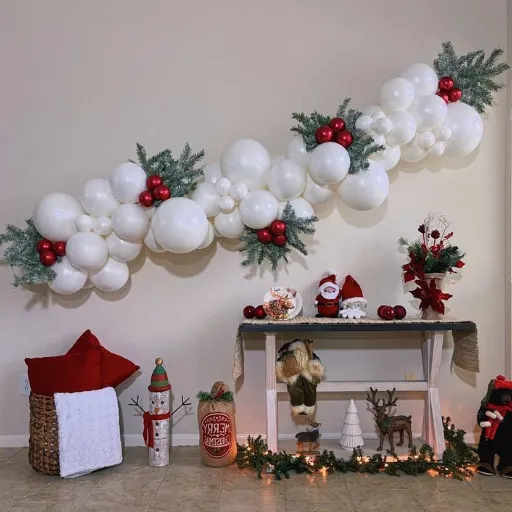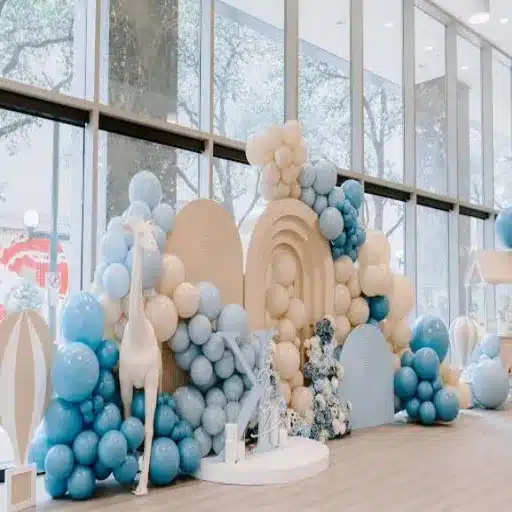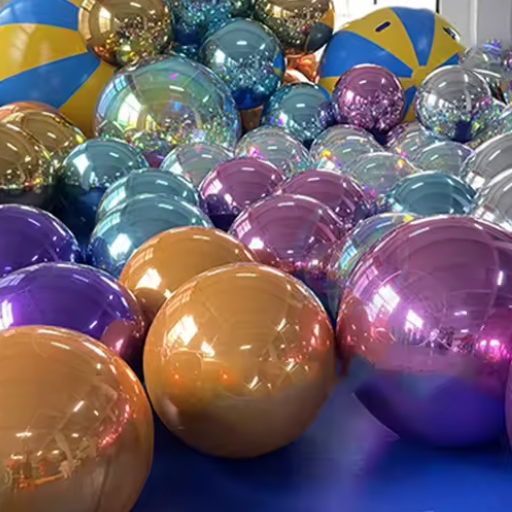
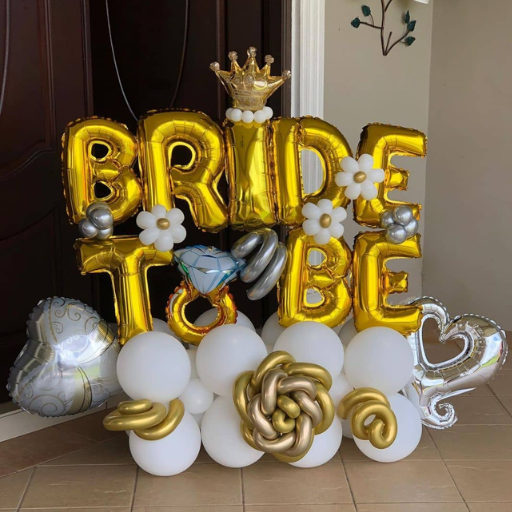
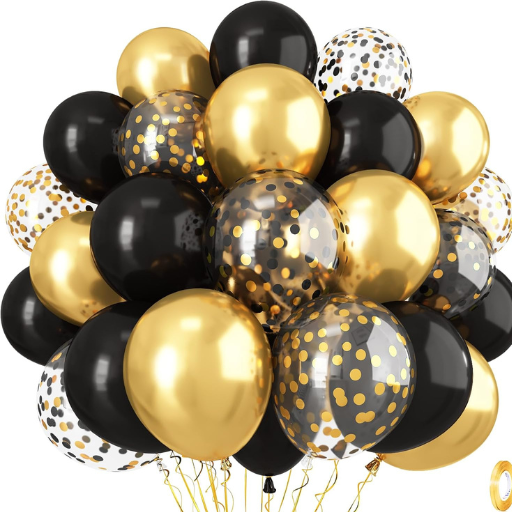
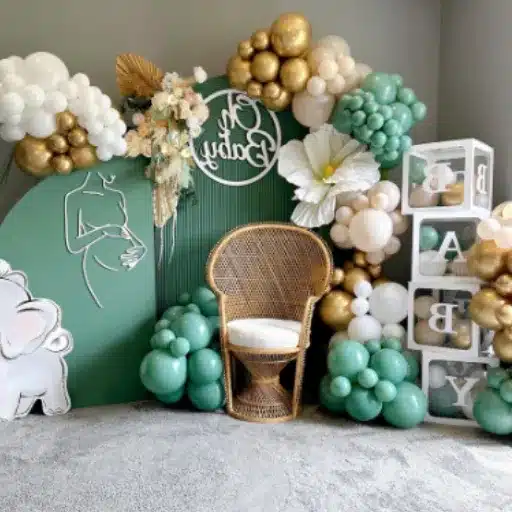
Eco-friendly balloons for corporate events are biodegradable decorations made from natural latex that decompose within months instead of years, allowing companies to create stunning visual experiences without compromising their sustainability commitments. In 2026, with sustainability now a mandatory requirement in corporate procurement rather than a nice-to-have, choosing the right event decorations has become a strategic decision that directly impacts brand reputation, ESG reporting, and stakeholder perception.
When Maria Chen, an event planner for a Fortune 500 tech company, was asked to organize the annual shareholder meeting in March 2026, she faced a familiar dilemma. The executive team wanted a bold, Instagram-worthy entrance. The sustainability officer needed proof that every decoration choice supported the company’s net-zero pledge. The procurement team demanded cost efficiency at scale. Maria solved all three challenges with one decision: she designed the entire space using biodegradable balloon installations paired with reusable metal frames. The arch at the main entrance drew more social media engagement than any previous event. The sustainability team logged the choice as a measurable ESG win. And the total decor cost came in 18% under budget because the frames could be stored and reused for the next quarterly meeting.
This guide will show you exactly how to replicate Maria’s success. You will learn what makes balloons truly eco-friendly, why corporate events are shifting to sustainable decor in 2026, the specific business benefits beyond optics, creative design ideas that do not sacrifice visual impact, how to evaluate suppliers and certifications, and the right way to handle disposal after your event ends. Looking for premium balloon products with reliable supply service? Reach out to Trading Shanxi Co., Ltd. for customized options and competitive pricing.
Key Takeaways
- Biodegradable balloons made from 100% natural latex decompose within 6 months to 2 years, unlike synthetic alternatives that persist for decades.
- In 2026, sustainability has shifted from optional to mandatory in corporate procurement, with ESG compliance now required in most vendor RFPs.
- Air-filled balloon installations use 97% air and 3% biodegradable material, offering dramatic visual impact with minimal environmental footprint.
- Look for third-party certifications like OK Compost, TUV, and Rain Forest Alliance to verify genuine eco-credentials rather than greenwashing.
- Proper post-event management includes deflation, composting, and reusing frames — never releasing balloons outdoors, even biodegradable ones.
What Makes Balloons Truly Eco-Friendly?
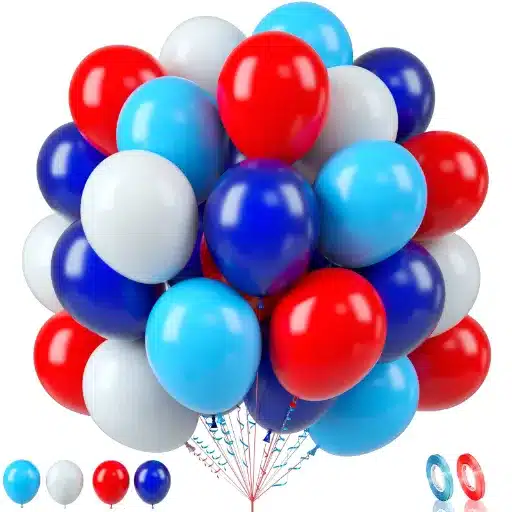
Not every balloon marketed as “green” deserves that label. Understanding the material science behind biodegradable options protects your company from greenwashing and ensures your sustainability claims hold up under scrutiny.
The Difference Between Natural Latex and Synthetic Materials
Truly eco-friendly balloons are made from 100% natural latex harvested from rubber trees (Hevea brasiliensis). This is a renewable resource. The sap is collected by tapping the bark, a process that does not harm the tree and can continue for decades. When a natural latex balloon is discarded, microorganisms in soil and water break it down through natural decomposition. The timeline varies by environment, but under normal conditions, a natural latex balloon degrades at roughly the same rate as an oak leaf.
Synthetic balloons, including most foil balloons and some latex blends, contain plastics, mylar, or chemical additives that prevent microbial breakdown. These materials can persist in landfills and natural environments for years. Worse, some products labeled “degradable” or “oxo-degradable” use additives that only fragment the plastic into microplastics. The pieces become invisible but remain in the ecosystem indefinitely. This distinction matters enormously for corporate buyers because using oxo-degradable products while claiming sustainability can expose your company to accusations of greenwashing.
Certifications That Actually Matter
When evaluating suppliers of eco-friendly balloons for corporate events, look for specific third-party credentials rather than vague marketing language. The most reliable certifications include:
- OK Compost (TUV Austria): Confirms the product meets strict biodegradability and compostability standards under industrial composting conditions.
- Rain Forest Alliance Certified: Verifies that the latex was sourced from plantations meeting rigorous environmental and social standards.
- Forest Stewardship Council (FSC): Ensures responsible forest management in the supply chain.
- ISO 14001: Indicates the manufacturer maintains an environmental management system, though this does not certify the product itself.
Ask your supplier for certification numbers and verify them directly with the issuing body. Reputable manufacturers like Trading Shanxi Co., Ltd. provide this documentation as standard practice for corporate orders. For a deeper dive into sustainable materials, see our complete guide to eco-friendly balloons.
Red Flags to Avoid
Be skeptical of these common misleading terms:
- “Degradable” without qualification: This often means oxo-degradable fragmentation, not true biodegradation.
- “Eco-friendly” without certification: A meaningless claim unless backed by verified standards.
- Vague decomposition timelines: “Breaks down faster” is not a standard. Look for specific timeframes tested under defined conditions.
- Green packaging imagery: Leaf motifs and earth-tone colors do not indicate actual environmental performance.
Why Eco-Friendly Balloons for Corporate Events Are Essential in 2026
The shift toward sustainable event decor is not a trend. It is a structural change in how corporations plan, budget, and report on their activities.
ESG Has Become a Procurement Requirement
In 2026, sustainability has moved from the “nice-to-have” column to a mandatory line item in corporate procurement. Event planners report that vendor RFPs now routinely include questions about environmental impact, carbon footprint, and material sourcing. Companies that cannot demonstrate green practices are simply disqualified before creative capabilities are even evaluated.
The regulatory environment drives much of this shift. The EU Corporate Sustainability Reporting Directive (CSRD) now requires approximately 50,000 companies to disclose detailed emissions reduction plans and supply chain sustainability metrics. The EU Corporate Sustainability Due Diligence Directive (CSDDD) adds enforcement teeth. In the UK, major events face a net-zero-by-2028 mandate. These regulations mean that the decorations you choose for a corporate event are no longer just aesthetic decisions. They become data points in mandatory sustainability disclosures.
The Business Case Beyond Compliance
Sustainability investments in event decor deliver returns that extend far beyond checking regulatory boxes. Companies using sustainable decorations report stronger brand perception among clients, employees, and investors. A 2026 industry analysis found that 52% of consumers hold negative sentiment toward events perceived as environmentally harmful, while 28% actively seek out brands demonstrating eco-friendly practices.
For internal stakeholders, sustainable events boost employee engagement. Gen Z and millennial workers, now the majority of the workforce, consistently rank environmental responsibility among their top employer expectations. A corporate gala decorated with biodegradable balloons sends a visible message that the company shares their values. This alignment correlates with higher retention and advocacy rates.
Event Industry Data Points
Leading sustainable events now achieve remarkable efficiency benchmarks. According to MCI Group’s event sustainability research, the Global Vaccine Impact Conference diverted 70% of event assets through rental and reclamation, served 79% vegetarian or vegan catering, and sent only 3.4% of total waste to landfill. The World Energy Congress operated on renewable power with natural-fiber materials throughout. These are not fringe experiments. They are the new standard that corporate event planners are expected to meet or exceed.
Five Benefits of Eco-Friendly Balloons for Corporate Events
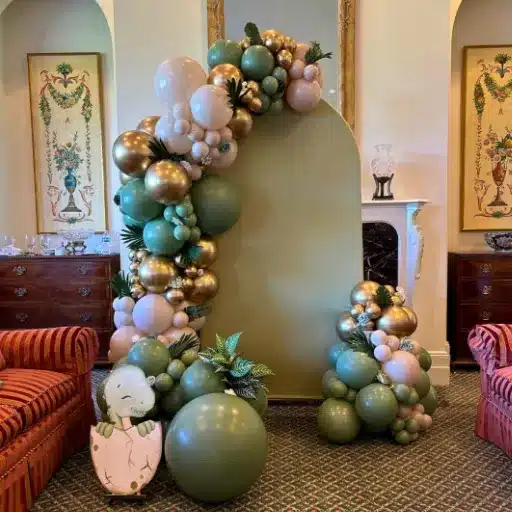
Switching to biodegradable balloons delivers specific, measurable advantages that address the concerns of multiple stakeholders within your organization.
1. Aligns with CSR and ESG Goals
Corporate social responsibility has evolved from charitable donations to operational integration. Every vendor choice, including event decorations, either supports or undermines your stated sustainability commitments. Eco-friendly balloons for corporate events provide a tangible, visible demonstration of environmental responsibility that stakeholders can literally see and photograph.
Unlike backend supply chain changes that consumers never notice, event decorations are public-facing. A biodegradable balloon arch at your annual meeting becomes proof of your commitments. This visibility matters for ESG reporting, investor relations, and public perception. It transforms an abstract policy document into a physical experience.
2. Maintains Visual Impact Without Compromise
The most common misconception about sustainable event decor is that it looks somehow less impressive. Modern biodegradable latex balloons disprove this completely. Natural latex accepts vibrant pigments beautifully. Extra-strong formulations hold air and shape for days. Advanced manufacturing produces surfaces that are indistinguishable from conventional options to the casual observer.
Air-filled installations are particularly compelling from a sustainability standpoint. A large-scale ceiling installation or organic arch is approximately 97% air and 3% biodegradable latex. You achieve dramatic visual volume with an almost invisible material footprint. Some of the most photographed corporate events in 2026 have used precisely this approach.
3. Enhances Brand Reputation
When James Okonkwo planned the product launch for his fintech startup in April 2026, he made a deliberate choice. Instead of the standard synthetic balloon display, he commissioned a fully biodegradable installation using his brand colors, paired with a small sign explaining the material choice. Attendees photographed the arch and the sign together. The resulting social media posts generated three times the organic engagement of his previous launch. Several prospects mentioned the sustainability detail in follow-up sales conversations. The decor cost the same. The brand impact was measurably stronger.
Stories like James’s illustrate how sustainability decisions can differentiate your brand in competitive markets. In industries where product features are increasingly similar, values-based positioning creates memorable distinction.
4. Reduces Environmental Footprint
The quantitative case for biodegradable balloons is compelling. A natural latex balloon decomposes within 6 months to 2 years under normal environmental conditions. A synthetic foil balloon can persist for decades. When you are decorating an event with hundreds or thousands of balloons, this difference scales significantly.
Comparative analysis also favors balloons against some common alternatives. Fresh flower arrangements, while beautiful, require water-intensive cultivation, refrigerated transport, and typically end in landfill after a single use. Fabric decorations have longer lifespans but higher upfront costs and storage requirements. Biodegradable balloons paired with reusable frames offer a middle path: low material impact, high visual payoff, and manageable logistics.
5. Cost-Effective at Scale
For procurement teams, the bottom line always matters. Biodegradable latex balloons are competitively priced with conventional options at bulk volumes. When combined with reusable hardware — metal frames, weighted bases, and attachment systems — the total cost of decoration across multiple events drops substantially.
Consider a company hosting quarterly all-hands meetings. A single investment in professional-grade reusable frames, combined with fresh biodegradable balloons for each event, typically costs 30–40% less over a two-year period than renting entirely new synthetic decorations each quarter. For branding ideas that maximize this investment, see how custom balloons for corporate events can reinforce your visual identity at every gathering. The frames store compactly. The balloons compost after use. The finance team approves.
Ready to explore biodegradable options for your next corporate event? Browse our range of certified eco-friendly balloons designed specifically for business clients, with bulk pricing and custom branding available.
Creative Eco-Friendly Balloon Ideas for Corporate Events
Sustainability does not mean boring. The most successful sustainable corporate events of 2026 combine environmental responsibility with striking visual design.
Branded Balloon Arches and Entryways
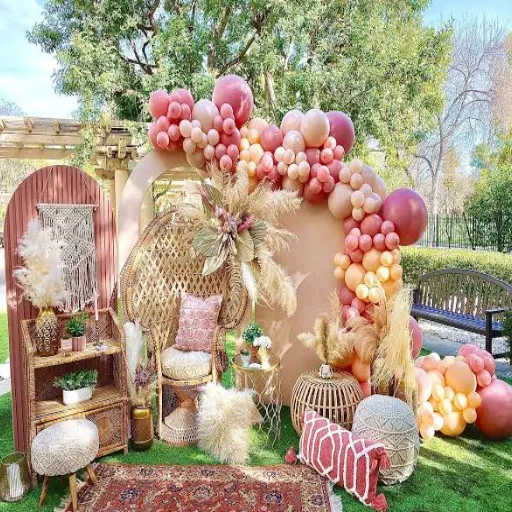
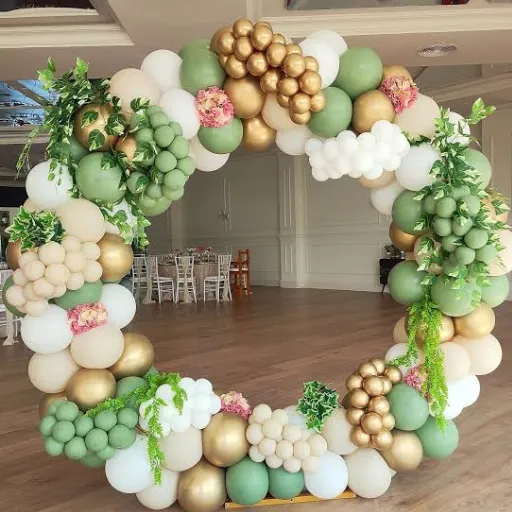
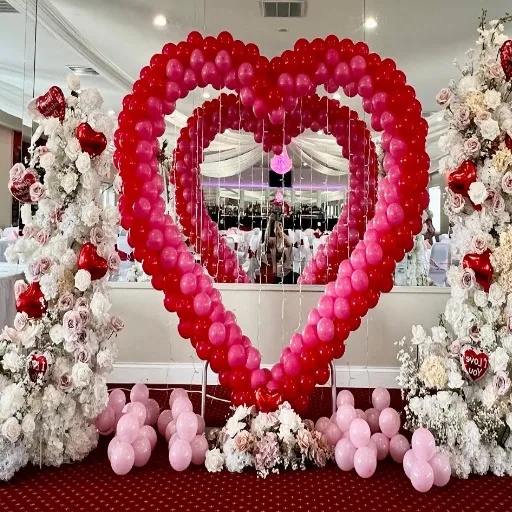
The entrance arch remains the most impactful single decoration element at corporate events. For a sustainable version, use organic balloon garlands in your brand colors, built on a reusable metal frame. Add custom-printed biodegradable balloons featuring your logo at focal points. The result photographs beautifully, welcomes attendees with immediate brand recognition, and leaves zero synthetic waste.
For product launches, consider a “reveal arch” — a partially constructed installation that completes as the event progresses, with each new balloon representing a feature or milestone. This creates narrative engagement alongside visual impact. For step-by-step construction techniques, see our balloon arch tutorial.
Sustainable Ceiling Installations
Air-filled balloon clouds and ceiling canopies create immersive environments without helium. Modern installation techniques use fishing line, reusable clips, and precise positioning to achieve effects that rival floating designs. LED integration adds programmable color changes that transform the room atmosphere throughout the event.
The sustainability advantage is double: no helium consumption (helium is a finite resource with supply constraints) and no balloons escaping into the environment. Everything comes down at the end of the night and is handled through proper disposal channels.
Eco-Conscious Table Centerpieces
For dinners, galas, and award ceremonies, compact biodegradable balloon clusters make elegant centerpieces. Use 3–5 balloons in graduated sizes, anchored with reusable weighted bases. Add natural elements like dried botanicals or wooden accents for texture. Unlike floral arrangements that wilt after a few hours, balloon centerpieces maintain their appearance throughout multi-day events.
Seasonal themes work beautifully with this format. Spring events might use pastels with subtle floral accents. Autumn gatherings benefit from earth tones and metallic biodegradable options. Winter galas shine with white, silver, and deep blue palettes. For more seasonal inspiration, explore our balloon decorations for weddings guide, which covers year-round color palettes and themes.
Photo Booth Backdrops with a Green Message
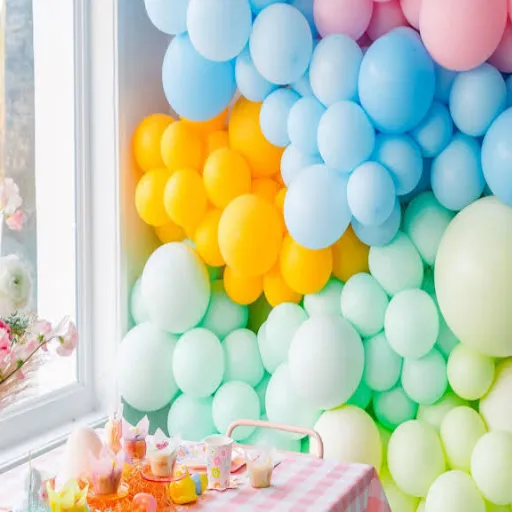
Every corporate event needs a shareable moment. Design your photo backdrop using a biodegradable balloon wall in a pattern or gradient that attendees want to photograph. Add a small, elegant sign explaining the sustainable material choice. This transforms a decoration into a conversation piece and extends your brand message through organic social sharing.
The key is subtlety. The sign should inform, not preach. Something like “This installation uses 100% biodegradable natural latex balloons that compost within 12 months” invites curiosity without heavy-handedness.
How to Choose Eco-Friendly Balloons for Corporate Events

Navigating supplier claims requires a systematic approach. Use this framework to ensure your procurement decisions deliver genuine sustainability outcomes.
Procurement Team Checklist
Before placing any order, verify these fundamentals:
- Material specification: Does the supplier explicitly state “100% natural latex”? Blends and synthetic additives disqualify the product.
- Third-party certification: Can the supplier provide current, verifiable OK Compost, TUV, or Rain Forest Alliance documentation?
- Packaging standards: Is the product shipped in plastic-free, recyclable, or compostable packaging?
- Sourcing transparency: Does the manufacturer disclose where and how the latex is harvested?
- Bulk pricing structure: Are volume discounts available for corporate orders?
- Customization options: Can colors, sizes, and printing be tailored to your brand?
Reputable suppliers answer these questions promptly and provide documentation without hesitation. Evasive responses are a warning sign.
Questions to Ask Your Supplier
Go deeper with these specific inquiries:
“What is the exact decomposition timeframe under standard conditions?”
Look for specific months or years, not vague “faster than traditional” claims. Request test data if available.
“Are the pigments and dyes non-toxic and naturally derived?”
The balloon material matters, but so do the colorants. Some dyes contain heavy metals or synthetic chemicals that persist in the environment.
“Do you offer take-back, recycling, or composting support?”
Premium suppliers help manage post-event disposal, either through take-back programs or detailed composting guidance.
“Can you provide carbon footprint data for your production and shipping?”
Advanced suppliers track and disclose this information, which supports your own ESG reporting requirements.
Air-Filled vs. Helium: Making the Sustainable Choice
Helium balloons float beautifully, but helium is a non-renewable resource with critical applications in medicine and scientific research. Using it for decoration is increasingly viewed as environmentally questionable. Air-filled designs eliminate this concern entirely.
Modern air-filled balloon techniques achieve remarkable structural creativity. Columns, arches, garlands, ceiling installations, and sculptural forms are all possible without helium. The designs last longer because air does not diffuse through latex as quickly as helium. And the cost per balloon is lower because you are not paying for gas.
For corporate buyers, the message is clear: air-filled biodegradable balloon installations offer superior sustainability credentials, longer display life, lower costs, and equal or greater design flexibility compared to helium alternatives.
Eco-Friendly Balloons for Corporate Events: Disposal and Post-Event Management
The sustainability story does not end when the event does. Proper post-event handling ensures your environmental commitments hold up through the entire lifecycle.
The No-Release Rule
Even biodegradable balloons should never be released outdoors. While they break down faster than synthetics, they can still harm wildlife and ecosystems during the decomposition period. Birds, marine animals, and land animals may ingest balloon fragments or become entangled. A responsible corporate sustainability policy explicitly prohibits balloon releases of any kind.
Communicate this policy clearly to your event team, decorators, and venue. Include it in vendor contracts. Make it non-negotiable.
Deflate and Compost
The correct disposal process is straightforward. After the event, balloons should be deliberately deflated rather than popped. Deflation allows for controlled handling and minimizes fragment scatter. Collect all balloon material in a designated container.
If your venue or municipality operates an industrial composting facility, natural latex balloons can be added to the compost stream. Industrial composting provides the temperature and microbial activity needed for efficient breakdown. Home composting is less reliable for balloons because conditions vary, but small quantities may break down over time.
Reusing Frames and Hardware
The most sustainable component of your decoration is often the frame. Metal arches, stands, bases, and attachment clips can be reused dozens or hundreds of times with proper care. After each event, clean hardware thoroughly, inspect for damage, and store in a dry location. Track inventory so you know exactly what you have available for the next event.
Some corporate event teams maintain a “decor library” of reusable frames in standard sizes. This approach reduces per-event costs, simplifies planning, and ensures consistent quality across all company gatherings.
Conclusion
Eco-friendly balloons for corporate events represent one of the smartest intersections of visual impact and environmental responsibility available to event planners in 2026. They deliver the dramatic aesthetics that executives expect, the sustainability credentials that compliance teams require, and the cost efficiency that procurement demands.
The key is making informed choices. Verify that your balloons are genuinely 100% natural latex with third-party certification. Design air-filled installations that maximize visual volume with minimal material use. Invest in reusable frames that reduce costs across multiple events. And handle post-event disposal responsibly through deflation and composting.
As sustainability regulations tighten and stakeholder expectations rise, the companies that integrate environmental responsibility into every operational detail — including event decorations — will build the strongest brands and the most resilient reputations. The choice of balloon might seem small in isolation. But multiplied across hundreds of corporate events worldwide, it becomes part of a meaningful shift toward responsible business practices.
Your next corporate event is an opportunity to demonstrate that your company takes sustainability seriously. The decorations you choose will be photographed, shared, and remembered. Make sure they tell a story you are proud of.
Ready to make your next corporate event both stunning and sustainable? Contact Trading Shanxi Co., Ltd. today to discuss custom biodegradable balloon solutions tailored to your brand, budget, and sustainability goals. Our team specializes in large-scale corporate orders with certified eco-friendly materials, custom branding options, and dedicated account support for event planners and procurement teams.